Twa kɔ nsɛm atitiriw so
Log in
Sign up for FREE
arrow_back
Laabri

7.2 - Colonial Developments: - Practice E

star
star
star
star
star
Last updated about 1 month ago
25 Nsɛmmisa
Hyɛ no nsow a efi ɔkyerɛwfo no hɔ:

Use the historical document(s) and the short readings in the left panel to answer the associated questions.

Use the historical document(s) and the short readings in the left panel to answer the associated questions.

Ɛhia
1
7.2.a
DOK.SS.2
Ɛhia
1
7.2.a
DOK.SS.2
Ɛhia
1
7.2.a
DOK.SS.2
Ɛhia
1
7.2.a
DOK.SS.2
Ɛhia
1
7.2.a
DOK.SS.2
Ɛhia
1
7.2.b
DOK.SS.2
Ɛhia
1
7.2.b
DOK.SS.2
Ɛhia
1
7.2.b
DOK.SS.2
Ɛhia
1
7.2.b
DOK.SS.2
Ɛhia
1
7.2.b
DOK.SS.2
Ɛhia
1
7.2.c
DOK.SS.2
Ɛhia
1
7.2.c
DOK.SS.2
Ɛhia
1
7.2.c
DOK.SS.2
Ɛhia
1
7.2.c
DOK.SS.2
Ɛhia
1
7.2.c
DOK.SS.2
Ɛhia
1
7.2.d
DOK.SS.2
Ɛhia
1
7.2.d
DOK.SS.2
Ɛhia
1
7.2.d
DOK.SS.2
Ɛhia
1
7.2.d
DOK.SS.2
Ɛhia
1
7.2.d
DOK.SS.2
Ɛhia
1
7.2.e
DOK.SS.2
Ɛhia
1
7.2.e
DOK.SS.2
Ɛhia
1
7.2.e
DOK.SS.2
Ɛhia
1
7.2.e
DOK.SS.2
Ɛhia
1
7.2.e
DOK.SS.2

Historical Document:
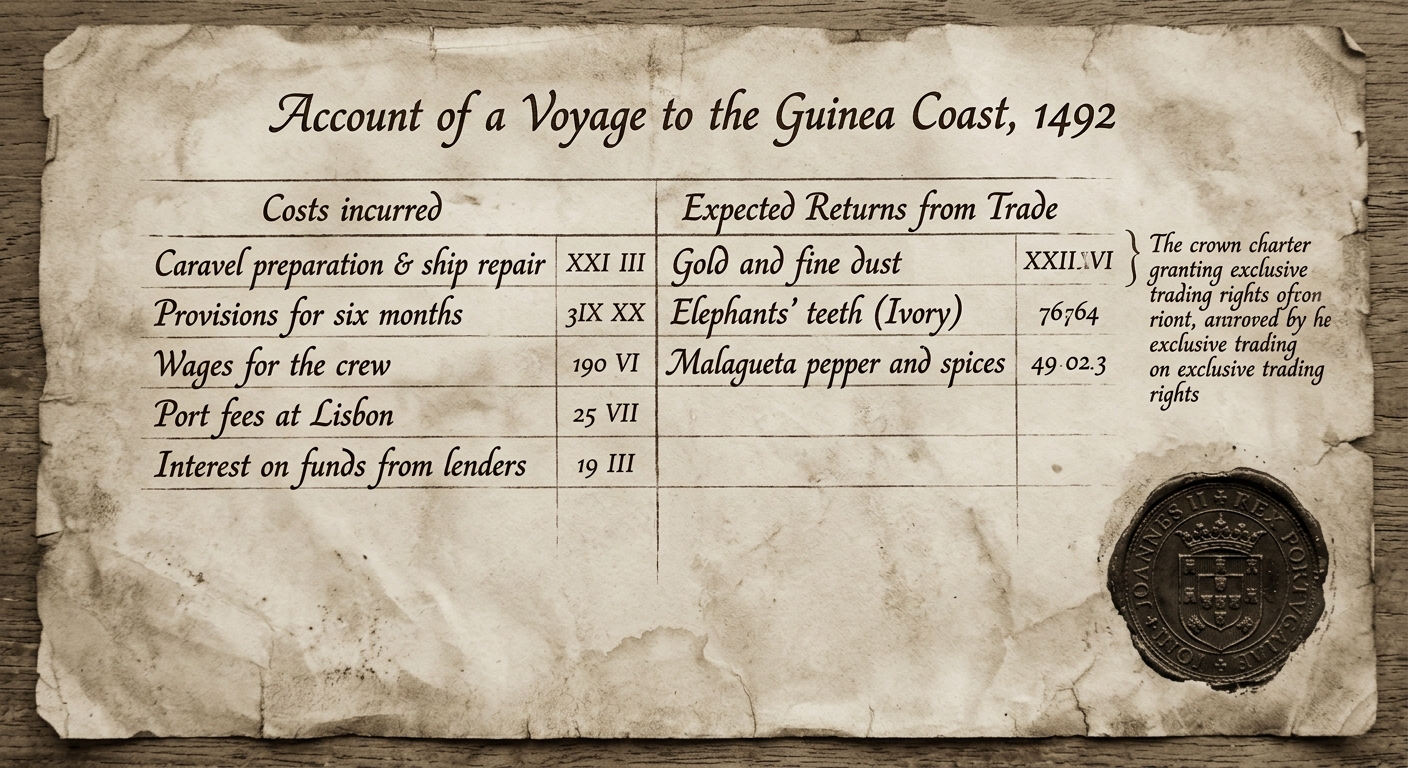
Sepia-toned parchment document labeled as a 1492 voyage account, showing handwritten costs and expected returns, a crown charter note granting exclusive trading rights, and a royal seal impression.

A royal clerk recorded the costs and expected returns of a late-1400s ocean voyage. The note mentions a crown charter granting exclusive trading rights. Use the listed expenses, returns, and the charter detail to analyze how governments and investors funded exploration for profit.
Asemmisa {{asɛmmisaAhyɛnsode}}
1.

Based on the charter note granting exclusive trading rights, which economic idea is BEST illustrated by this document?

Asemmisa {{asɛmmisaAhyɛnsode}}
2.

A sponsor wants to increase profit from this voyage. Based on the cost list, which change would MOST directly reduce the total cost of the voyage?

Asemmisa {{asɛmmisaAhyɛnsode}}
3.

Which statement BEST explains how a scientific improvement (such as better navigation tools) could affect the economics of voyages like the one in the document?

Asemmisa {{asɛmmisaAhyɛnsode}}
4.

Using evidence from the document, explain one way a crown charter granting exclusive trading rights could shape an economic system during the Age of Exploration.

In your answer, refer to at least one cost or return listed and explain a likely impact on merchants or the government.

Asemmisa {{asɛmmisaAhyɛnsode}}
5.

Explain how TWO improvements—one economic and one scientific—could work together to make European exploration more likely.

Use the document as evidence (for example, the listed costs/returns or the charter) to support your explanation.

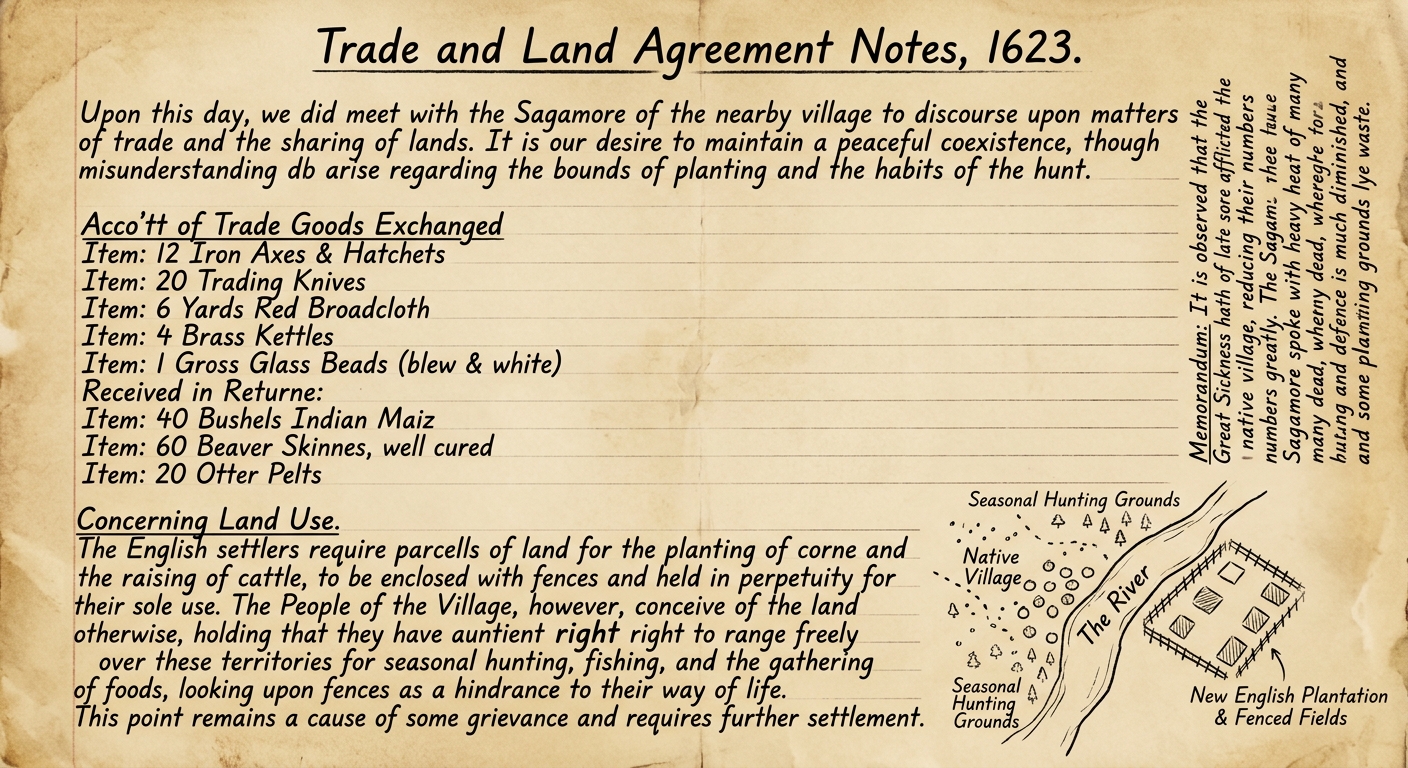
Historical Document:

Sepia-toned handwritten 1623 document listing traded goods between settlers and a Native community, notes about land use disagreements, a marginal note about disease, and a small sketch map of a river, village, and fenced fields.

A 1623 clerk summarized trade and land discussions between settlers and a nearby Native community. The notes list exchanged goods and describe different ideas about land use. A margin note reports illness and population loss, affecting bargaining power and conflict.

Asemmisa {{asɛmmisaAhyɛnsode}}
6.

Which economic relationship is MOST directly shown by the list of exchanged goods in the document?

Asemmisa {{asɛmmisaAhyɛnsode}}
7.

The "Land Use" notes describe seasonal hunting grounds and fenced farms. Which outcome is MOST likely when these two ideas of land ownership collide?

Asemmisa {{asɛmmisaAhyɛnsode}}
8.

How would the margin note about disease MOST likely affect economic decisions described in the document?

Asemmisa {{asɛmmisaAhyɛnsode}}
9.

Using evidence from the document, explain one way trade could create both benefits and tensions between settlers and the Native community.

Refer to at least one traded good and connect it to an economic incentive for each group.

Asemmisa {{asɛmmisaAhyɛnsode}}
10.

Explain how differing conceptions of land ownership could change an economic system in a colony.

Use the document’s land-use notes and include one likely effect on each group’s ability to earn a living.

Historical Document:

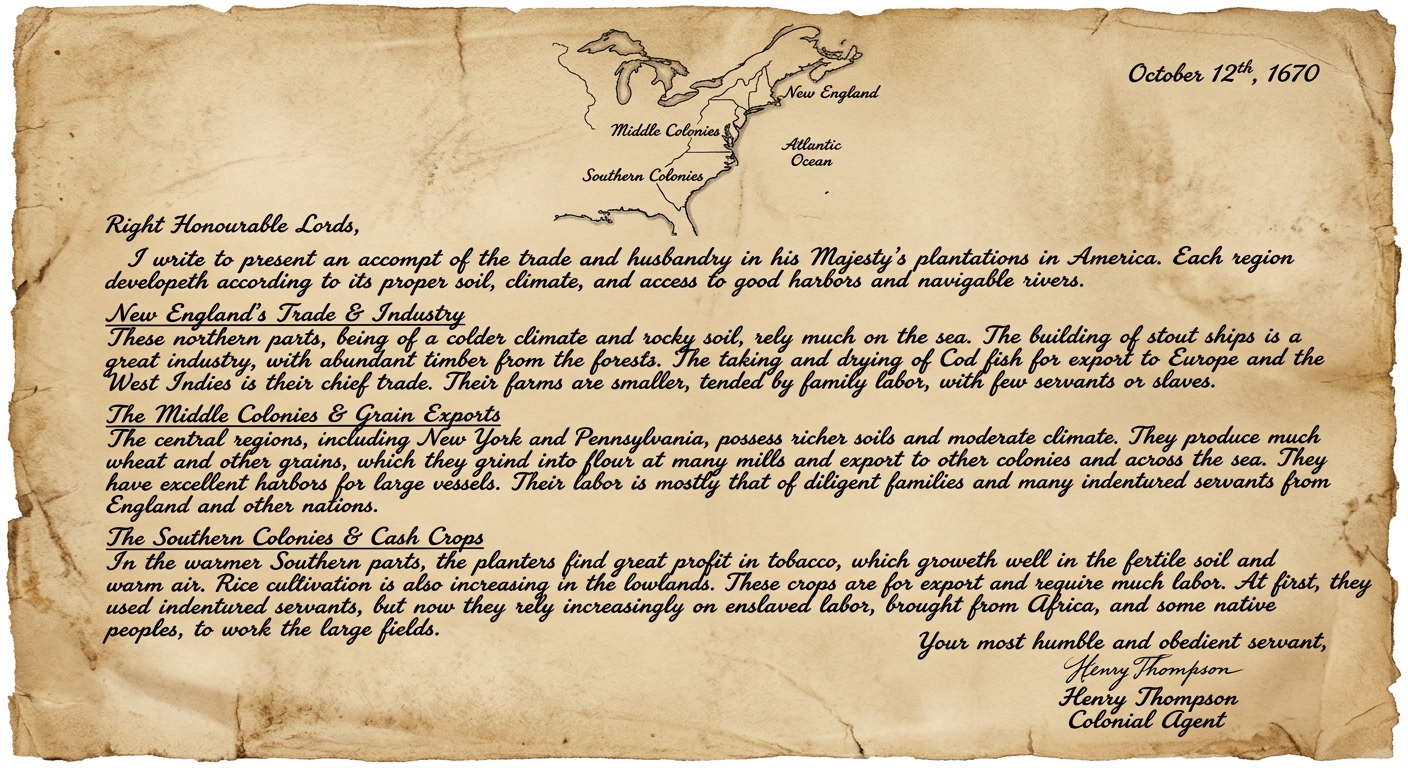
Sepia-toned handwritten 1670 letter describing New England trade and shipbuilding, Middle Colonies grain exports, and Southern cash crops with notes on climate, waterways, and labor sources, plus a small sketch map labeling the three colonial regions.

In a 1670 letter, a colonial agent compares how climate, waterways, and labor shaped regional economies. The writer notes New England’s trade and shipbuilding, the Middle Colonies’ grain exports, and Southern plantation cash crops. Use this evidence to analyze reasons colonies developed different economies.

Asemmisa {{asɛmmisaAhyɛnsode}}
11.

Which statement BEST explains why New England developed an economy focused on shipbuilding and trade, based on the document?

Asemmisa {{asɛmmisaAhyɛnsode}}
12.

The document describes grain exports from the Middle Colonies. Which geographic factor would MOST directly support that type of economy?

Asemmisa {{asɛmmisaAhyɛnsode}}
13.

The writer mentions different sources of labor across regions. Which labor system is MOST closely connected to large Southern plantation cash-crop production?

Asemmisa {{asɛmmisaAhyɛnsode}}
14.

Using evidence from the document, explain one reason the economies of the New England, Middle, and Southern Colonies developed differently.

In your answer, name one region and describe how a physical feature or labor source shaped its economy.

Asemmisa {{asɛmmisaAhyɛnsode}}
15.

The document suggests colonies made economic choices based on their conditions. Explain one trade-off a colonial leader might consider when choosing to promote plantation agriculture versus trade and shipbuilding.

Use at least one detail from the document as evidence.

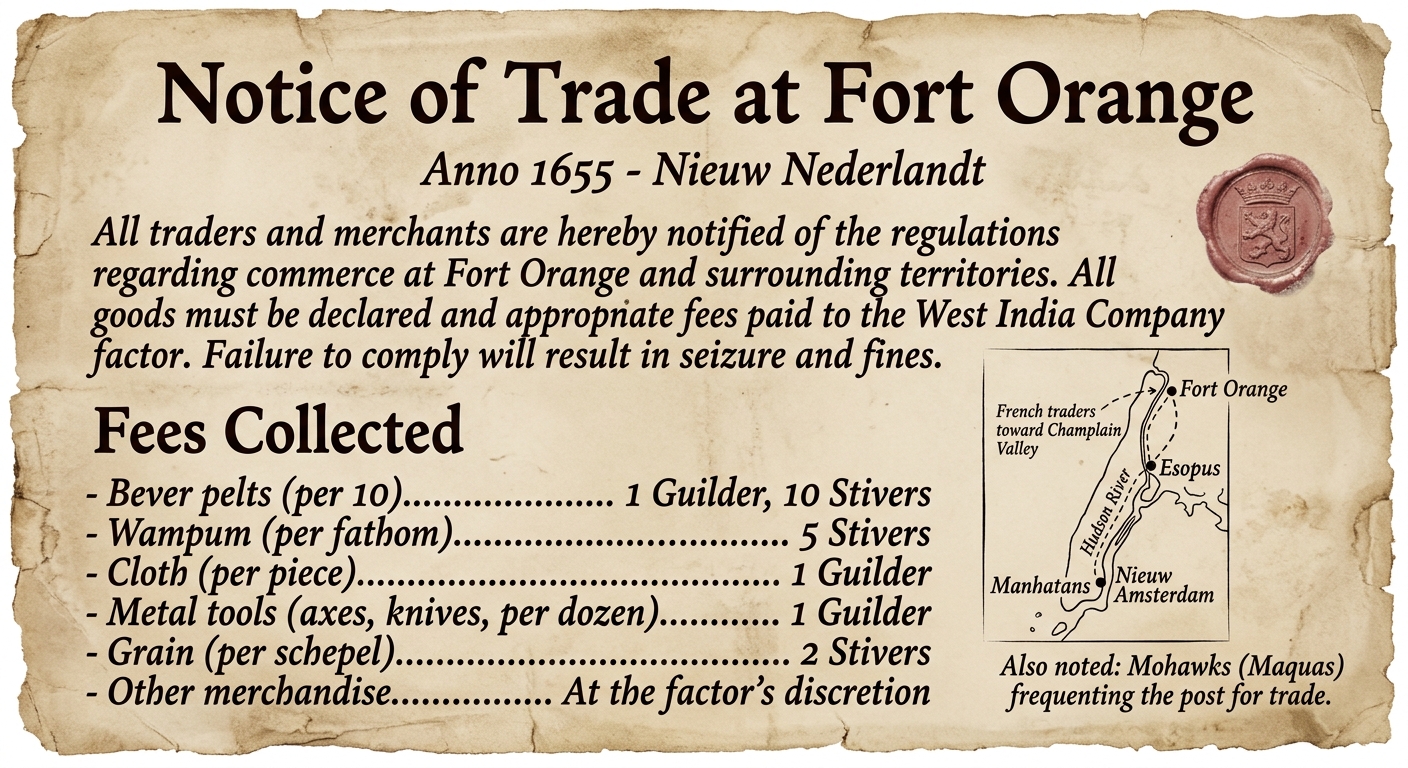
Historical Document:

Sepia-toned 1655 Dutch trade notice listing goods and fees at Fort Orange with an inset map labeling the Hudson River, Fort Orange, New Amsterdam, and a note about French traders toward the Champlain Valley.

A 1655 Dutch trade notice from the Hudson River region lists goods exchanged and fees collected at Fort Orange. A map fragment shows Dutch settlements along the Hudson and notes French traders in the Champlain Valley. Use the evidence to analyze how trade shaped colonial economies.

Asemmisa {{asɛmmisaAhyɛnsode}}
16.

Which detail from the document BEST shows the role of an institution in shaping the Hudson River economy?

Asemmisa {{asɛmmisaAhyɛnsode}}
17.

Based on the map fragment, why would settlements along the Hudson River be well-placed for economic growth?

Asemmisa {{asɛmmisaAhyɛnsode}}
18.

The document notes French traders in the Champlain Valley. Which economic effect is MOST likely when two European groups compete for the same trade goods?

Asemmisa {{asɛmmisaAhyɛnsode}}
19.

Using evidence from the document, explain one way Dutch control of trade and fees along the Hudson River could have long-lasting effects on New York’s economy.

Refer to at least one good or fee listed.

Asemmisa {{asɛmmisaAhyɛnsode}}
20.

Explain how the document suggests Dutch and French settlement patterns could lead to different economic priorities.

In your answer, use one detail about location (Hudson River or Champlain Valley) and one detail about trade goods or fees.

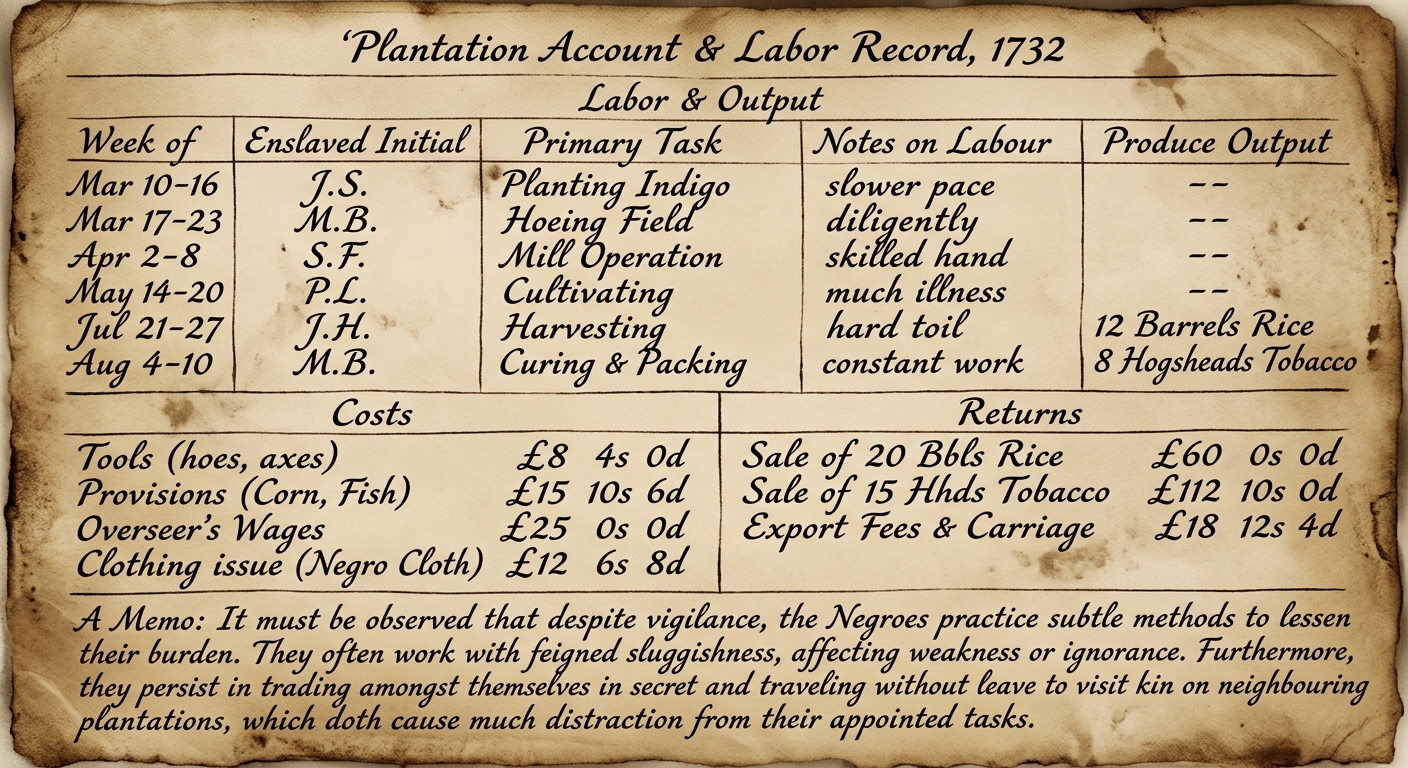
Historical Document:

Sepia-toned handwritten 1732 plantation account showing a labor record for enslaved workers, a ledger of costs and crop returns, and a brief note about an enslaved person’s strategy to survive or resist.

A plantation manager’s 1732 account lists labor tasks, production totals, and profits from exporting a cash crop. A margin note describes how an enslaved worker used a strategy to survive or resist. Use the record to analyze how slavery shaped colonial economic systems.

Asemmisa {{asɛmmisaAhyɛnsode}}
21.

Which statement BEST explains how the labor record connects slavery to the colonial economy?

Asemmisa {{asɛmmisaAhyɛnsode}}
22.

Which detail from the document BEST shows how plantation owners calculated profit?

Asemmisa {{asɛmmisaAhyɛnsode}}
23.

The margin note describes a strategy of survival or resistance. Which economic effect is MOST likely if that strategy spread across many plantations?

Asemmisa {{asɛmmisaAhyɛnsode}}
24.

Using evidence from the document, explain one way slavery supported the growth of colonial cash-crop economies.

Refer to one item from the labor record or the costs/returns sections.

Asemmisa {{asɛmmisaAhyɛnsode}}
25.

Explain how the strategy described in the margin note shows that enslaved Africans were not only laborers but also economic actors.

Use one detail from the note and connect it to how the plantation system worked.