Use the historical document(s) and the short readings in the left panel to answer the associated questions.
Read the historical document image. It is a circular letter written after the Annapolis meeting in 1786. The delegates argue that the Articles of Confederation leave the national government too weak to solve shared problems, and they urge the states to meet again to revise the federal system.
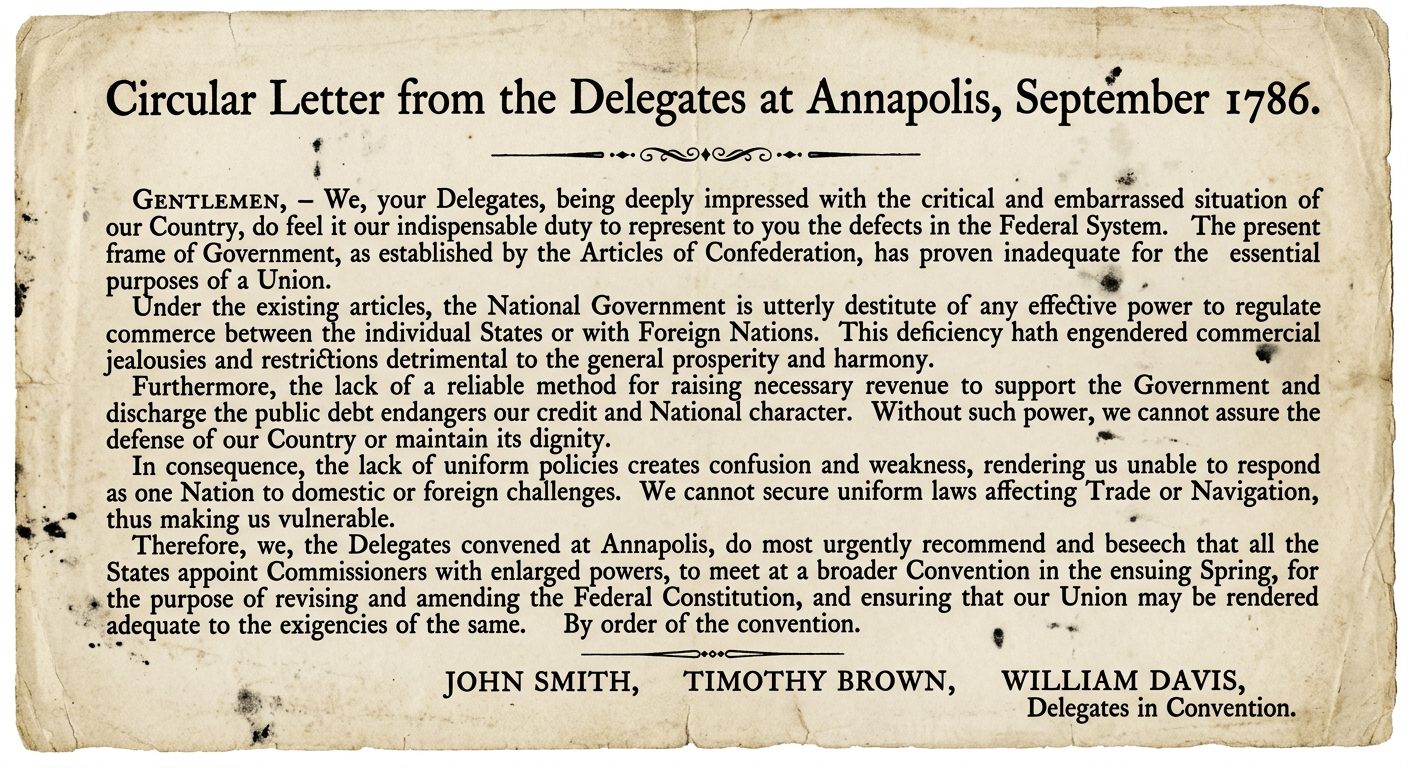
Which weakness of the Articles of Confederation is MOST directly supported by the document?
Based on the document, what is the BEST inference about why the delegates urged the states to meet again?
Which feature of the U.S. Constitution MOST directly addresses the problem of inconsistent trade policies described in the document?
Explain how the document provides evidence that the Articles of Confederation created an overly weak central government.
Use at least two specific ideas from the document as evidence in your paragraph.
Choose one issue raised in the document (trade rules, raising money, or enforcing national policies).
Explain how the Constitution created a stronger central government to address that issue, using evidence from the document and one constitutional feature.
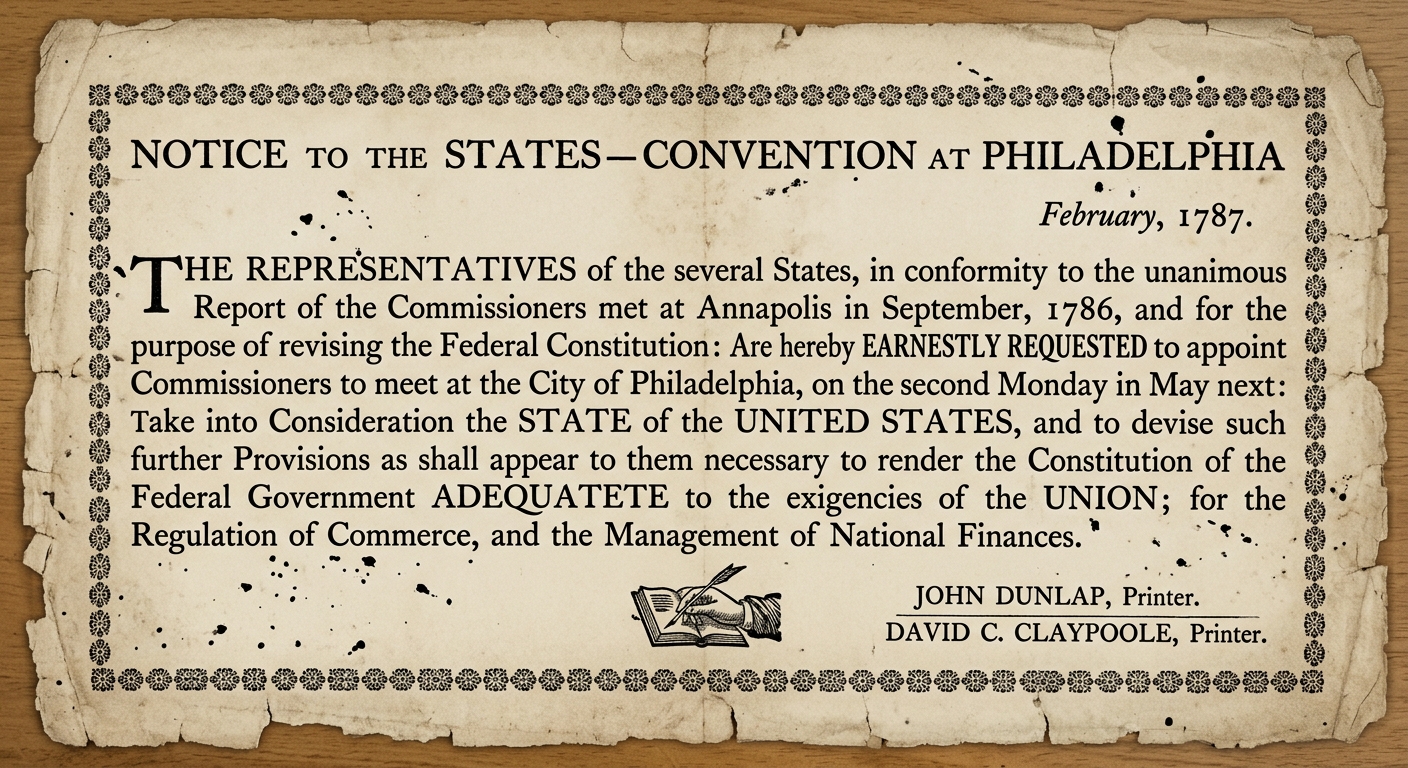
Read the historical document image. Dated February 1787, it connects the Annapolis meeting (September 1786) to a planned convention in Philadelphia (May 1787). The notice suggests that weaknesses under the Articles of Confederation led, over time, to calls for a new plan of government.

Which sequence of events is MOST consistent with the timeline implied by the document?
Because the notice is dated February 1787, which event mentioned or implied in the document would occur NEXT?
The notice links earlier problems under the Articles of Confederation to a later convention.
Which later constitutional change BEST fits that sequence of problem → response?
Explain how the document uses dates or time references to show a sequence of events leading toward a new plan of government.
Use at least two specific time markers from the notice as evidence.
The notice suggests that weaknesses under the Articles of Confederation built up over time.
Explain how that long-term problem led to creating a stronger central government under the Constitution.
Use evidence from the notice and describe the change in what the national government could do.
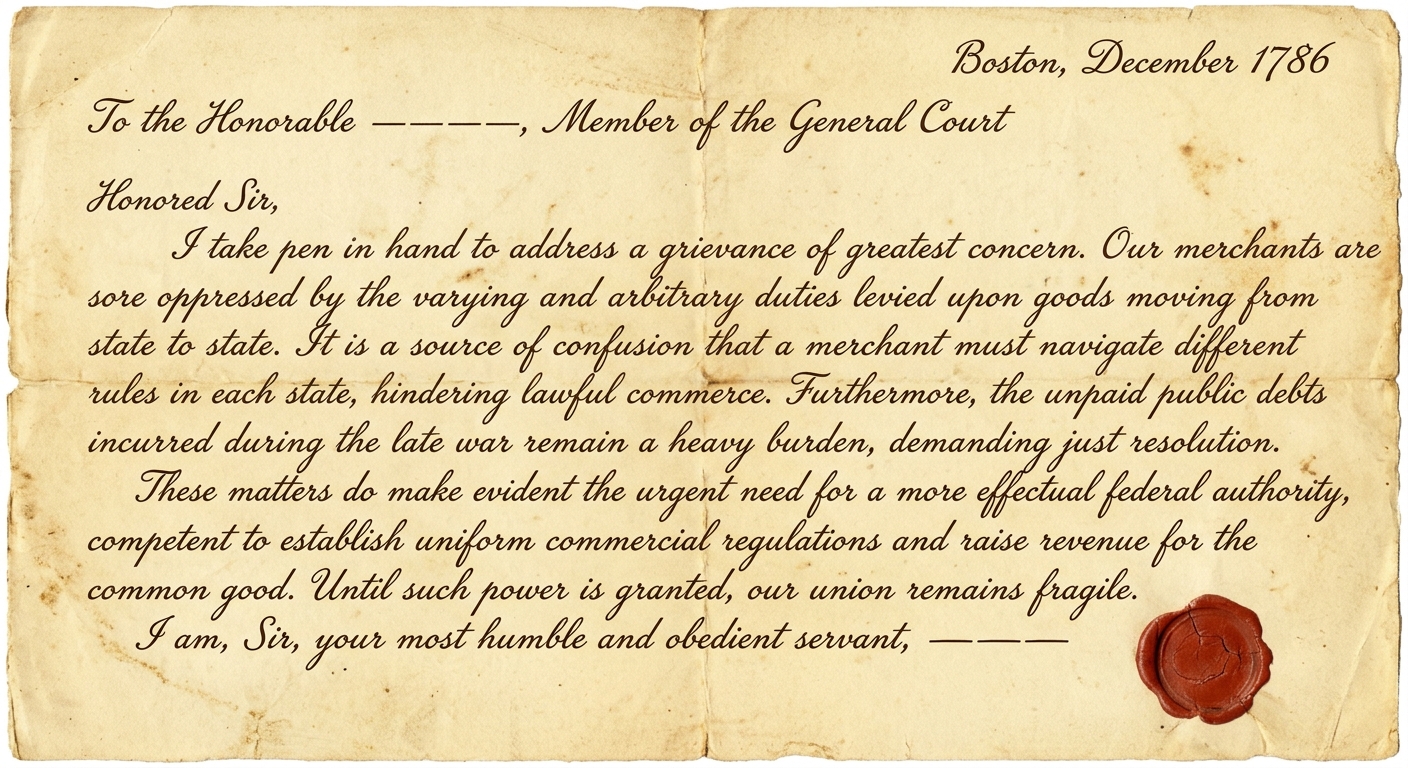
Read the historical document image. This excerpted letter from a Boston merchant (December 1786) describes economic problems after independence. As you answer the questions, compare the author’s view of state versus national action and place the letter in the broader context of the Articles of Confederation.

Which statement BEST compares the author’s view of state power and national power?
Which broader historical context BEST helps explain why the author wrote this letter in late 1786?
Which detail from the letter BEST supports the claim that the Articles of Confederation harmed the national economy?
Compare two economic problems the author describes.
For each problem, explain how it connects to a weakness of the Articles of Confederation.
Explain how conditions in the United States between 1776 and 1786 could lead some people to support a stronger central government.
Use one specific detail from the letter as evidence.
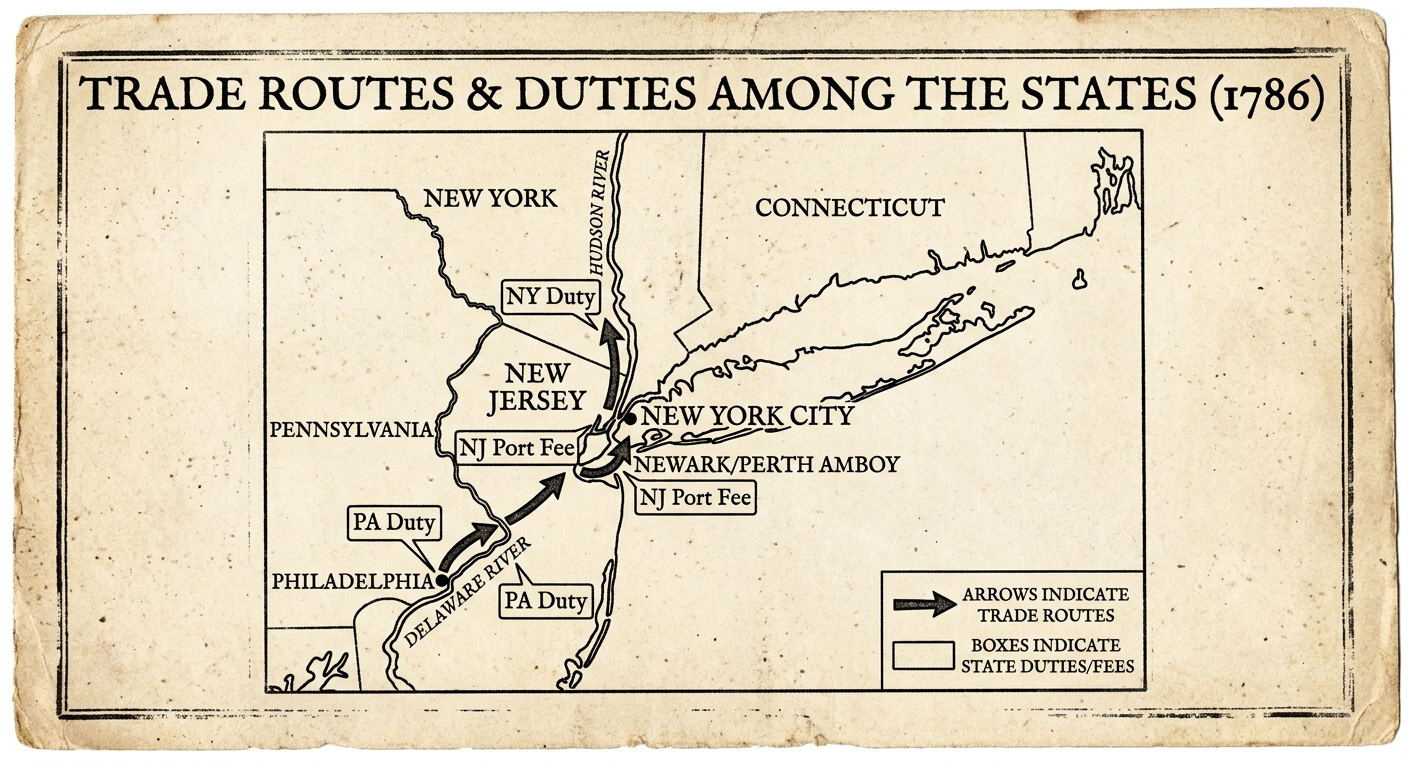
Read the historical document image. This 1786 trade notice includes a map of Mid-Atlantic routes and labels showing different state duties and port fees. Use the locations, rivers, and routes to infer how geography and state borders created economic problems under the Articles of Confederation.

Which map detail MOST directly shows an economic barrier created by different state policies under the Articles of Confederation?
Based on the map, which geographic feature would MOST likely make trade disputes affect more than one state?
Which feature of the U.S. Constitution MOST directly addresses the geographic trade problem shown on the map?
Explain how the map uses geographic information to show why economic problems under the Articles of Confederation could cross state borders.
Use at least two specific map elements (such as rivers, ports, arrows, or duty labels) as evidence.
Choose one geographic pattern shown on the map (such as shared waterways, connected ports, or routes that cross several states).
Explain how the Constitution created a stronger central government to reduce the problem shown, using map evidence and one constitutional feature.
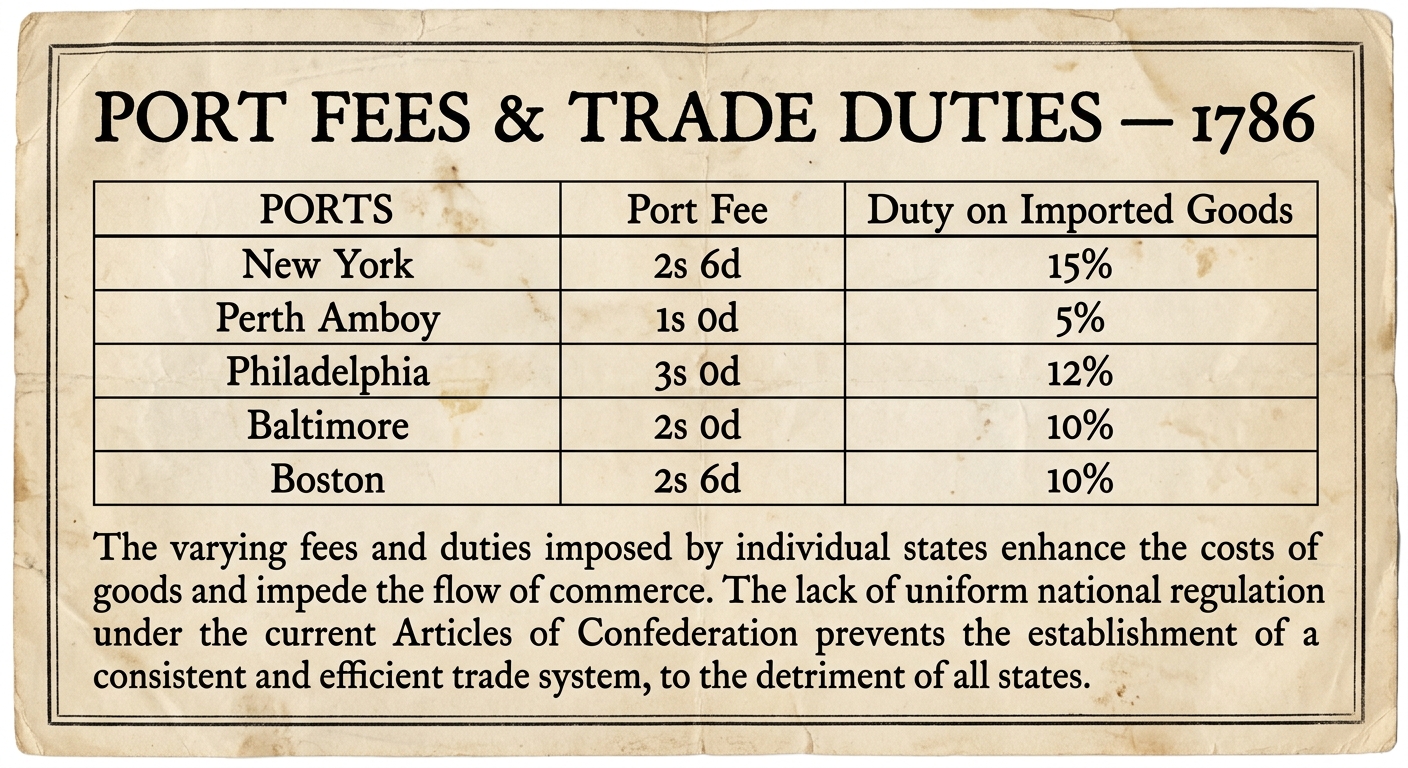
Read the historical document image. This 1786 broadside lists different port fees and trade duties in several states. Use the evidence to infer how inconsistent state policies could disrupt markets under the Articles of Confederation, and why some Americans argued for a stronger national economic system.

Which economic problem is MOST directly illustrated by the different fees and duties listed in the broadside?
Which detail from the broadside BEST supports the claim that the Articles of Confederation created an inefficient economic system?
Which feature of the U.S. Constitution MOST directly addresses the economic problem shown in the broadside?
Use evidence from the broadside to explain how different state port fees and duties could affect prices or trade.
Use at least two specific pieces of evidence from the document (ports, fees, or the note) in your paragraph.
Explain how the Constitution created a stronger national economic system than the Articles of Confederation for the kind of problem shown in the broadside.
Use one piece of evidence from the document and describe one constitutional feature in your paragraph.