Twa kɔ nsɛm atitiriw so
Log in
Sign up for FREE
arrow_back
Laabri

7.4c - Historical Development of the Constitution: - Practices A through E

star
star
star
star
star
Last updated about 1 month ago
25 Nsɛmmisa
Hyɛ no nsow a efi ɔkyerɛwfo no hɔ:

Use the historical document(s) and the short readings in the left panel to answer the associated questions.

Use the historical document(s) and the short readings in the left panel to answer the associated questions.

7.4.c
DOK.SS.2
7.4.c
DOK.SS.2
7.4.c
DOK.SS.2
7.4.c
DOK.SS.2
7.4.c
DOK.SS.2
Ɛhia
1
7.4.c
DOK.SS.2
Ɛhia
2
7.4.c
DOK.SS.2
Ɛhia
1
7.4.c
DOK.SS.2
Ɛhia
2
7.4.c
DOK.SS.2
Ɛhia
1
7.4.c
DOK.SS.2
Ɛhia
1
7.4.c
DOK.SS.2
Ɛhia
2
7.4.c
DOK.SS.2
Ɛhia
1
7.4.c
DOK.SS.2
Ɛhia
1
7.4.c
DOK.SS.2
Ɛhia
2
7.4.c
DOK.SS.2
Ɛhia
2
7.4.c
DOK.SS.2
Ɛhia
1
7.4.c
DOK.SS.2
Ɛhia
1
7.4.c
DOK.SS.2
Ɛhia
2
7.4.c
DOK.SS.2
Ɛhia
1
7.4.c
DOK.SS.2
Ɛhia
1
7.4.c
DOK.SS.2
Ɛhia
1
7.4.c
DOK.SS.2
Ɛhia
1
7.4.c
DOK.SS.2
Ɛhia
2
7.4.c
DOK.SS.2
Ɛhia
2
7.4.c
DOK.SS.2
Ɛhia
2
7.4.c
DOK.SS.2
Ɛhia
1
7.4.c
DOK.SS.2
Ɛhia
1
7.4.c
DOK.SS.2
Ɛhia
1
7.4.c
DOK.SS.2
Ɛhia
2
7.4.c
DOK.SS.2

Document A (1788): Pamphlet excerpt

During the Constitution’s ratification debates, Anti-Federalists warned that a strong national government might limit state authority and individual freedoms. Federalists argued the new system could still protect liberty. Many states agreed to ratify only after compromises, including promises to add protections for rights.
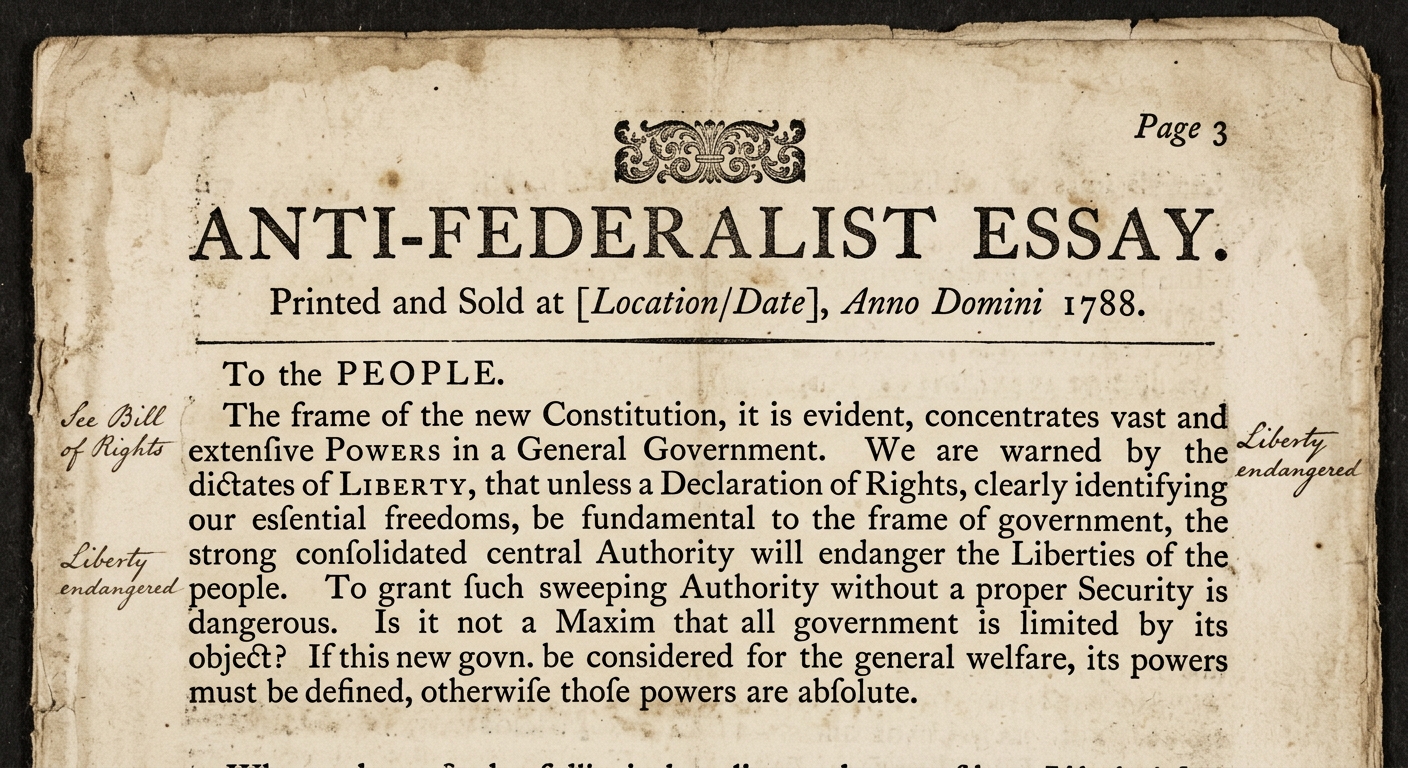
A scanned 1788-style pamphlet excerpt titled “Anti-Federalist Essay” warning that a strong central government could threaten liberty unless a declaration of rights is included.

Asemmisa {{asɛmmisaAhyɛnsode}}
1.

Which concern is most clearly supported by evidence in Document A?

Asemmisa {{asɛmmisaAhyɛnsode}}
2.

Using evidence from Document A, explain why compromises were needed to ratify the Constitution.

In your paragraph, cite at least two specific ideas or phrases from the document and connect them to the debate over states’ rights, federal power, and protections for individual freedoms.

Asemmisa {{asɛmmisaAhyɛnsode}}
3.

Which ratification-era compromise most directly responds to the concern expressed in Document A?

Asemmisa {{asɛmmisaAhyɛnsode}}
4.

In 2–3 sentences, explain how adding a Bill of Rights could address the concern in Document A while still allowing a stronger national government.

Reference one idea from the document as evidence.

Asemmisa {{asɛmmisaAhyɛnsode}}
5.

Which constitutional feature best shows how federalism addressed fears of federal power during ratification?

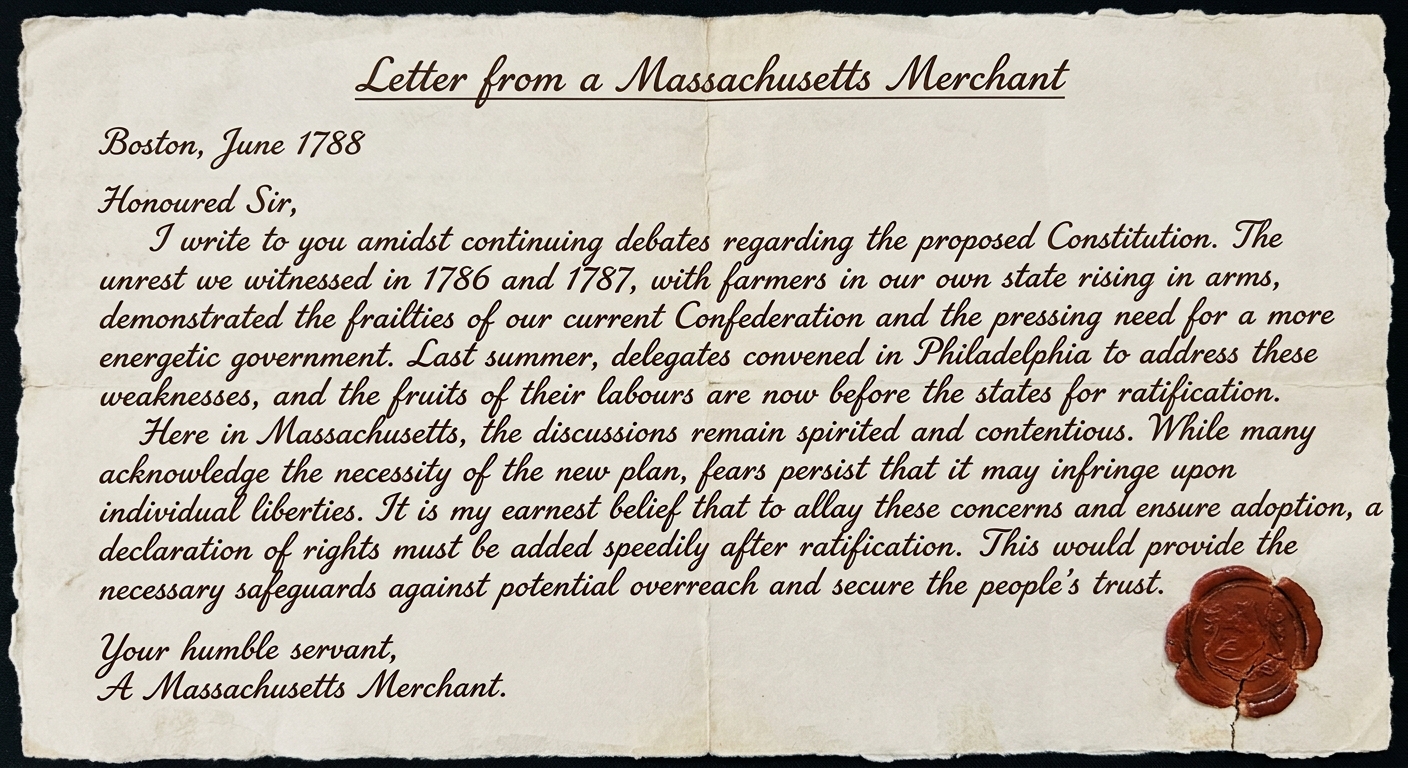
Document B (June 1788): Letter excerpt

After unrest under the Articles in 1786–1787, delegates met in Philadelphia in 1787 to revise the government. In 1788, states debated whether to ratify the new Constitution. Some supported ratification only if leaders promised to add a declaration of rights soon after.

A scanned handwritten letter dated June 1788 from a Massachusetts merchant describing unrest under the Articles, the 1787 Philadelphia convention, and 1788 ratification debates, suggesting a declaration of rights to calm fears.

Asemmisa {{asɛmmisaAhyɛnsode}}
6.

Based on Document B, which development most directly explains why delegates met in Philadelphia in 1787?

Asemmisa {{asɛmmisaAhyɛnsode}}
7.

Using evidence from Document B, explain in chronological order why compromises were needed to ratify the Constitution.

In your paragraph, cite at least two dates or time references from the document and connect them to concerns about federal power, states’ rights, and individual freedoms.

Asemmisa {{asɛmmisaAhyɛnsode}}
8.

Which event happened first in the sequence described in Document B?

Asemmisa {{asɛmmisaAhyɛnsode}}
9.

According to the sequence in Document B, what promise came after the 1788 ratification debates to address concerns about rights?

Asemmisa {{asɛmmisaAhyɛnsode}}
10.

In 2–3 sentences, explain how the timing of adding a declaration of rights could help win ratification. Reference one time clue (such as 1788 or “soon after”) from Document B as evidence.

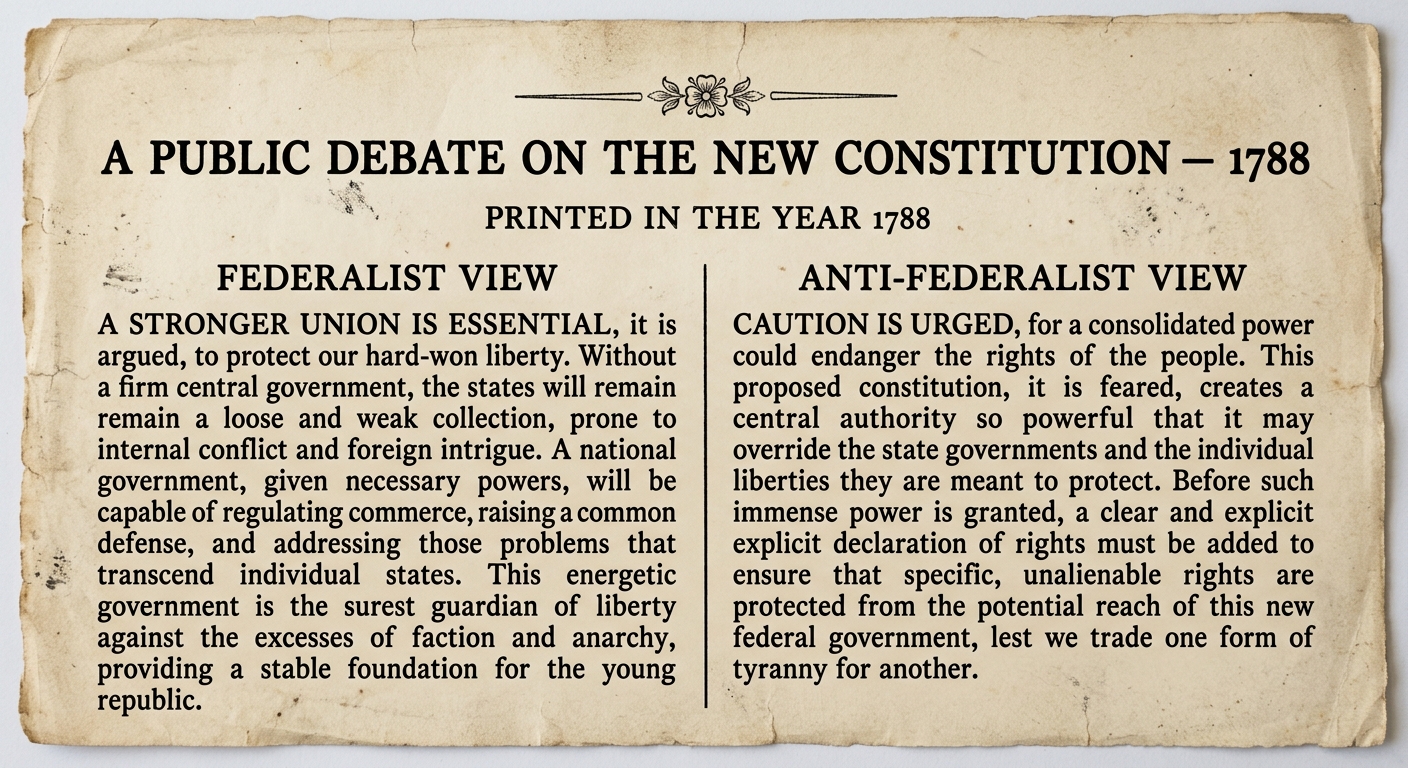
Document C (1788): Newspaper broadside

In 1788, Americans debated ratifying the Constitution. Federalists argued a stronger national government was needed to solve problems under the Articles of Confederation. Anti-Federalists warned that new federal powers could threaten liberties unless rights were clearly protected. This broadside summarizes both views.

A scanned 1788-style newspaper broadside with two columns labeled “Federalist View” and “Anti-Federalist View,” contrasting arguments about federal power and the need for a declaration of rights.

Asemmisa {{asɛmmisaAhyɛnsode}}
11.

In 2–3 sentences, explain how promising to add a Bill of Rights helped place the debate in context and win support for ratification.

Reference one idea from Document C as evidence.

Asemmisa {{asɛmmisaAhyɛnsode}}
12.

Which problem under the Articles of Confederation provides the best context for why many Federalists supported a stronger central government?

Asemmisa {{asɛmmisaAhyɛnsode}}
13.

Which statement best matches the Federalist viewpoint in Document C?

Asemmisa {{asɛmmisaAhyɛnsode}}
14.

Using evidence from Document C, compare the Federalist and Anti-Federalist viewpoints.

In your paragraph, include at least one specific idea from each side and explain how these competing concerns led to compromises during ratification.

Asemmisa {{asɛmmisaAhyɛnsode}}
15.

Which statement best matches the Anti-Federalist viewpoint in Document C?

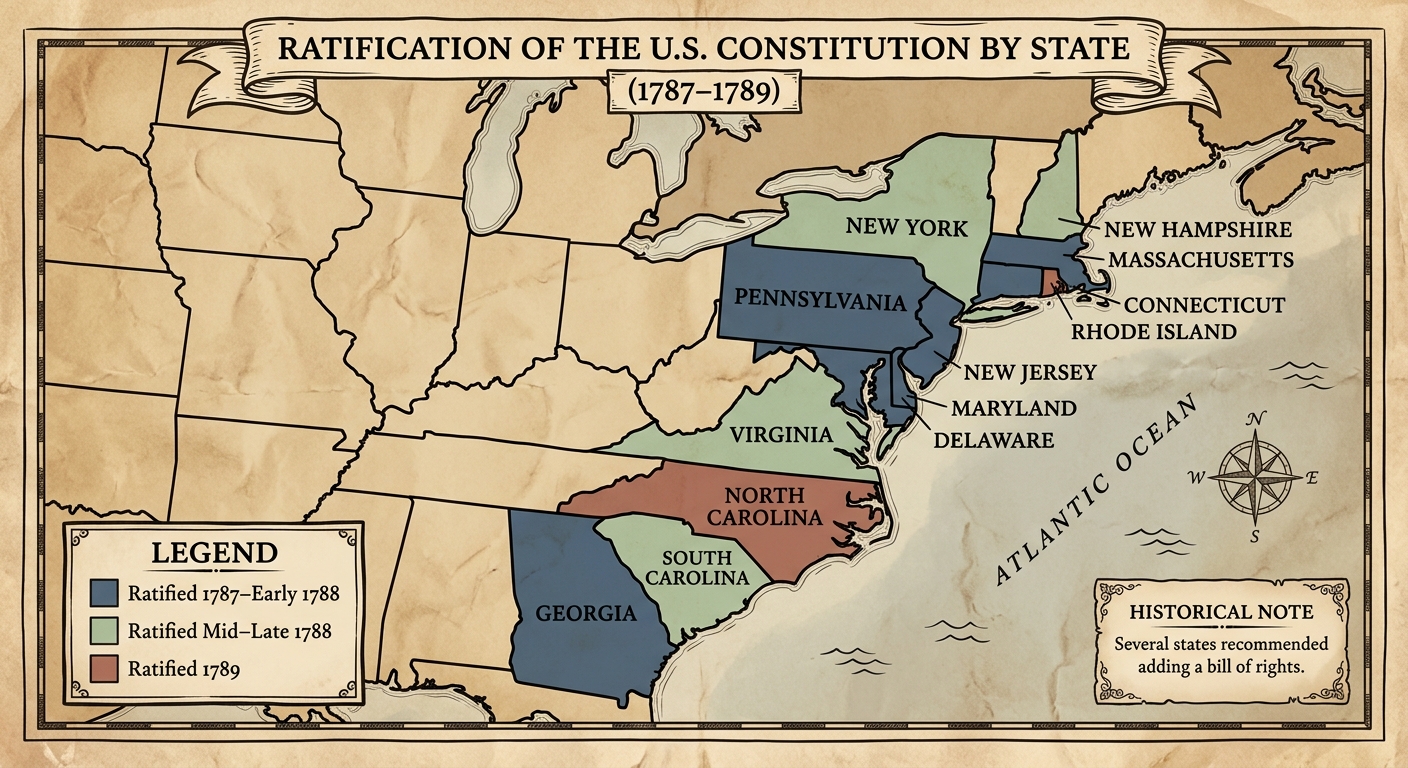
Document D (1787–1789): Ratification map

This map shows when each of the original 13 states ratified the U.S. Constitution. The legend groups states by early, middle, or late ratification. The pattern helps place ratification debates in regional context, including concerns about federal power and demands for rights protections.

A vintage-style map of the original 13 states shaded by when they ratified the U.S. Constitution (1787–1789), with a legend and a note that several states recommended adding a bill of rights.

Asemmisa {{asɛmmisaAhyɛnsode}}
16.

Based on the map, which region shows the greatest concentration of early ratifications (1787–early 1788)?

Asemmisa {{asɛmmisaAhyɛnsode}}
17.

Which group of states on the map would be the best evidence for identifying areas where support for ratification may have taken longer to build?

Asemmisa {{asɛmmisaAhyɛnsode}}
18.

Which conclusion is best supported by the map’s regional pattern of ratification timing?

Asemmisa {{asɛmmisaAhyɛnsode}}
19.

Using evidence from Document D, compare two regions (for example, New England vs. the South) in terms of ratification timing.

In your paragraph, explain how these regional differences help contextualize disagreements over federal power, states’ rights, and protections for individual freedoms.

Asemmisa {{asɛmmisaAhyɛnsode}}
20.

In 2–3 sentences, explain how a promise to add a Bill of Rights could address the concerns of later-ratifying states shown on the map.

Reference one map detail (such as a legend category or region) as evidence.

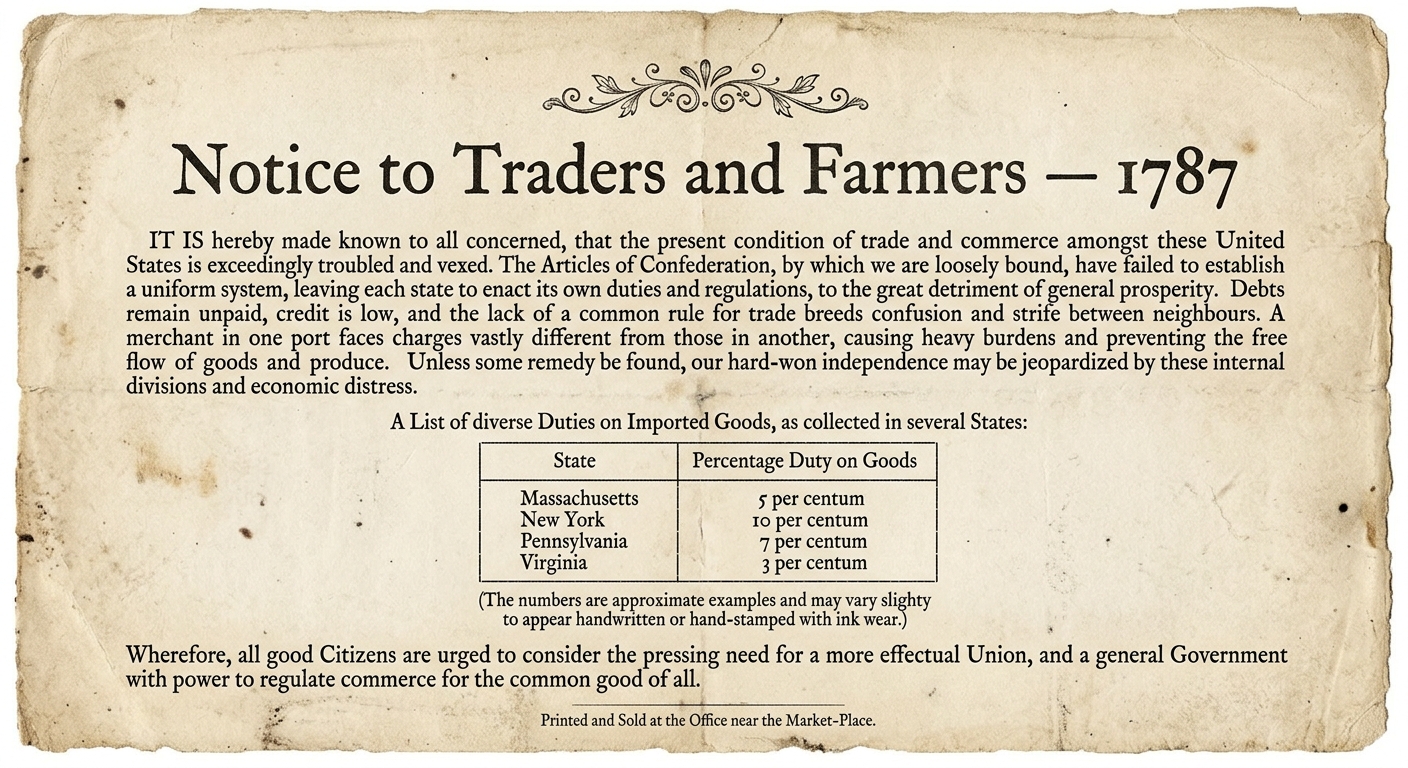
Document E (1787): Merchant broadside

In 1787, many Americans complained that the Articles of Confederation left Congress too weak to fix economic problems. States set different trade duties and the national government struggled to raise revenue to pay debts. This broadside connects these issues to arguments for a stronger federal system.

A scanned 1787-style broadside titled “Notice to Traders and Farmers — 1787” describing uneven state trade duties and debts under the Articles of Confederation, with a small table showing different import duties by state.

Asemmisa {{asɛmmisaAhyɛnsode}}
21.

Using evidence from Document E, explain how economic problems under the Articles of Confederation influenced the debate over ratifying the Constitution.

In your paragraph, cite at least two specific pieces of evidence (such as the table or a phrase) and explain why compromises were still needed.

Asemmisa {{asɛmmisaAhyɛnsode}}
22.

Which economic problem is most clearly supported by evidence in Document E?

Asemmisa {{asɛmmisaAhyɛnsode}}
23.

Even if the Constitution could improve trade and revenue, which concern would many Anti-Federalists still raise during ratification?

Asemmisa {{asɛmmisaAhyɛnsode}}
24.

Which conclusion best connects the economic evidence in Document E to a Federalist argument for the Constitution?

Asemmisa {{asɛmmisaAhyɛnsode}}
25.

In 2–3 sentences, explain how adding a Bill of Rights could function as a compromise for people who wanted economic stability but feared stronger federal power.

Reference one economic issue from Document E as context.