Twa kɔ nsɛm atitiriw so
Log in
Sign up for FREE
arrow_back
Laabri

7.8b - Nation Divided: - Practices A through E

star
star
star
star
star
Last updated about 1 month ago
25 Nsɛmmisa
Hyɛ no nsow a efi ɔkyerɛwfo no hɔ:

Use the historical document(s) and the short readings in the left panel to answer the associated questions.

Use the historical document(s) and the short readings in the left panel to answer the associated questions.

DOK.SS.2
DOK.SS.2
DOK.SS.2
DOK.SS.2
DOK.SS.2
Ɛhia
1
7.8.b
DOK.SS.2
Ɛhia
1
7.8.b
DOK.SS.2
Ɛhia
1
7.8.b
DOK.SS.2
Ɛhia
1
7.8.b
DOK.SS.2
Ɛhia
1
7.8.b
DOK.SS.2
Ɛhia
1
7.8.b
DOK.SS.2
Ɛhia
1
7.8.b
DOK.SS.2
Ɛhia
1
7.8.b
DOK.SS.2
Ɛhia
1
7.8.b
DOK.SS.2
Ɛhia
1
7.8.b
DOK.SS.2
Ɛhia
1
7.8.b
DOK.SS.2
Ɛhia
1
7.8.b
DOK.SS.2
Ɛhia
1
7.8.b
DOK.SS.2
Ɛhia
1
7.8.b
DOK.SS.2
Ɛhia
1
7.8.b
DOK.SS.2
Ɛhia
1
7.8.b
DOK.SS.2
Ɛhia
1
7.8.b
DOK.SS.2
Ɛhia
1
7.8.b
DOK.SS.2
Ɛhia
1
7.8.b
DOK.SS.2
Ɛhia
1
7.8.b
DOK.SS.2
Ɛhia
1
7.8.b
DOK.SS.2
Ɛhia
1
7.8.b
DOK.SS.2
Ɛhia
1
7.8.b
DOK.SS.2
Ɛhia
1
7.8.b
DOK.SS.2
Ɛhia
1
7.8.b
DOK.SS.2

Historical Document (1854)
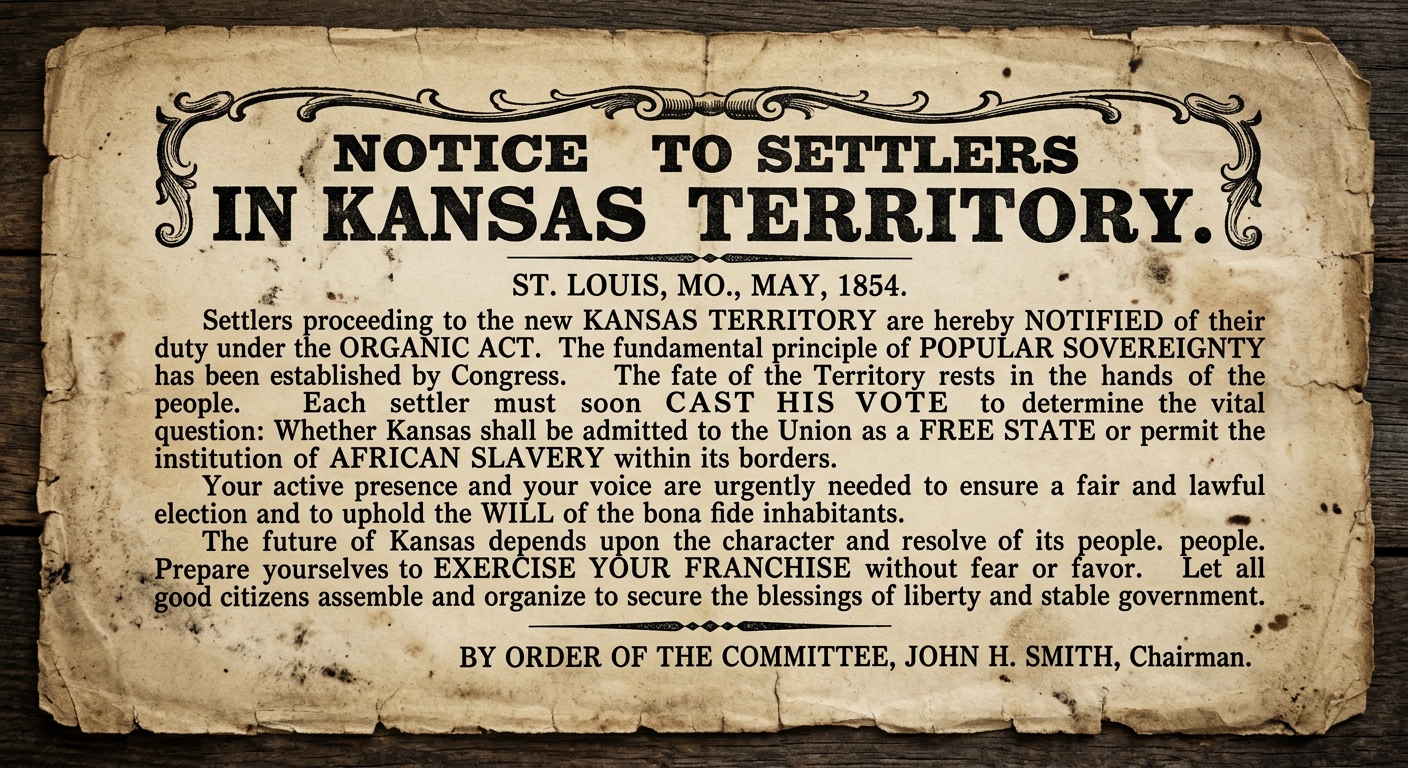
A sepia-toned 1854 printed handbill titled “Notice to Settlers in Kansas Territory,” dated St. Louis, May 1854, discussing popular sovereignty and voting on slavery in Kansas.

In 1854, the Kansas–Nebraska Act said settlers in Kansas Territory could vote on whether slavery would be allowed. The handbill below urges people to move to Kansas and shape that vote. Read the document closely and use specific phrases as evidence in your answers.
Asemmisa {{asɛmmisaAhyɛnsode}}
1.

Which piece of evidence from the document most directly relates to a broader sectional conflict?

Asemmisa {{asɛmmisaAhyɛnsode}}
2.

Based on the author’s word choice, what is the most likely purpose of this handbill?

Asemmisa {{asɛmmisaAhyɛnsode}}
3.

Which statement is best supported by evidence in the document about why the author wants people to move to Kansas?

Asemmisa {{asɛmmisaAhyɛnsode}}
4.

Interpret the document as a historical source: What viewpoint is the author promoting about Kansas, and what evidence in the document helps you identify that viewpoint?

Asemmisa {{asɛmmisaAhyɛnsode}}
5.

Using two specific phrases or details from the document, explain how this handbill shows that “attempts at compromise ended in failure.”

Historical Document (1850)

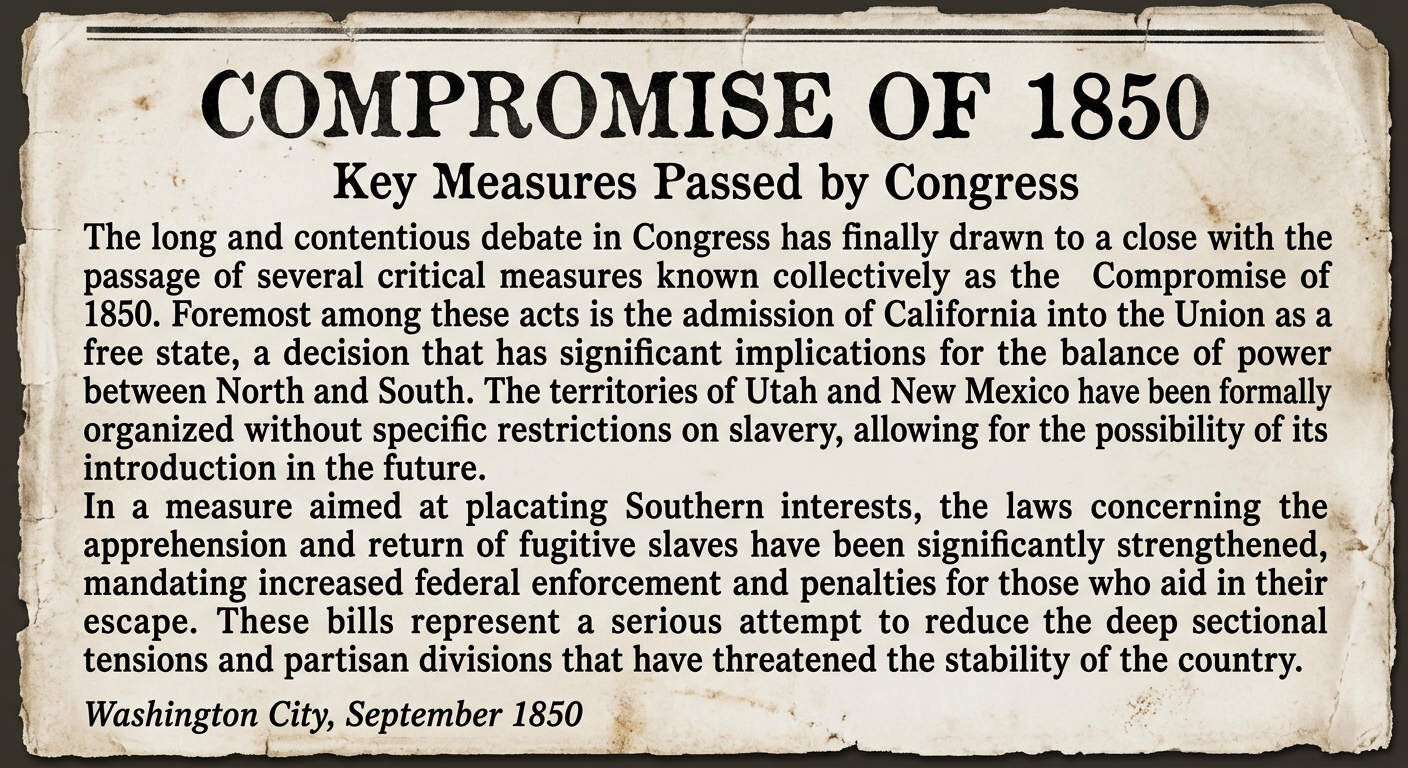
A scanned 1850 newspaper clipping titled “Compromise of 1850,” dated Washington City, September 1850, summarizing California’s admission and other measures including stronger fugitive slave enforcement.

In 1850, Congress passed a set of measures meant to reduce conflict over slavery as the nation expanded west. The document below highlights key parts of that compromise. Read closely, then place the document in sequence with later events and use details from the text as evidence.

Asemmisa {{asɛmmisaAhyɛnsode}}
6.

Place this document between two other events from the period 1820–1857 (name them), and explain how the sequence shows compromises failing to ease sectional tensions.

Asemmisa {{asɛmmisaAhyɛnsode}}
7.

Which later development most directly shows that this 1850 attempt at compromise did not end the conflict over slavery in the West?

Asemmisa {{asɛmmisaAhyɛnsode}}
8.

Which detail from the document best supports the conclusion that the Compromise of 1850 tried to balance sectional interests?

Asemmisa {{asɛmmisaAhyɛnsode}}
9.

Using two specific details from the document, explain how the Compromise of 1850 connects to the later idea of popular sovereignty in Kansas.

Focus on cause and effect across time.

Asemmisa {{asɛmmisaAhyɛnsode}}
10.

Based on the date and content of the document, which event most likely happened next in the sequence of growing sectional tensions?

Historical Document (1857)

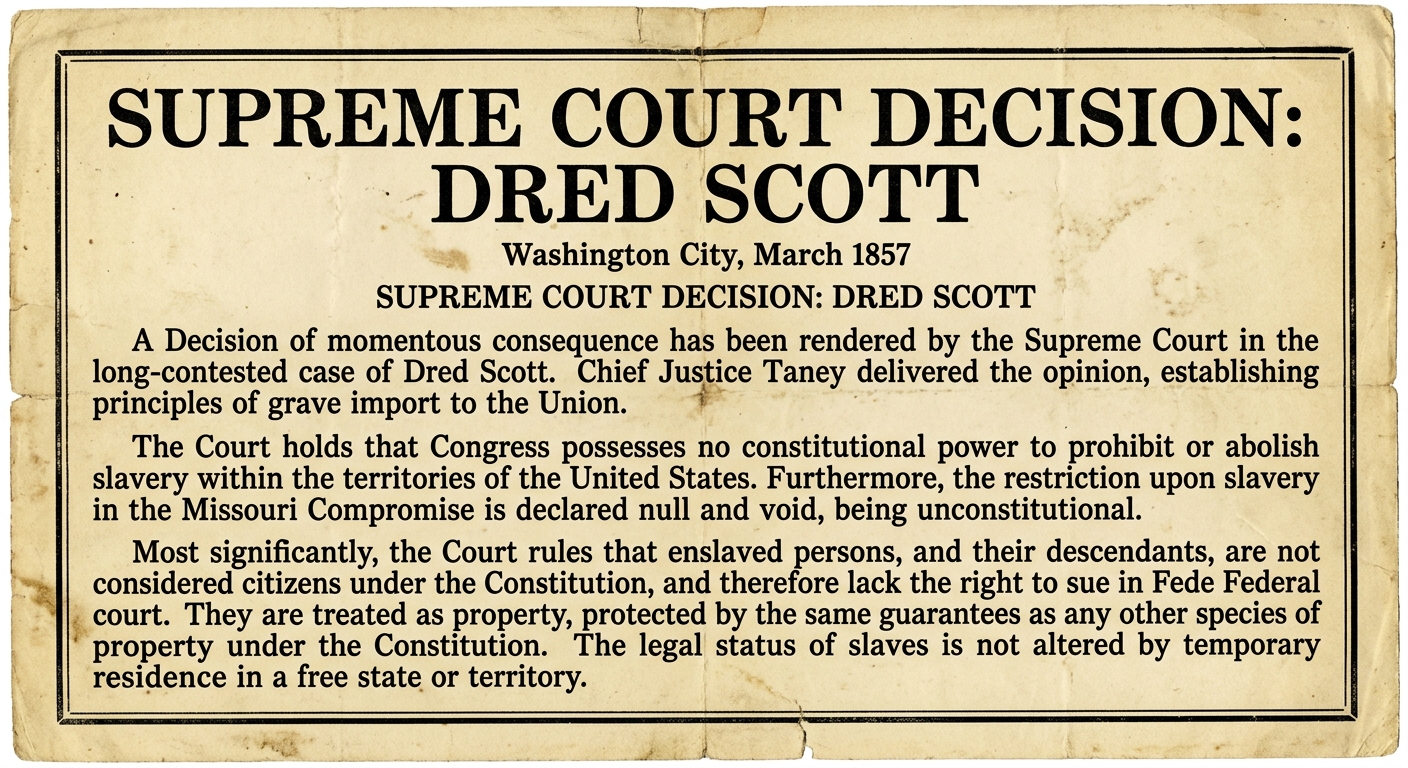
A scanned 1857 newspaper broadside titled “Supreme Court Decision: Dred Scott,” dated Washington City, March 1857, summarizing the ruling about slavery in the territories.

In 1857, the Supreme Court’s decision in Dred Scott v. Sanford intensified sectional conflict by addressing slavery in the territories. Read the broadside and connect its claims to earlier compromises. Use exact words or phrases from the document when comparing what changed—and what stayed unresolved—over time.

Asemmisa {{asɛmmisaAhyɛnsode}}
11.

Identify one claim in the 1857 broadside that would likely anger many Northerners and one that would likely reassure many Southerners.

Use one quoted word or phrase from the document for each.

Asemmisa {{asɛmmisaAhyɛnsode}}
12.

Which phrase or idea from the broadside would be the strongest evidence that compromises were failing to reduce sectional tension?

Asemmisa {{asɛmmisaAhyɛnsode}}
13.

Compared with popular sovereignty in the Kansas–Nebraska Act (1854), what key difference does this document suggest about who would decide the slavery question in the territories?

Asemmisa {{asɛmmisaAhyɛnsode}}
14.

Place this document in a short timeline by naming two related events from 1820–1857 (one earlier, one close in time).

Explain in 3–5 sentences how the context helps explain why sectional tensions increased despite repeated attempts at compromise.

Asemmisa {{asɛmmisaAhyɛnsode}}
15.

Which statement best places this 1857 document in the context of earlier compromises over slavery in the territories?

Historical Document (1854)

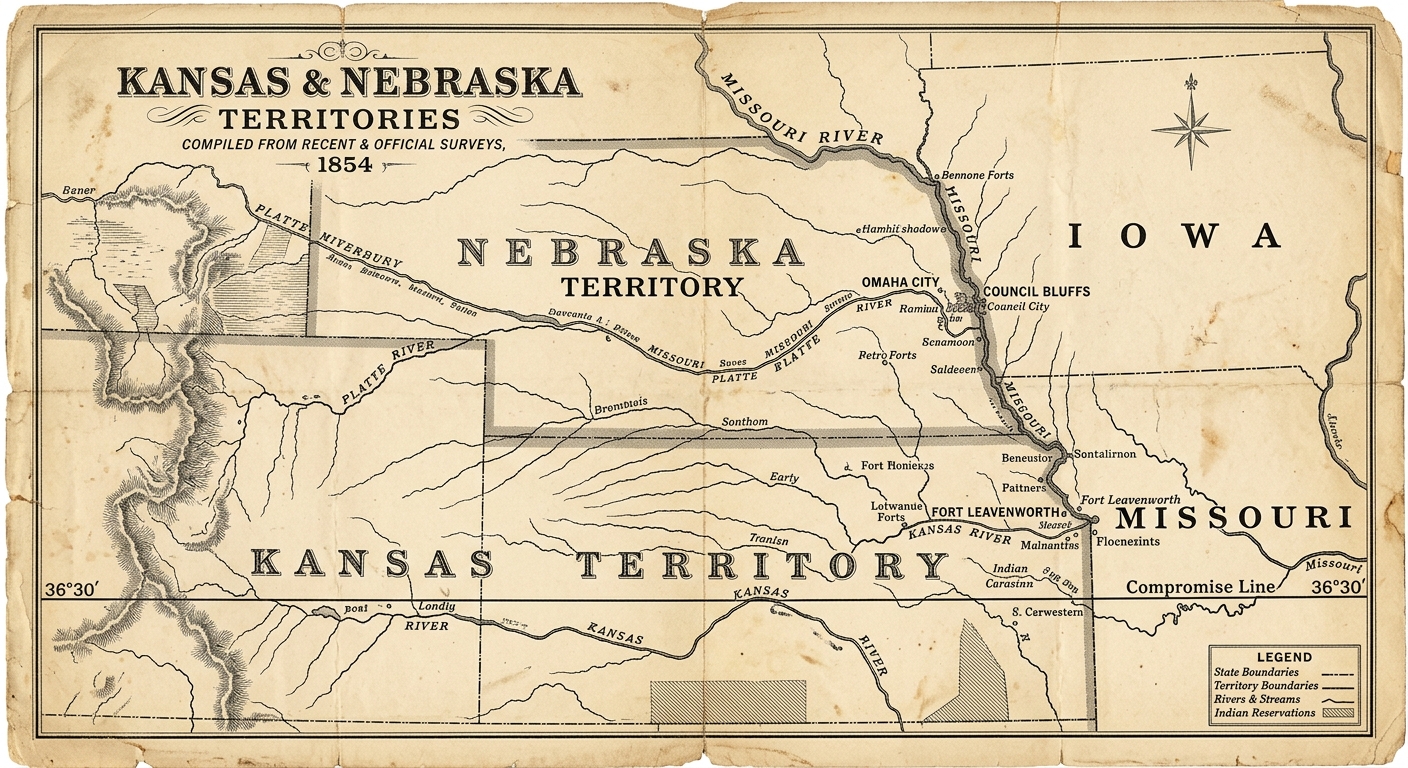
An engraved-style 1854 map labeled “Kansas & Nebraska Territories,” showing Missouri and Iowa nearby, the Missouri River, and the 36°30′ reference line.

In 1854, Congress organized Kansas and Nebraska Territories from land west of Missouri and Iowa. The map below shows borders and key reference lines used in earlier debates, including 36°30′. Use the map’s spatial details to explain how westward expansion increased sectional tension over slavery.

Asemmisa {{asɛmmisaAhyɛnsode}}
16.

Based on the map, which neighboring area is most directly positioned to send settlers into Kansas Territory quickly, helping shape a popular sovereignty vote?

Asemmisa {{asɛmmisaAhyɛnsode}}
17.

Which map detail best supports the conclusion that westward expansion reopened the slavery debate that earlier compromises tried to settle?

Asemmisa {{asɛmmisaAhyɛnsode}}
18.

Explain how a map like this helps historians connect the Missouri Compromise (1820) to later events such as “Bleeding Kansas” (1854–1856).

Use one specific map detail as evidence.

Asemmisa {{asɛmmisaAhyɛnsode}}
19.

Which inference is best supported by the map about why conflict could become intense in Kansas in the mid-1850s?

Asemmisa {{asɛmmisaAhyɛnsode}}
20.

Use two pieces of evidence from the map (for example, borders, rivers, or reference lines) to explain how the location of Kansas and Nebraska Territories increased sectional tensions over slavery.

Historical Document (1856)

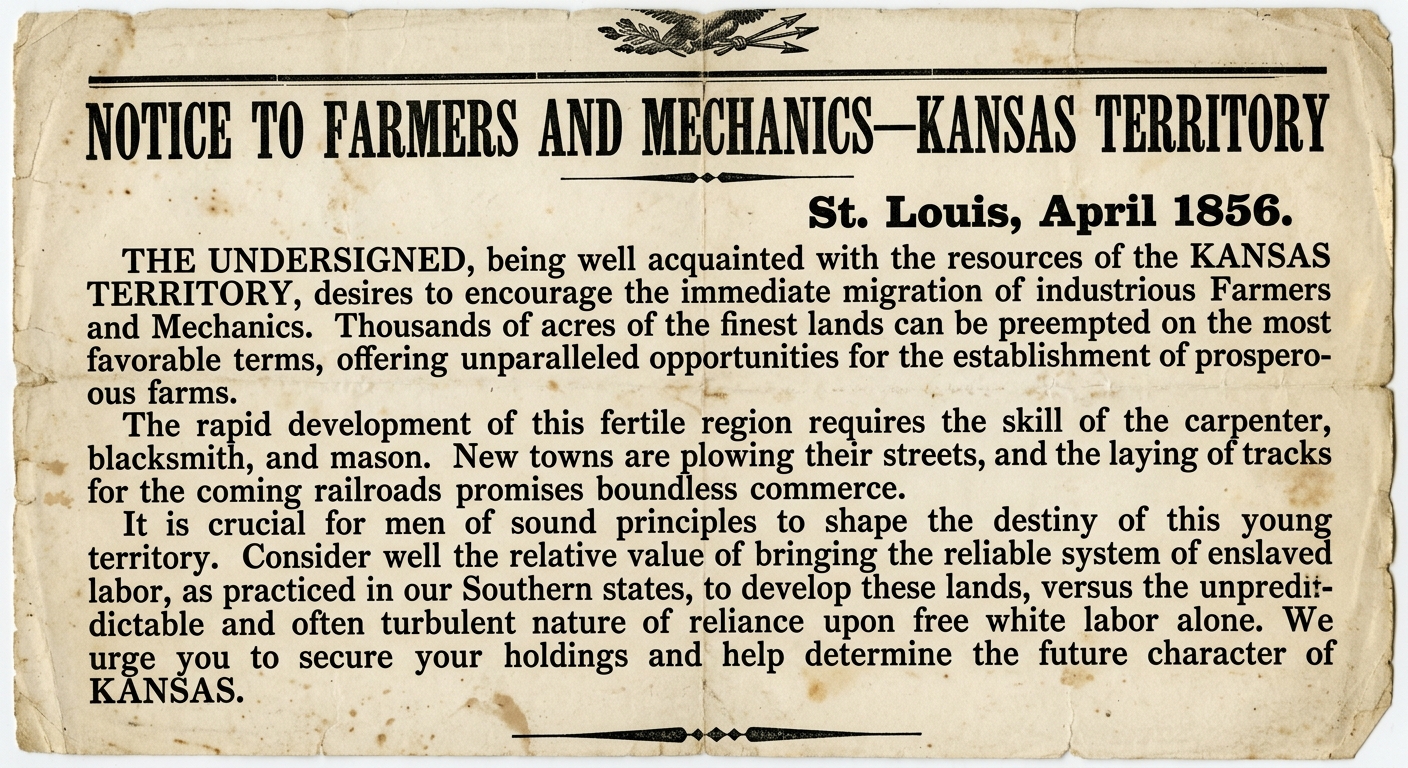
A scanned 1856 broadside titled “Notice to Farmers and Mechanics—Kansas Territory,” dated St. Louis, April 1856, promoting cheap land and debating free labor versus enslaved labor.

As settlers moved west in the 1850s, people argued about what kind of economy new territories should develop. Some promoted “free labor” farms and towns, while others defended slavery as an economic system. Read the broadside and use its claims to connect economics to rising sectional tensions.

Asemmisa {{asɛmmisaAhyɛnsode}}
21.

Which economic question is most directly connected to sectional conflict in the document?

Asemmisa {{asɛmmisaAhyɛnsode}}
22.

Using two specific phrases or details from the document, explain how the broadside connects the question of slavery to economic opportunities in Kansas.

Asemmisa {{asɛmmisaAhyɛnsode}}
23.

Which conclusion is best supported about why economic arguments mattered in debates over slavery in new territories?

Asemmisa {{asɛmmisaAhyɛnsode}}
24.

Which evidence from the broadside best shows an attempt to persuade people using economic incentives?

Asemmisa {{asɛmmisaAhyɛnsode}}
25.

Explain how an economic argument like the one in this document could increase sectional tensions even when political compromises were attempted.

Use one specific detail from the document as evidence.