Use the historical document(s) and the short readings in the left panel to answer the associated questions.
Read the document image. It is a Reconstruction-era military circular (1867) summarizing conditions for a former Confederate state to rejoin the Union: writing a new constitution, ratifying the Fourteenth Amendment, and protecting voting rights. Use evidence from the document when answering each question.
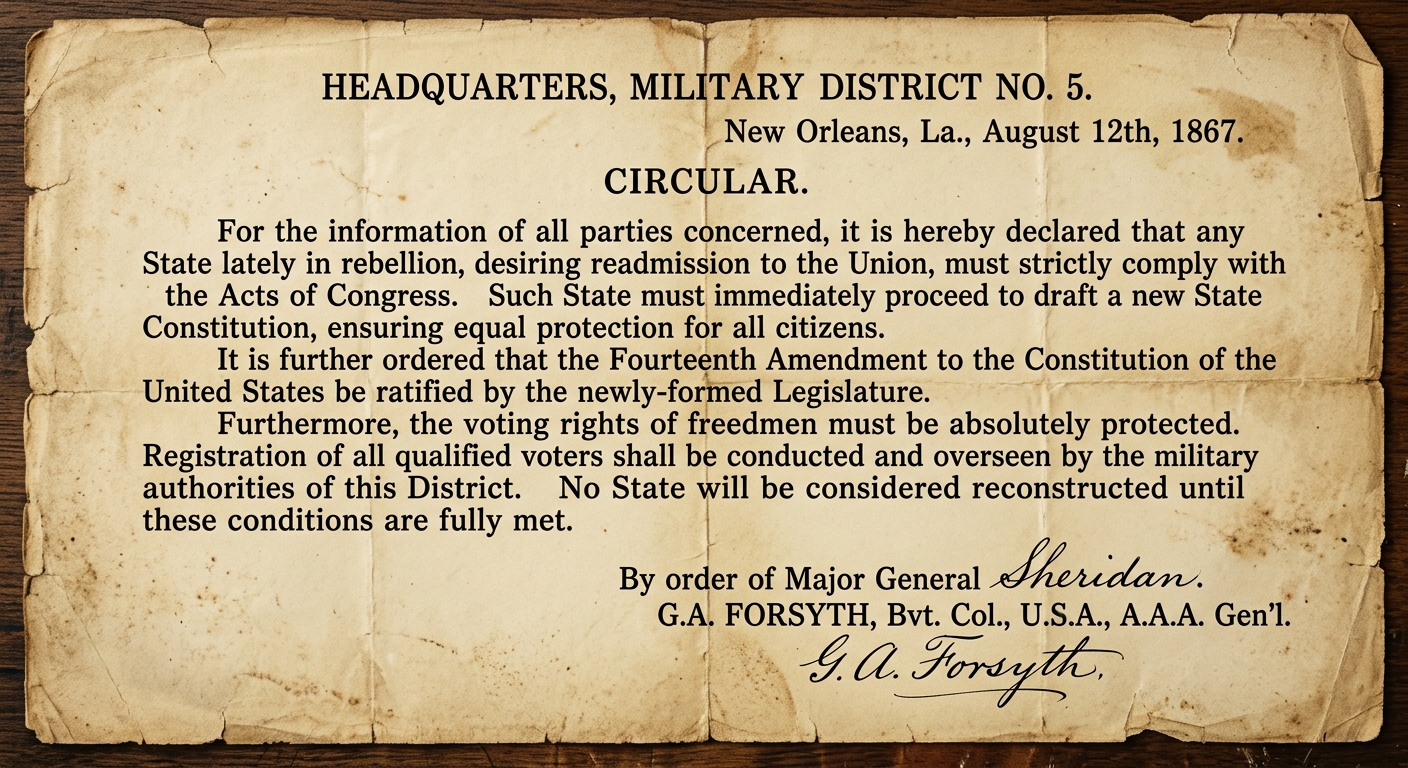
Which approach to Reconstruction is most consistent with the requirements listed in the document?
Which detail from the document best supports the claim that the federal government was setting conditions for state readmission?
Which challenge of reunifying the nation after the Civil War is most clearly shown by the document?
Using evidence from the document, explain how TWO specific conditions show the goals of Reconstruction. In your answer, quote or paraphrase the two conditions and explain what each suggests about reunifying the nation.
Compare the approach to Reconstruction suggested by this document with what you would expect under President Andrew Johnson’s plan. Identify ONE likely point of conflict and support your comparison with evidence from the document.
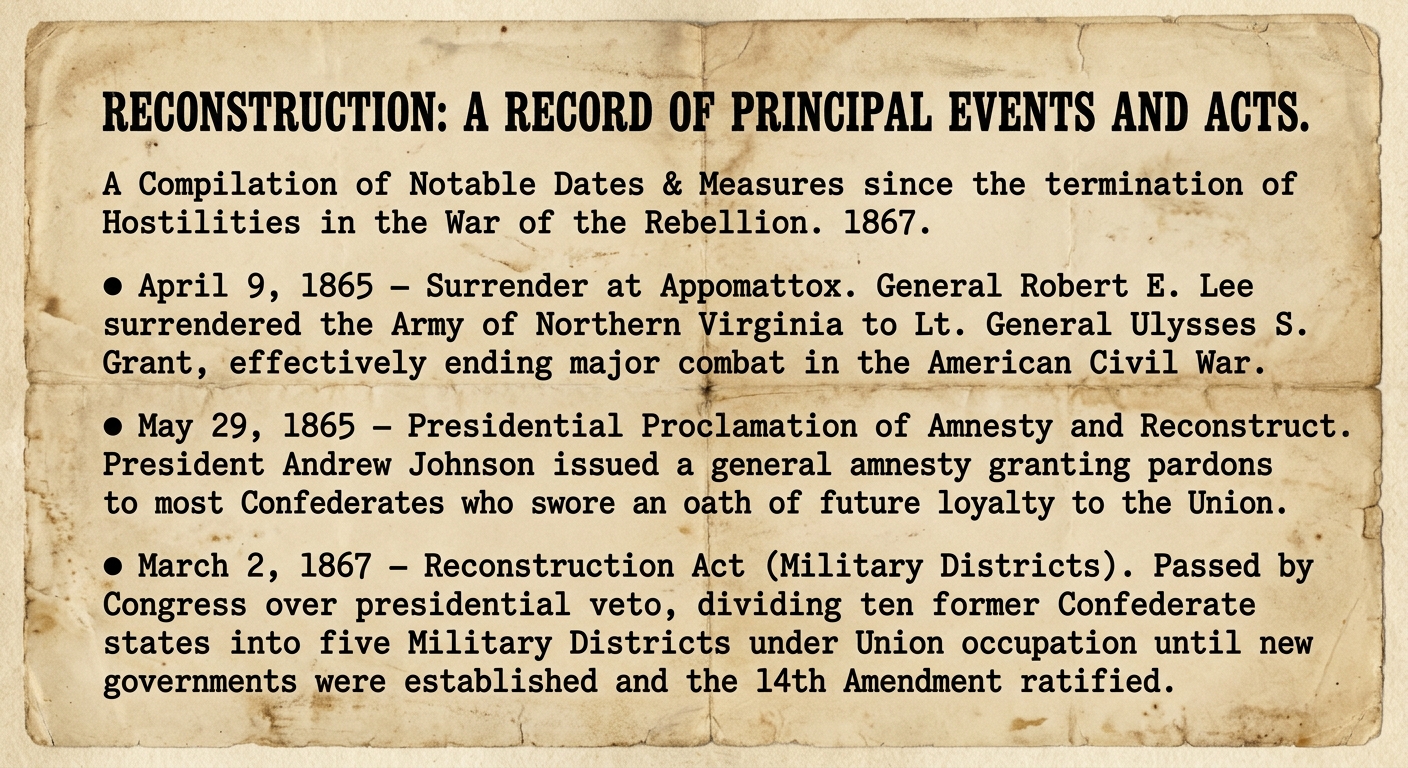
Read the document image. It is a timeline-style notice listing key dates from 1865–1867, including the end of the Civil War, an early presidential Reconstruction policy, and a later congressional Reconstruction law. Use the dates and details as evidence when answering each question.

Based on the dates in the document, which event happened last?
Which option best explains how Reconstruction policy changed from May 1865 to March 1867, based on the document?
Which statement is best supported by the order of events shown in the document?
Using the chronology in the document, explain why a presidential Reconstruction policy appears before a congressional Reconstruction law.
In your answer, reference at least TWO dated entries and explain what the sequence suggests about the challenges of reunifying the nation.
Choose ONE later entry in the document and explain how it could be a response to an earlier entry.
In your answer, name both dates, summarize what changed, and use evidence from the document to support your explanation.
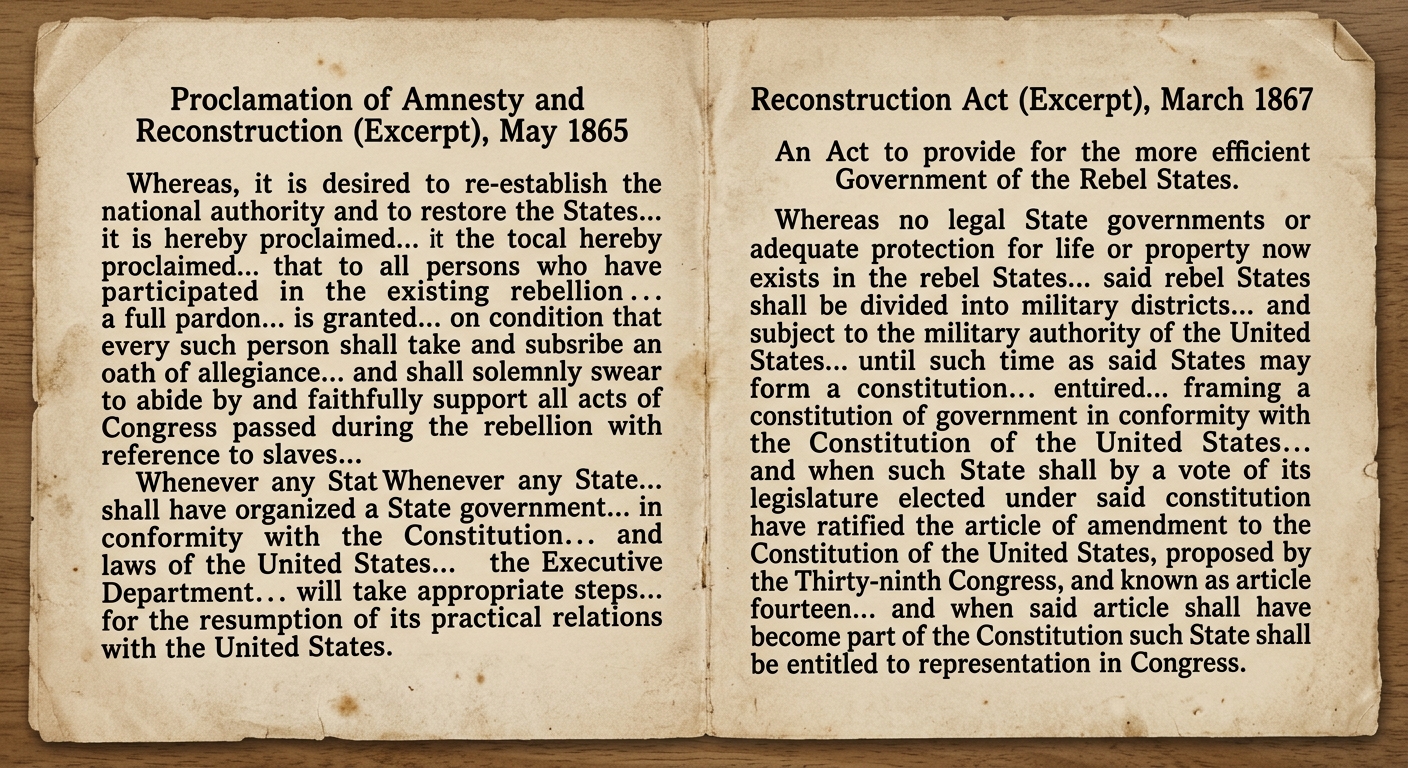
Read the document image. It shows two short excerpts (1865 and 1867) describing different Reconstruction approaches. Use the language in each excerpt to compare federal and state roles, and to place each policy in its historical context after the Civil War.

Which comparison between the two excerpts is best supported by the documents?
Which phrase or requirement would you most likely find in the 1867 excerpt rather than the 1865 excerpt?
Which historical context best helps explain why the later excerpt includes stricter requirements than the earlier excerpt?
Use evidence from BOTH excerpts to compare how each document describes the role of the federal government in Reconstruction.
In your answer, quote or paraphrase one detail from each excerpt.
Explain one problem facing the United States after the Civil War that could help explain why Reconstruction policy changed between the two excerpts.
Use at least ONE piece of evidence from the later excerpt to support your explanation.
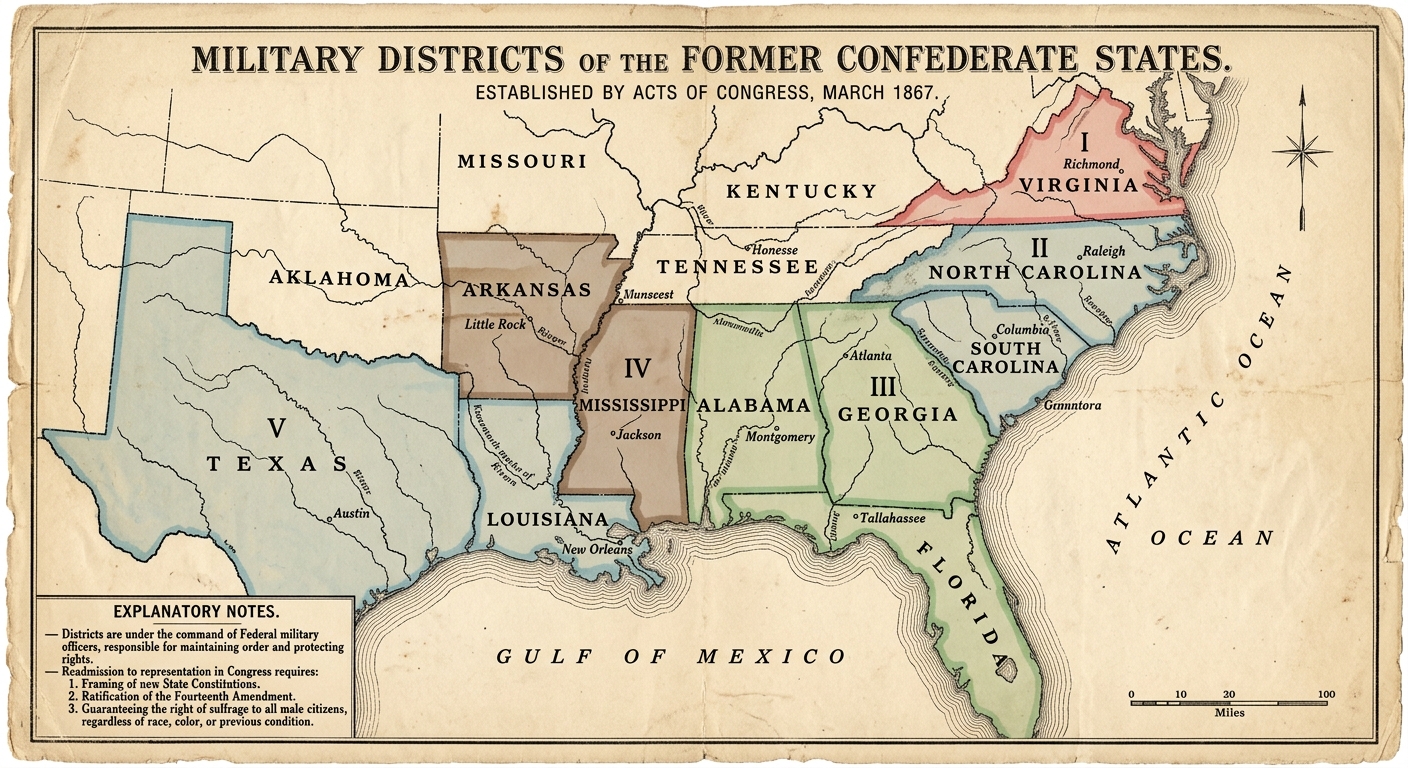
Read the document image. It is a Reconstruction-era map showing former Confederate states grouped into numbered military districts under federal supervision. Use the map’s regions and legend to explain how geography shaped Reconstruction policy and the challenges of reuniting the nation.

Based on the map and legend, what was the main purpose of dividing the former Confederate states into military districts?
Which inference is best supported by the map’s regional grouping of states into districts?
Which statement best explains how the map helps show the challenges of reunifying the nation after the Civil War?
Using evidence from the map’s regions and legend, explain how geography could affect how Reconstruction policies were enforced.
In your answer, describe ONE way the district system might change federal oversight across different areas.
Explain how the map supports the idea that different Reconstruction approaches were used to address regional challenges in the South.
Use ONE piece of evidence from the legend or the district divisions to support your answer.
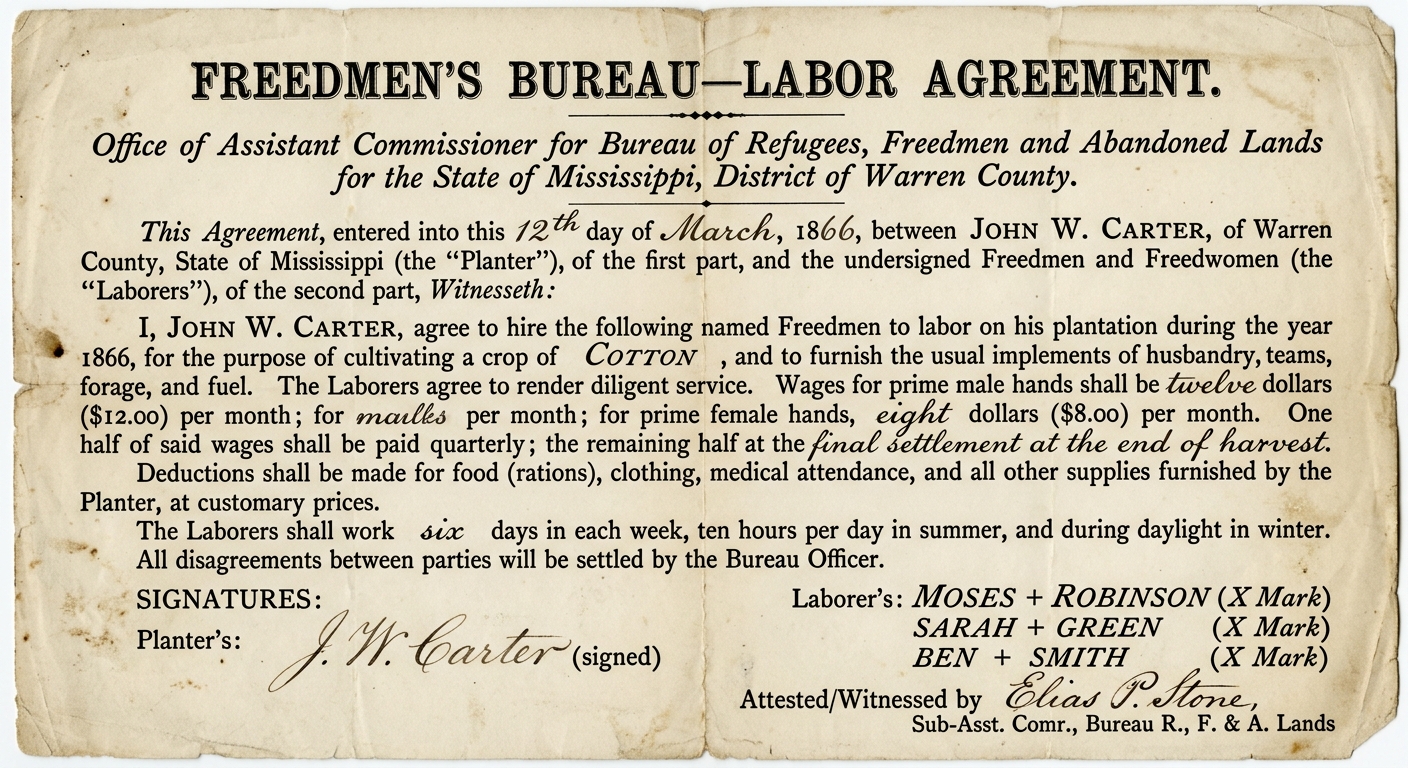
Read the document image. It is a Reconstruction-era labor agreement (1866) overseen by the Freedmen’s Bureau. It describes how a laborer and planter would divide the cotton crop and repay supplies at harvest. Use details from the contract to answer each question about Reconstruction-era economic systems.

Which economic system is most directly described by the labor agreement in the document?
Which detail from the contract best supports the idea that debt could shape a laborer’s economic choices during Reconstruction?
Which inference about incentives in this economic arrangement is best supported by the document?
Using evidence from the contract, explain ONE way this labor system could limit economic independence for freedpeople during Reconstruction.
Explain how a contract like this could connect to broader challenges of Reconstruction, such as reunifying the nation and rebuilding Southern economies.
Use ONE piece of evidence from the document to support your answer.