Twa kɔ nsɛm atitiriw so
Log in
Sign up for FREE
arrow_back
Laabri

8.6a - World War II: - Practices A through E

star
star
star
star
star
Last updated about 1 month ago
25 Nsɛmmisa
Hyɛ no nsow a efi ɔkyerɛwfo no hɔ:

Use the historical document(s) and the short readings in the left panel to answer the associated questions.

Use the historical document(s) and the short readings in the left panel to answer the associated questions.

8.6.a
DOK.SS.2
8.6.a
DOK.SS.2
8.6.a
DOK.SS.2
8.6.a
DOK.SS.2
8.6.a
DOK.SS.2
Ɛhia
1
8.6.a
DOK.SS.2
Ɛhia
1
8.6.a
DOK.SS.2
Ɛhia
1
8.6.a
DOK.SS.2
Ɛhia
1
8.6.a
DOK.SS.2
Ɛhia
1
8.6.a
DOK.SS.2
Ɛhia
1
8.6.a
DOK.SS.2
Ɛhia
1
8.6.a
DOK.SS.2
Ɛhia
1
8.6.a
DOK.SS.2
Ɛhia
1
8.6.a
DOK.SS.2
Ɛhia
1
8.6.a
DOK.SS.2
Ɛhia
1
8.6.a
DOK.SS.2
Ɛhia
1
8.6.a
DOK.SS.2
Ɛhia
1
8.6.a
DOK.SS.2
Ɛhia
1
8.6.a
DOK.SS.2
Ɛhia
1
8.6.a
DOK.SS.2
Ɛhia
1
8.6.a
DOK.SS.2
Ɛhia
1
8.6.a
DOK.SS.2
Ɛhia
1
8.6.a
DOK.SS.2
Ɛhia
1
8.6.a
DOK.SS.2
Ɛhia
1
8.6.a
DOK.SS.2
Ɛhia
1
8.6.a
DOK.SS.2
Ɛhia
1
8.6.a
DOK.SS.2
Ɛhia
1
8.6.a
DOK.SS.2
Ɛhia
1
8.6.a
DOK.SS.2
Ɛhia
1
8.6.a
DOK.SS.2

Historical Document:

League of Nations Memorandum (June 1937)

Read the short note below, then examine the document image. The memorandum describes debate over economic sanctions and reports that some member states refused to follow League decisions. Use this evidence to explain how the League’s limits could encourage aggressive actions in the late 1930s.
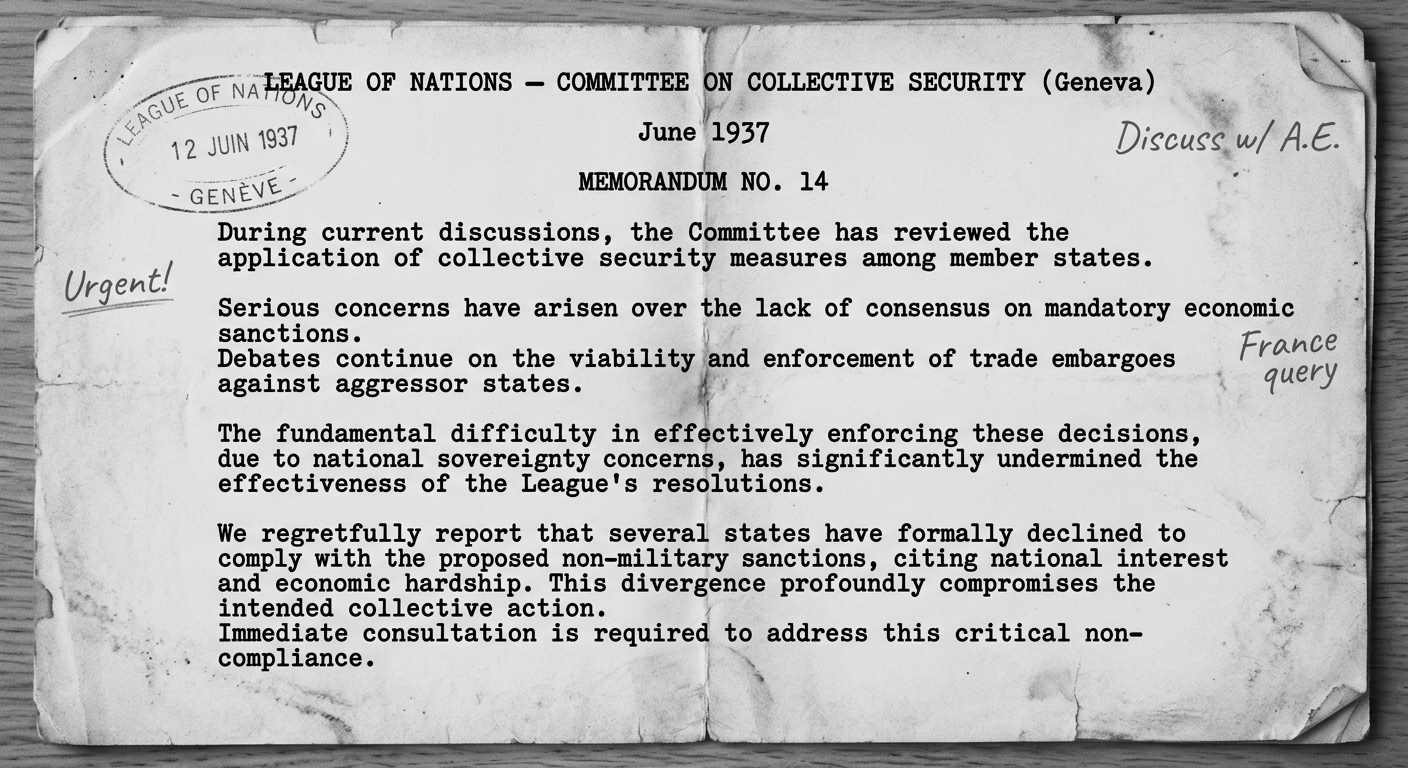
Grayscale scan-style memorandum dated June 1937 with a League of Nations Geneva header and typed notes about sanctions and members not complying, with a faint stamp and pencil marks.

Asemmisa {{asɛmmisaAhyɛnsode}}
1.

Which conclusion is BEST supported by evidence in the memorandum?

Asemmisa {{asɛmmisaAhyɛnsode}}
2.

In 2–3 sentences, compare the role of:

(1) worldwide economic depression and

(2) the League of Nations’ failure to preserve peace in contributing to war.

Use one piece of evidence from the stimulus for the League of Nations factor.

Asemmisa {{asɛmmisaAhyɛnsode}}
3.

Using evidence from the memorandum and the reading note above it, explain how the League of Nations’ limitations could contribute to the outbreak of war in Europe and Asia.

Use at least two specific pieces of evidence from the stimulus.

Asemmisa {{asɛmmisaAhyɛnsode}}
4.

Based on the memorandum, which outcome is the MOST likely result of an international organization that cannot reliably enforce sanctions?

Asemmisa {{asɛmmisaAhyɛnsode}}
5.

Which detail from the memorandum would be the BEST evidence that League decisions were difficult to carry out?

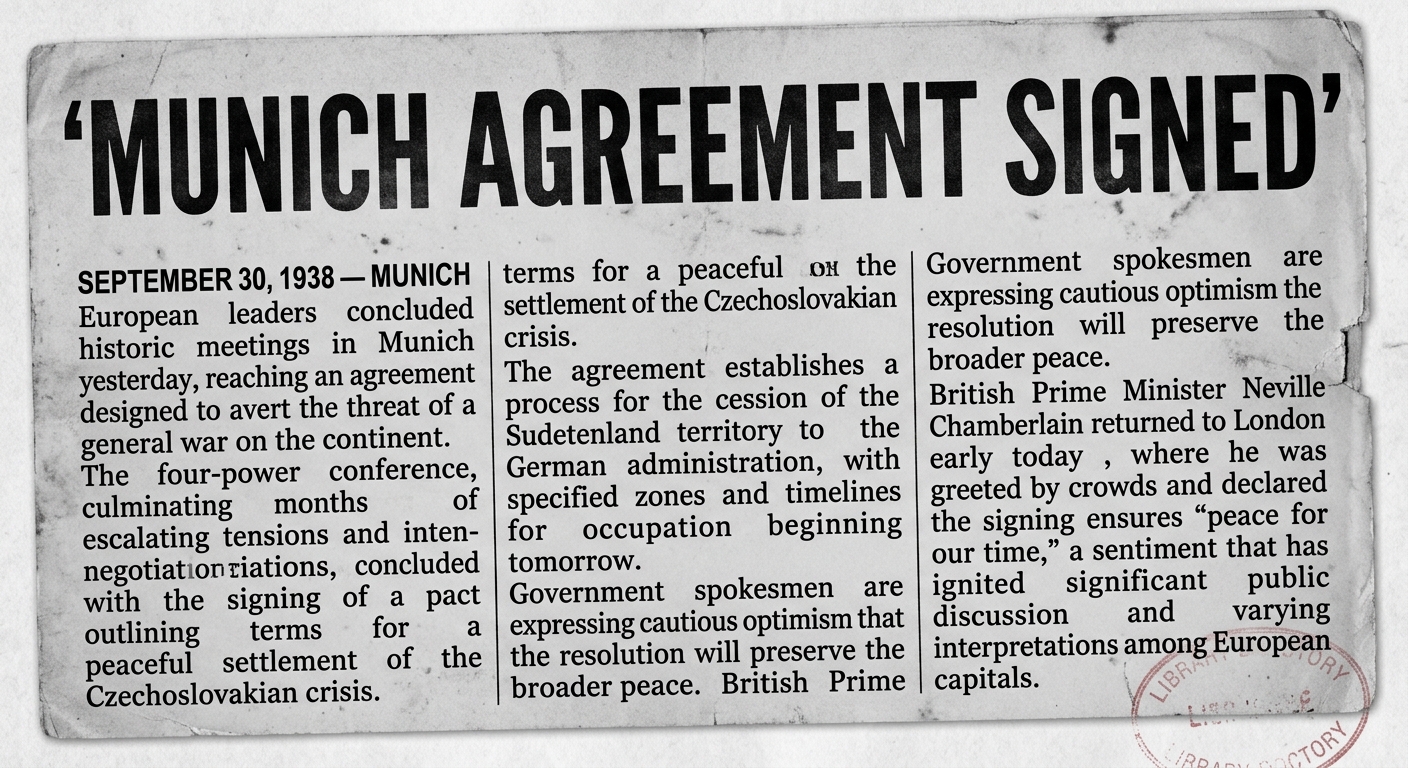
Historical Document:

Newspaper Clipping on the Munich Agreement (Sept. 1938)

Read the note, then examine the clipping. Use the date and the event described to place it within the sequence of events that led to war. Consider what this source suggests about international efforts to prevent conflict and what happened afterward.

Grayscale scan of a 1938 text-only newspaper clipping dated September 30, 1938 about the Munich Agreement and Germany taking the Sudetenland, with paper texture and a faint stamp.

Asemmisa {{asɛmmisaAhyɛnsode}}
6.

Based on the dateline, this document was created MOST likely

Asemmisa {{asɛmmisaAhyɛnsode}}
7.

Explain how the date and content of this document help a historian understand the timeline from international efforts to preserve peace to the outbreak of war in Europe.

Use at least two specific details from the stimulus as evidence.

Asemmisa {{asɛmmisaAhyɛnsode}}
8.

Which later event MOST directly shows that agreements like the one described here did not prevent war in Europe?

Asemmisa {{asɛmmisaAhyɛnsode}}
9.

In 2–3 sentences, describe one reason why this 1938 document would be useful for chronological reasoning and one limitation a historian should keep in mind.

Use evidence from the stimulus.

Asemmisa {{asɛmmisaAhyɛnsode}}
10.

Which claim about the League of Nations is MOST consistent with the sequence suggested by this 1938 document and the outbreak of war that followed?

Historical Document:

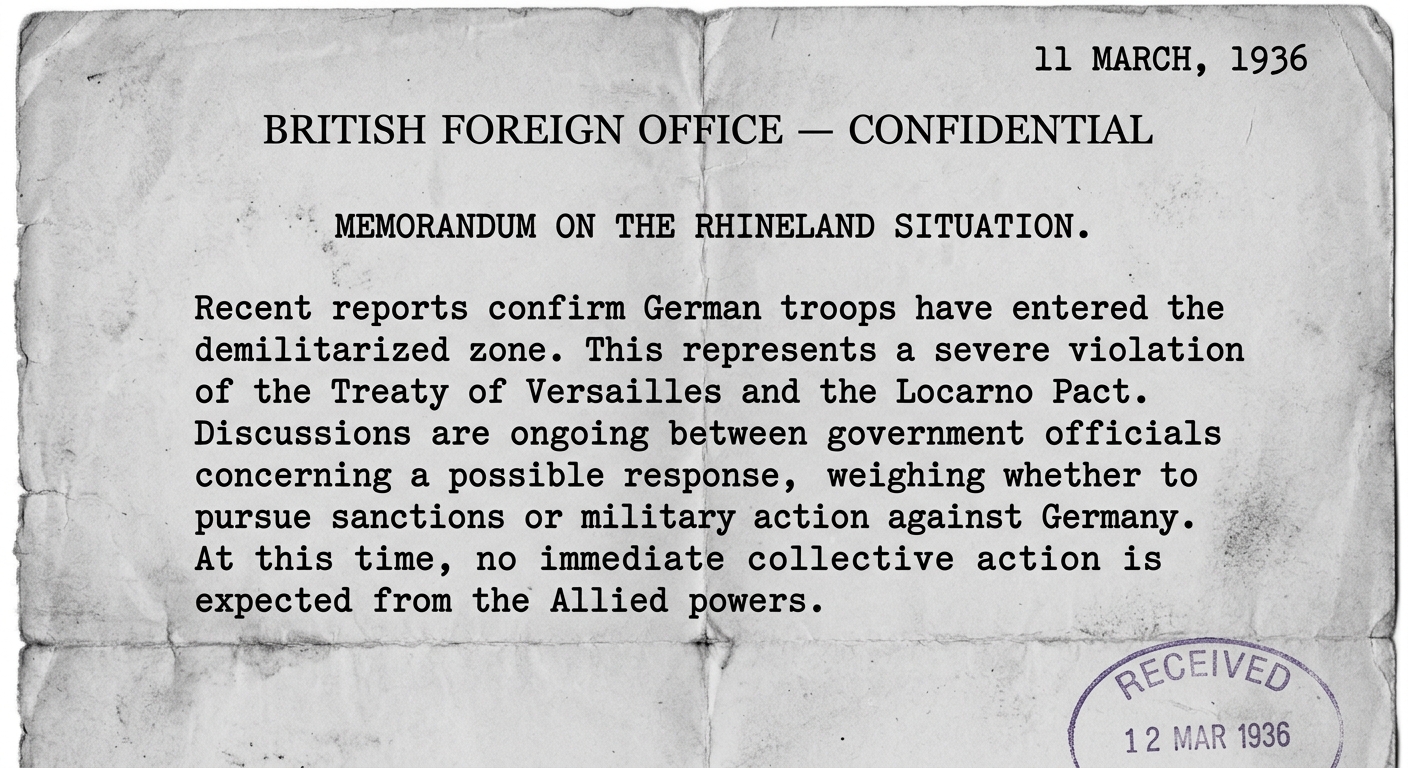
British Foreign Office Memorandum on the Rhineland (March 1936)

Read the note, then examine the memorandum image. This source reflects reactions to German actions in 1936 and debates over how to respond. Use the document to compare international responses to aggression and to place this event in the broader context of weakening efforts to prevent war in Europe.

Grayscale scan-style British Foreign Office confidential memo dated March 1936 about the remilitarization of the Rhineland and debate over how to respond, with a faint stamp and fold marks.

Asemmisa {{asɛmmisaAhyɛnsode}}
11.

Compared with a strong system of collective security, what does this document suggest about the likely impact of hesitant responses to aggression in the 1930s?

Asemmisa {{asɛmmisaAhyɛnsode}}
12.

Which detail from the memorandum would be the BEST evidence that some governments were unsure how to respond to treaty violations?

Asemmisa {{asɛmmisaAhyɛnsode}}
13.

Which statement BEST explains how this 1936 memorandum fits into the broader context (worldwide economic depression, militant nationalism, rise of totalitarian rule)

Asemmisa {{asɛmmisaAhyɛnsode}}
14.

Using evidence from the memorandum and the reading note above it, explain how events like the remilitarization of the Rhineland can be contextualized within the larger pattern of the 1930s that contributed to the outbreak of war.

Use at least two specific pieces of evidence from the stimulus.

Asemmisa {{asɛmmisaAhyɛnsode}}
15.

In 2–3 sentences, compare this document’s evidence about international responses to aggression with what a historian might expect to see in a League of Nations document about sanctions.

Identify one similarity and one difference.

Historical Document:

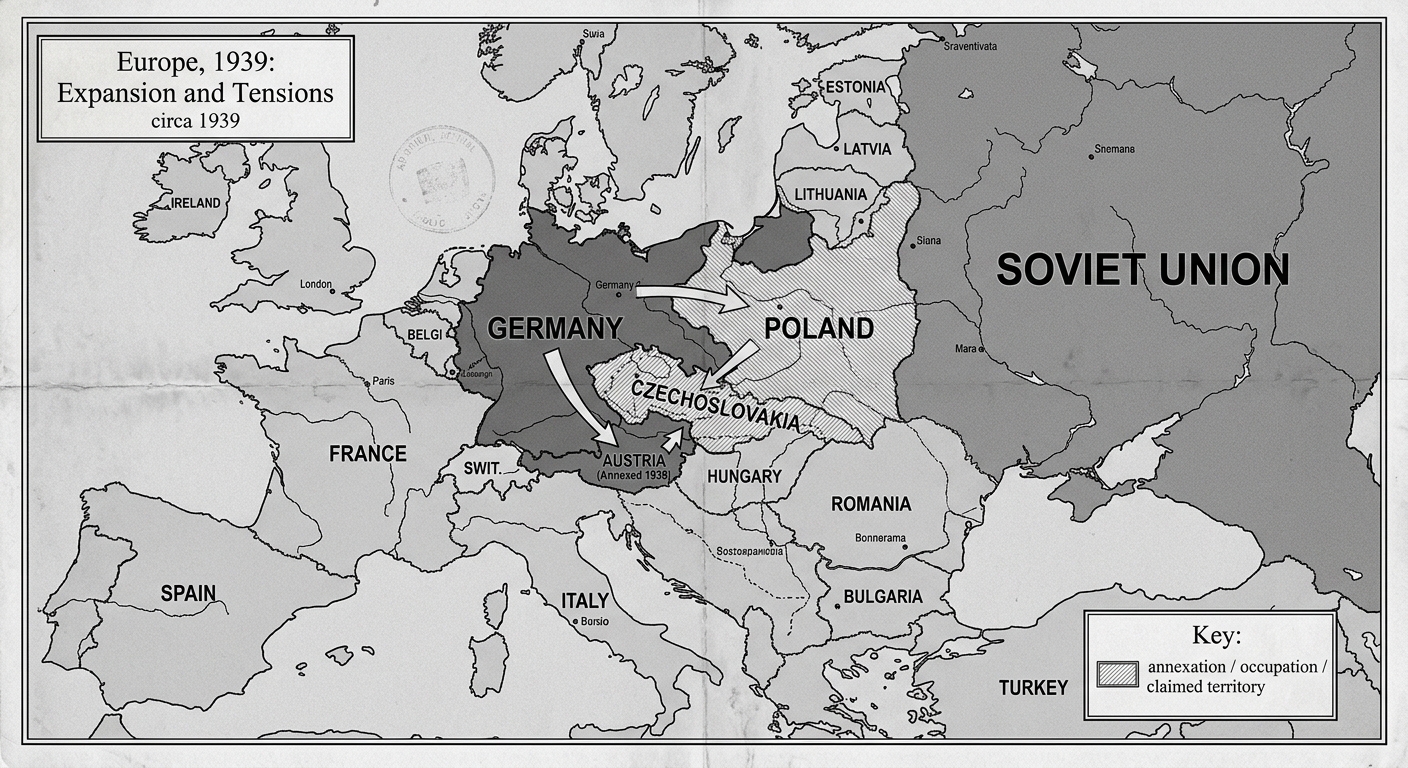
Map—Europe on the Eve of War (1939)

Read the note, then examine the map. It highlights territorial changes and expansion routes in Europe. Use the legend, borders, and arrows to explain how geography shaped tensions and made collective security difficult to enforce in the late 1930s.

Grayscale 1939-style map of Europe with shading for Germany and neighboring countries and arrows showing German expansion into Austria and Czechoslovakia and toward Poland, with a legend.

Asemmisa {{asɛmmisaAhyɛnsode}}
16.

Which claim is MOST consistent with the map about why international efforts to preserve peace weakened in the late 1930s?

Asemmisa {{asɛmmisaAhyɛnsode}}
17.

Based on the map’s arrows and borders, which conclusion is BEST supported about how geography affected the growth of tensions before war?

Asemmisa {{asɛmmisaAhyɛnsode}}
18.

Using evidence from the map and the reading note above it, explain how geographic proximity and changing borders could make collective security harder to enforce in the late 1930s.

Use at least two specific map details (e.g., arrows, borders, legend categories) as evidence.

Asemmisa {{asɛmmisaAhyɛnsode}}
19.

In 2–3 sentences, compare what a political map like this can show about causes of conflict with what a League of Nations memorandum about sanctions might show.

Identify one similarity and one difference.

Asemmisa {{asɛmmisaAhyɛnsode}}
20.

Which map feature would be the BEST evidence that one country’s actions could quickly threaten multiple neighboring states?

Historical Document:

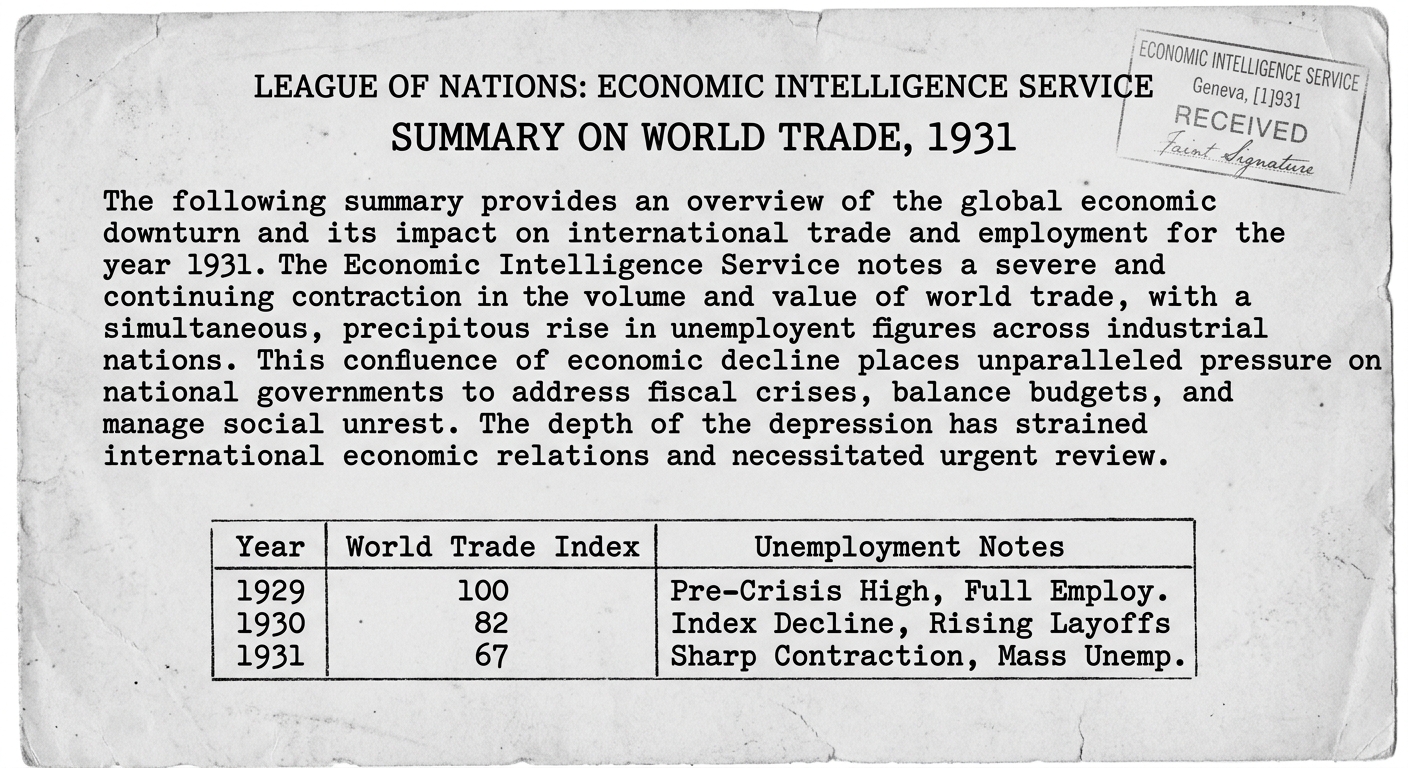
League of Nations Economic Summary on World Trade (1931)

Read the short note below, then examine the document image. This summary reports a sharp decline in world trade and rising unemployment during the worldwide economic depression. Use the table and notes as evidence to explain how economic instability could increase support for extreme policies in the 1930s.

Grayscale scan-style 1931 League of Nations economic summary with a small table showing world trade index falling from 1929 to 1931 and notes about rising unemployment.

Asemmisa {{asɛmmisaAhyɛnsode}}
21.

Which conclusion is BEST supported by the table about the worldwide economic depression?

Asemmisa {{asɛmmisaAhyɛnsode}}
22.

Which piece of evidence from the document BEST supports the idea that governments faced pressure to change economic policies?

Asemmisa {{asɛmmisaAhyɛnsode}}
23.

In 2–3 sentences, compare how an economic summary like this helps explain the causes of war with how a League of Nations document about sanctions might help explain the causes of war.

Identify one similarity and one difference.

Asemmisa {{asɛmmisaAhyɛnsode}}
24.

Using evidence from the table and the reading note above it, explain how changes in trade and employment could influence how governments and citizens viewed economic systems in the 1930s.

Use at least two specific pieces of evidence from the stimulus.

Asemmisa {{asɛmmisaAhyɛnsode}}
25.

Based on the document, which outcome is MOST likely when economic depression deepens and unemployment rises?