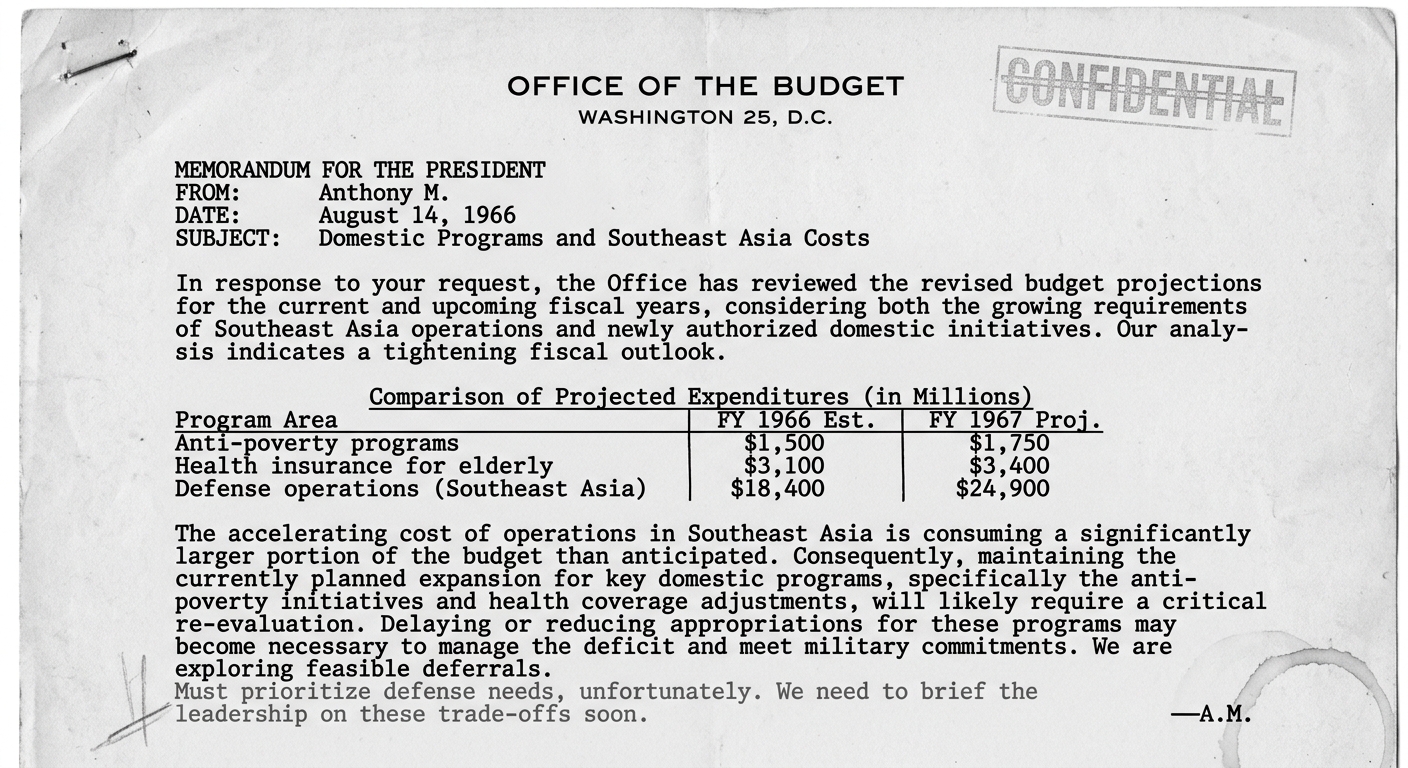
Read the 1966 memo below. It compares funding requests for anti-poverty efforts and health care for older Americans with rising costs of U.S. military operations in Southeast Asia. Use the memo’s wording and numbers as evidence in your answers.
Use the historical document(s) and the short readings in the left panel to answer the associated questions.
Use the historical document(s) and the short readings in the left panel to answer the associated questions.
Read the 1966 memo below. It compares funding requests for anti-poverty efforts and health care for older Americans with rising costs of U.S. military operations in Southeast Asia. Use the memo’s wording and numbers as evidence in your answers.
Which conclusion is best supported by the memo as evidence about tradeoffs in the mid-1960s?
Based on the memo, what is the most reasonable inference about how the Vietnam War affected domestic spending plans?
Explain how the memo provides evidence for the claim
"The Great Society programs of President Lyndon Johnson strengthened efforts aimed at reducing poverty and providing health care for the elderly, but the Vietnam War drained resources and divided society."
In a well-formed paragraph, use at least two specific pieces of evidence from the memo (words, phrases, and/or numbers) to support your explanation.
Using evidence from the memo, describe one likely effect these budget tradeoffs could have had on U.S. society in the 1960s (for example, on support for programs, public debate, or perceptions of government priorities).
Write a well-formed paragraph and cite at least two details from the document.
Which detail from the memo best supports the idea that Great Society programs aimed to reduce poverty or expand health care for the elderly?
Read the dated briefing timeline below (1964–1968). It lists major Great Society actions and expanding U.S. commitments in Southeast Asia. Use the dates and specific entries to support your answers, showing how priorities and resource pressures changed over time.
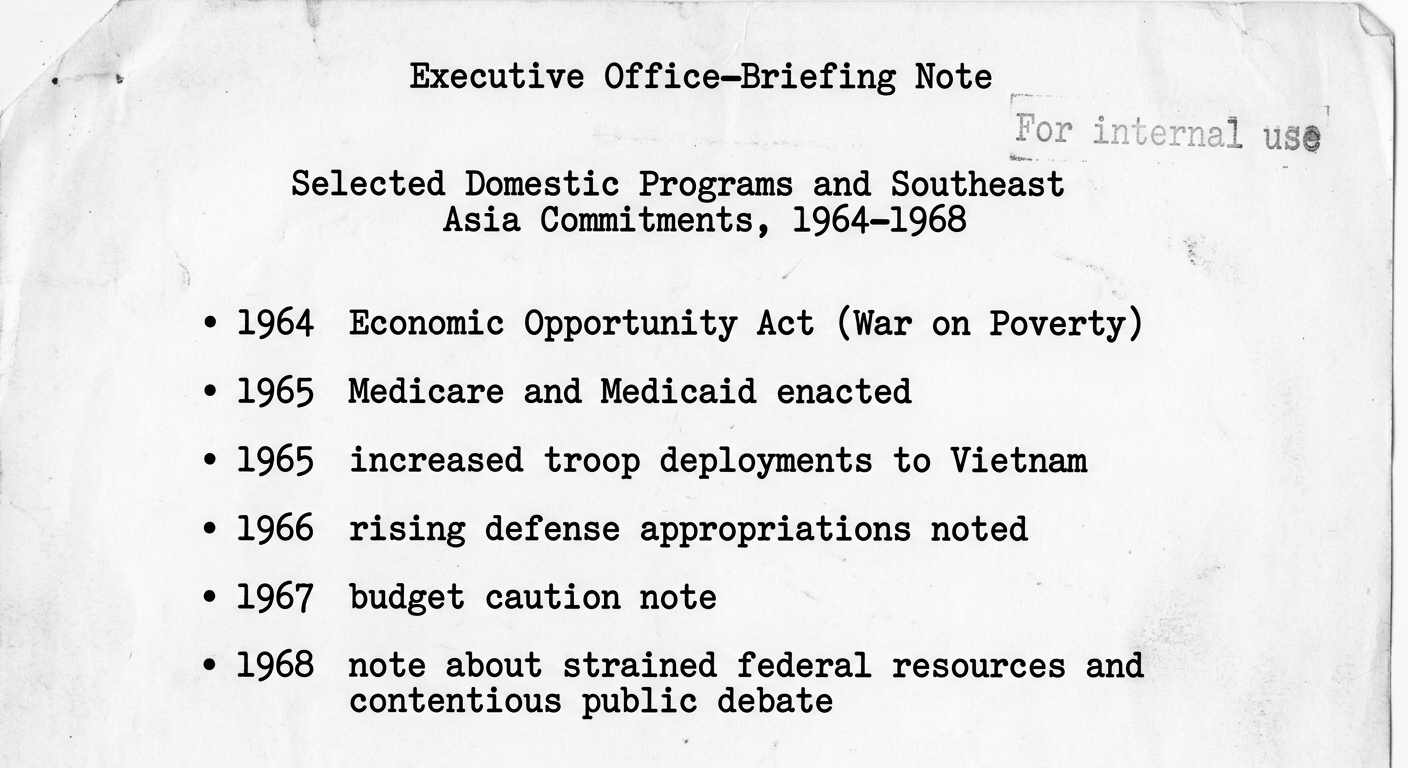
According to the timeline, which event happened first?
Which pair of entries best shows that Great Society programs and the Vietnam War both demanded attention during the same year?
Using evidence from the timeline, describe one way expanding Vietnam War commitments could have affected the pace or scale of Great Society programs between 1965 and 1968.
Write a well-formed paragraph and cite at least two dated details.
Explain how the timeline provides evidence for the claim "The Great Society programs of President Lyndon Johnson strengthened efforts aimed at reducing poverty and providing health care for the elderly, but the Vietnam War drained resources and divided society" by showing change over time.
In a well-formed paragraph, use at least two dated entries from the document as evidence.
Which claim is best supported by the timeline’s sequence of events from 1964 to 1968?
Read the paired excerpts below (1965 and 1967).
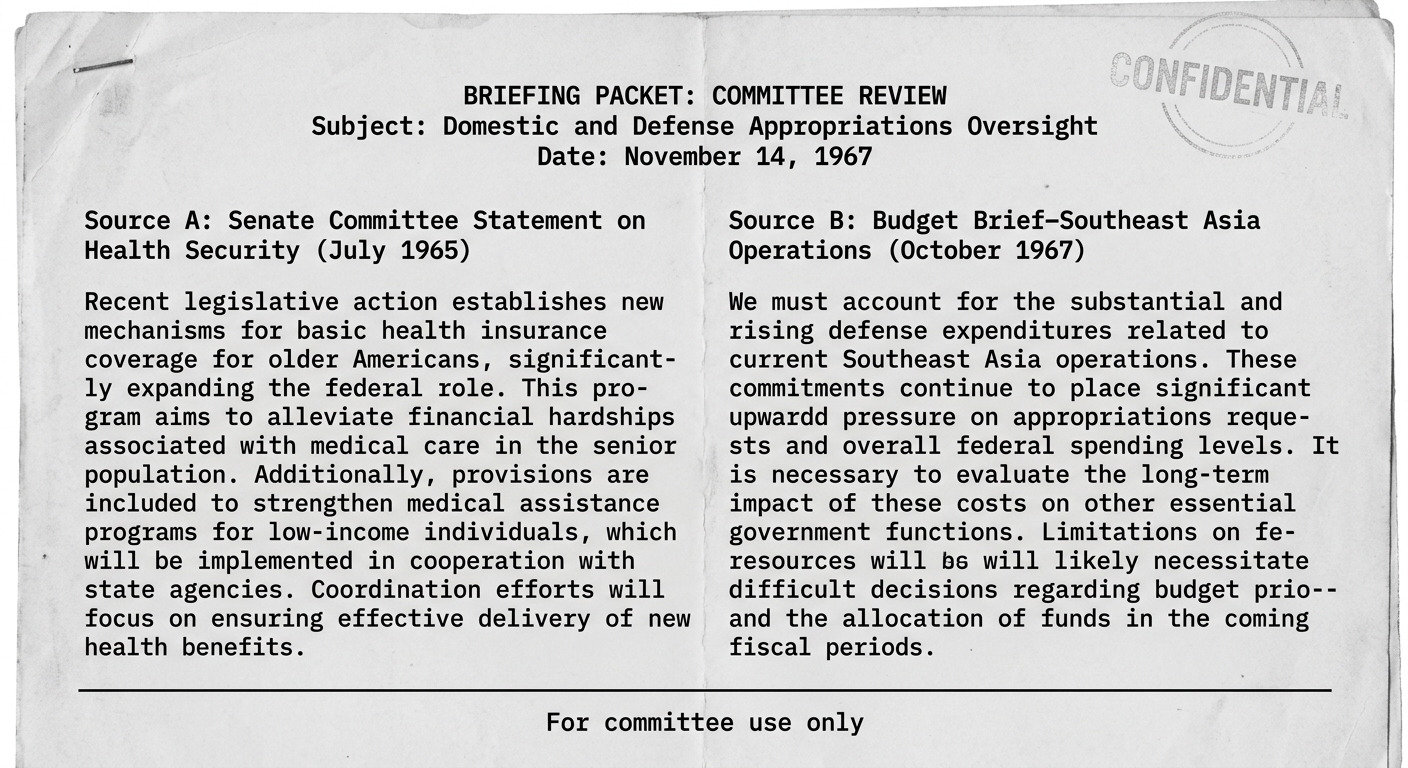
Compare what each source suggests about federal priorities. Use specific words and details from both documents to place them in mid-1960s context, including how domestic programs and Southeast Asia spending could create tradeoffs.
Which statement best contextualizes why these two documents could be produced during the mid-1960s?
In a well-formed paragraph, explain how the mid-1960s context helps explain the relationship between Great Society programs and Vietnam War spending.
Use at least two details from the documents (at least one from each source).
In a well-formed paragraph, compare the priorities shown in Source A and Source B.
Use at least one specific detail from each source as evidence.
Considering both sources together, which claim is best supported?
Which comparison between the two sources is best supported by evidence?
Study the 1967 briefing map below. It uses locations and labels to show domestic Great Society priorities in the United States and overseas military operations in Southeast Asia. Use the legend, place names, and callouts as evidence to explain how geography relates to budget tradeoffs.
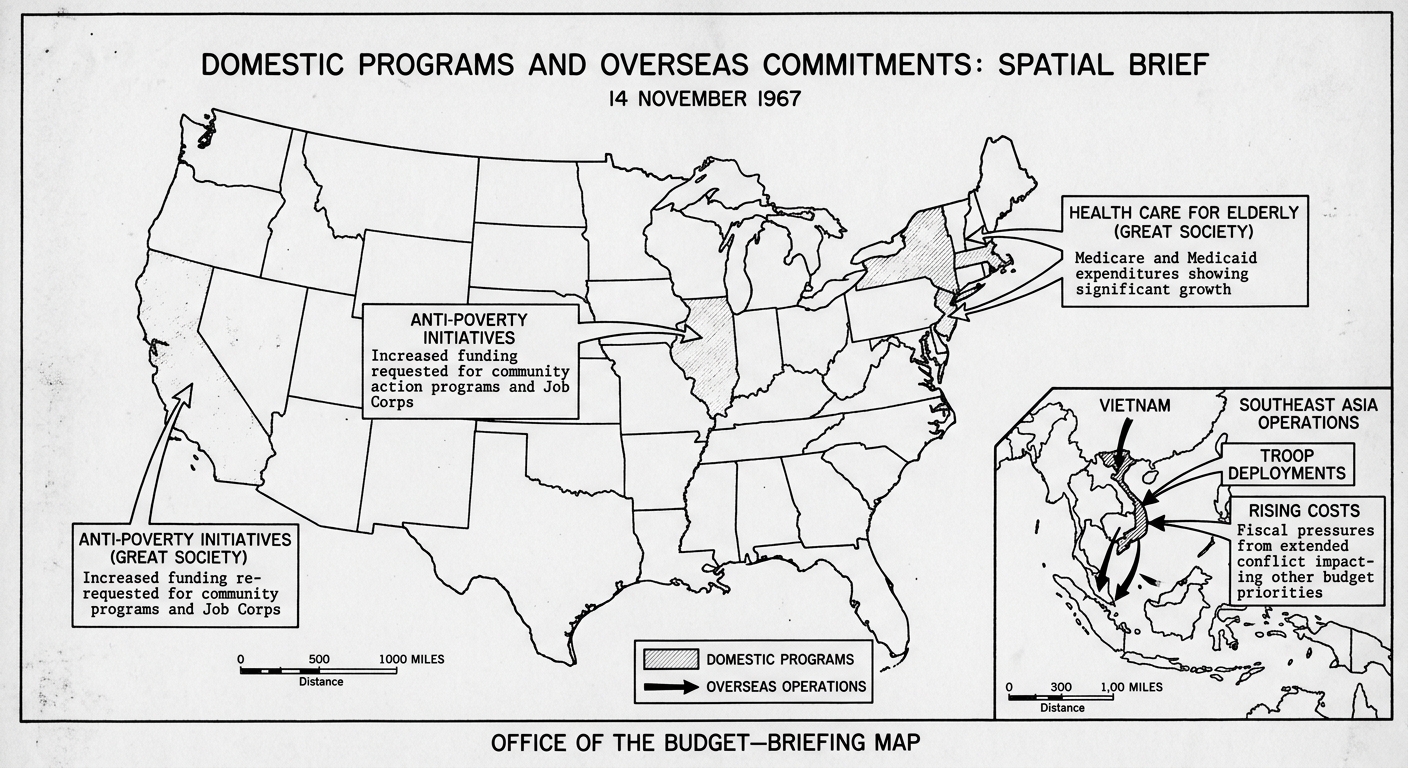
According to the map, which location is most directly connected to U.S. military operations that could drain federal resources?
Explain how the map provides evidence for the claim "The Great Society programs of President Lyndon Johnson strengthened efforts aimed at reducing poverty and providing health care for the elderly, but the Vietnam War drained resources and divided society."
In a well-formed paragraph, use at least two specific map details (locations, labels, legend information, or callouts) as evidence.
Which map detail best supports the idea that war commitments could increase federal costs over time?
Using evidence from the map, describe one way geographic distance between domestic needs and overseas war operations could have contributed to debate or division in U.S. society in the 1960s.
Write a well-formed paragraph and cite at least two map details.
Which inference is best supported by the map’s design (U.S. map plus Southeast Asia inset) and the legend?
Read the 1967 budget briefing sheet below. It lists federal outlays for anti-poverty efforts, health care for older Americans, and defense operations in Southeast Asia over several fiscal years. Use the table’s numbers and notes as evidence to explain economic tradeoffs and opportunity costs.
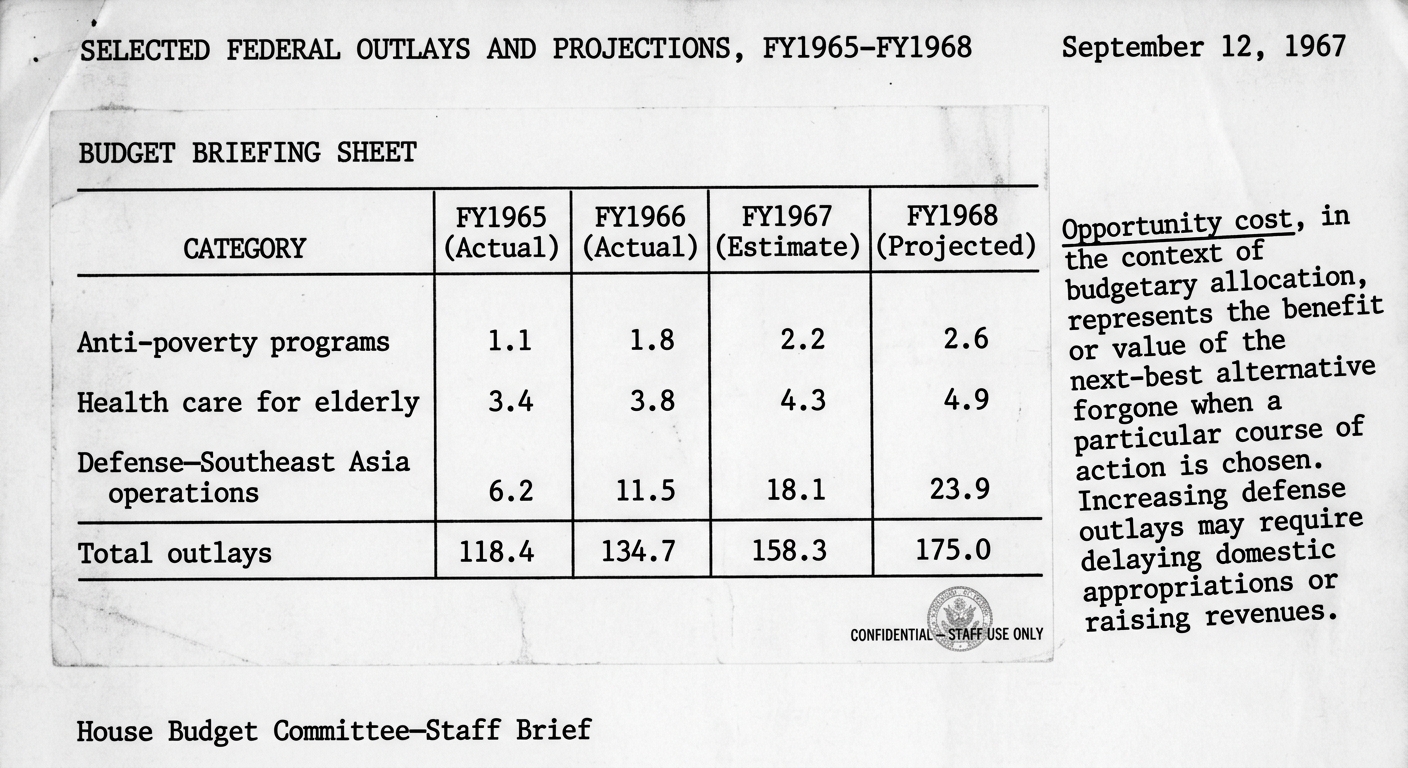
Based on the table, which spending category shows the clearest increase across the fiscal years shown?
Which conclusion about opportunity cost is best supported by the table and the memo note?
If federal revenues did not rise as fast as total outlays in the table, which economic problem would be most likely?
Explain how the budget table provides evidence for the claim
"The Great Society programs of President Lyndon Johnson strengthened efforts aimed at reducing poverty and providing health care for the elderly, but the Vietnam War drained resources and divided society."
In a well-formed paragraph, use at least two specific numbers (or numerical comparisons) from the table and/or notes as evidence.
Using evidence from the table, describe one economic consequence these spending tradeoffs could have for households or communities (for example, taxes, services, or perceptions of government priorities).
Write a well-formed paragraph and cite at least two data details (numbers or trends).