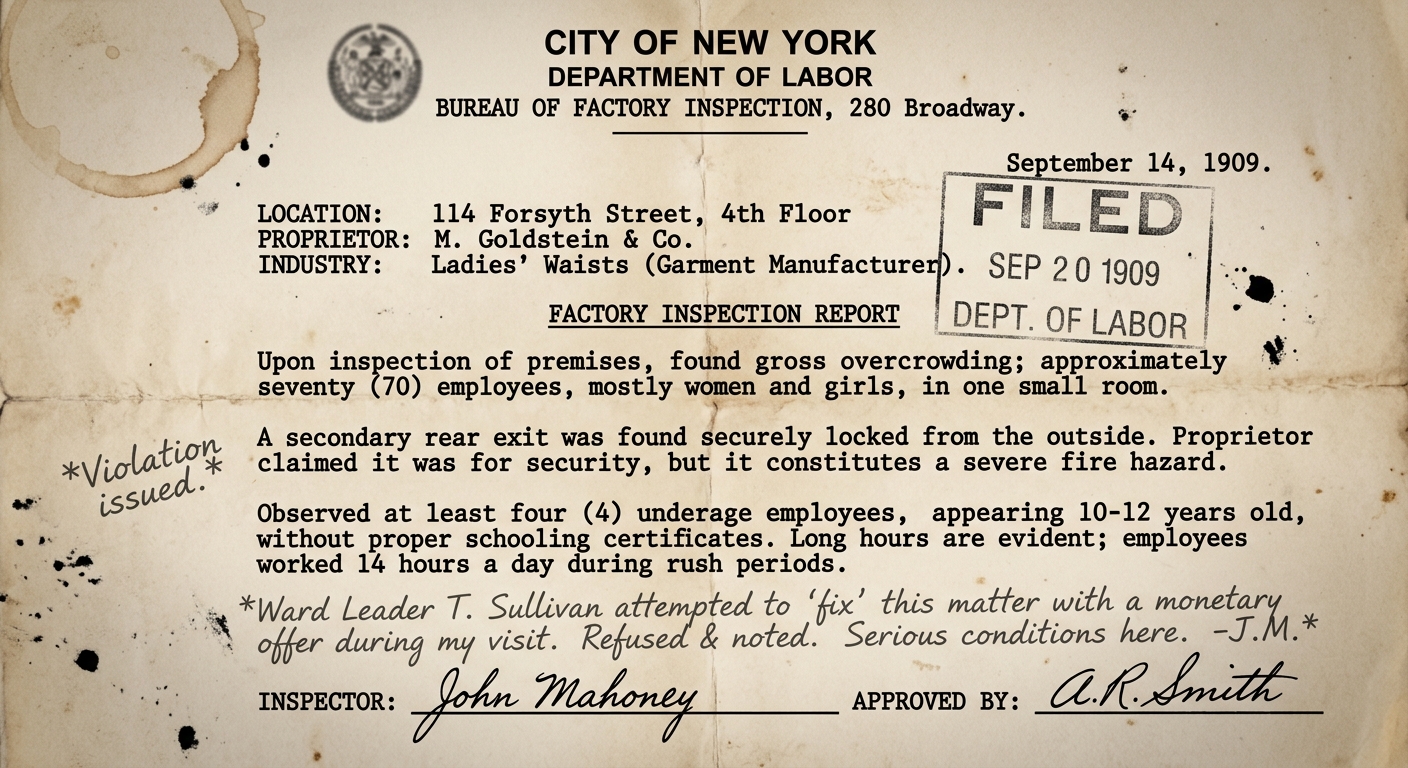
This document is a reconstructed factory inspection report from New York City in 1909. Read the inspector’s notes about working conditions and local politics. Use details from the document as evidence when answering the questions that follow.
Use the historical document(s) and the short readings in the left panel to answer the associated questions.
Use the historical document(s) and the short readings in the left panel to answer the associated questions.
This document is a reconstructed factory inspection report from New York City in 1909. Read the inspector’s notes about working conditions and local politics. Use details from the document as evidence when answering the questions that follow.
Which statement is best supported by the inspector’s observations in the document?
Which detail from the document most directly suggests political corruption connected to urban government?
Explain one way industrialization contributed to changing labor conditions in cities.
Use at least two specific details from the document as evidence.
The inspector records both unsafe conditions and political interference.
Using evidence from the document, describe how these two issues could be connected in an urban industrial setting.
Based on the document, which reform would most directly address the working condition problem described?
This document is a reconstructed New York newspaper clipping dated April 1911. Notice the date, references to earlier complaints, and the announcement of a city hearing. Use these time clues to explain what changed over time in urban industry and why reform efforts gained momentum.
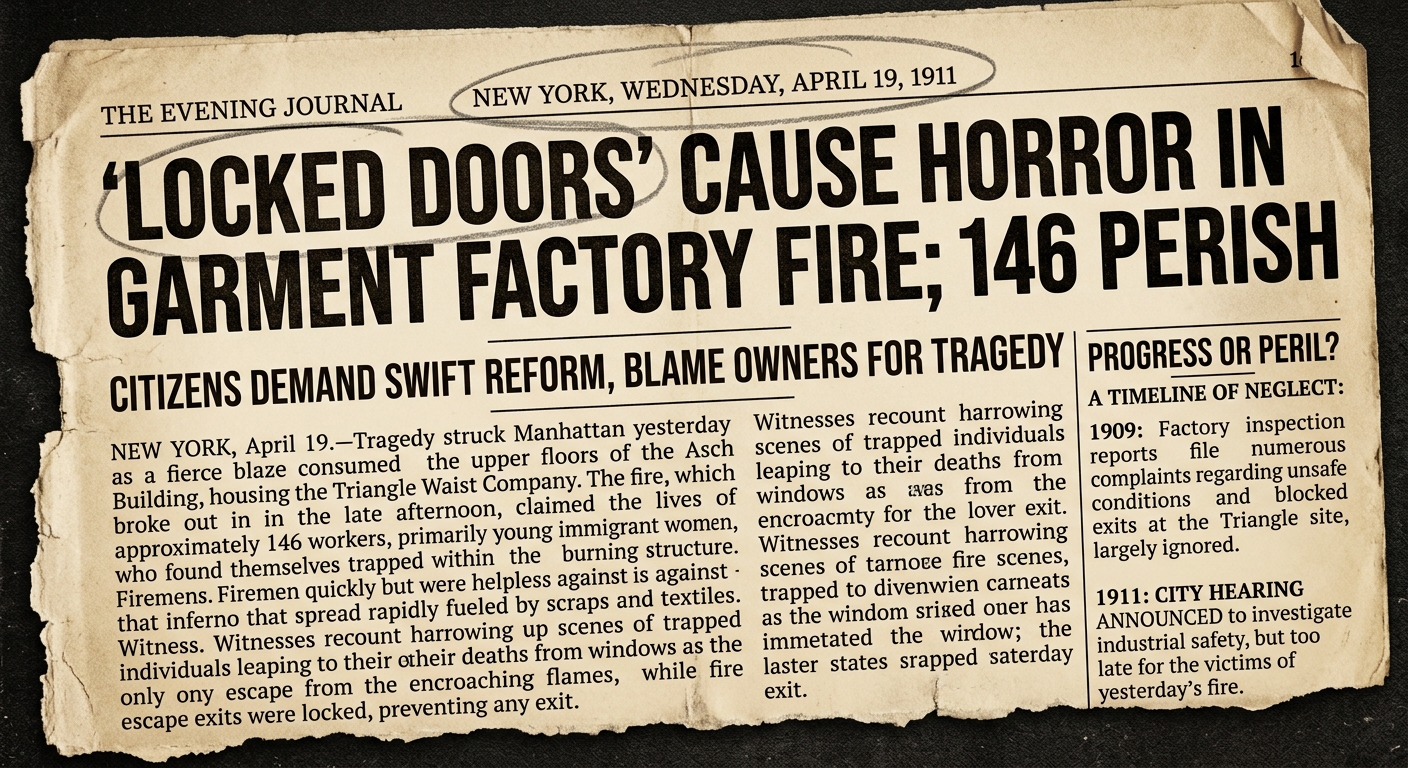
Using chronological reasoning, explain how earlier complaints (1909) and a later crisis (1911) could lead to changes in labor conditions.
Use at least two details from the document as evidence.
Which piece of evidence from the document would be MOST useful for placing this source in a timeline of urban labor reform?
If a city hearing was announced after the 1911 incident, which follow-up action would most logically come NEXT in time?
The sidebar notes “1909: Inspection complaints filed” and the article is dated April 1911. Which statement best describes the sequence of events implied by these details?
Describe one reason political corruption could delay reforms over time in an urban industrial setting.
Then explain what kind of event might eventually force action anyway, using evidence from the document.
This political cartoon was published in a New York newspaper in October 1910. It comments on sweatshop conditions and city politics. Study the labels, the setting, and the caption to compare viewpoints and place the cartoon in the context of industrialization, immigration, and reform debates.
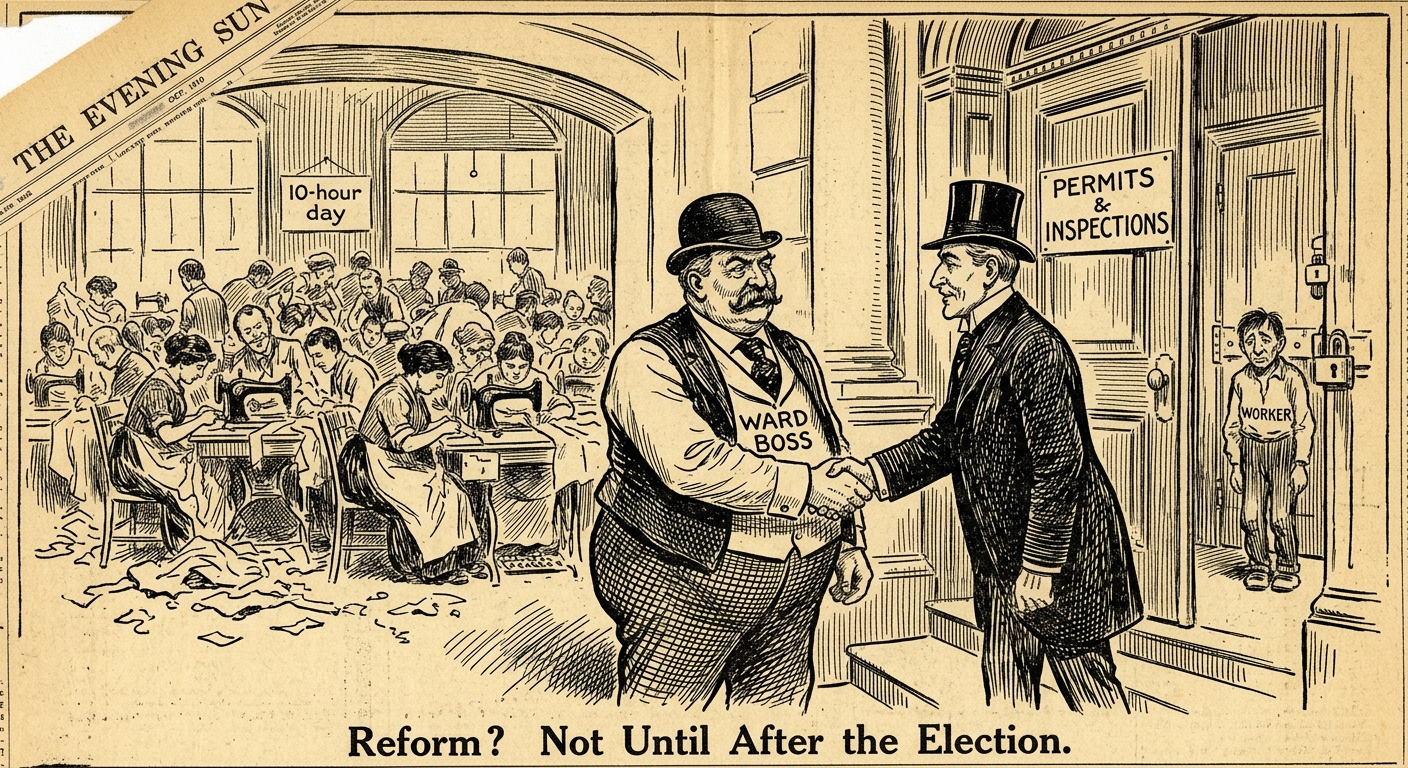
Which detail from the cartoon provides the strongest evidence that political corruption could affect labor conditions?
Which comparison is BEST supported by the cartoon’s labels and setting?
Contextualize the cartoon by explaining how urbanization and industrialization could create the conditions shown.
Then explain why immigration could be connected to these debates.
Use evidence from the cartoon to support your explanation.
Compare the implied perspective of reformers with the implied perspective of political machine leaders in the cartoon.
Use at least two specific details (labels, symbols, or caption) as evidence.
Placed in the context of early-1900s New York City, what issue is the cartoon MOST likely responding to?
This document is a reconstructed 1912 municipal map of New York City showing industrial districts, tenement areas, docks, and political ward boundaries. Use the legend and locations to identify patterns in where people lived and worked, and how geography shaped labor conditions and city politics.
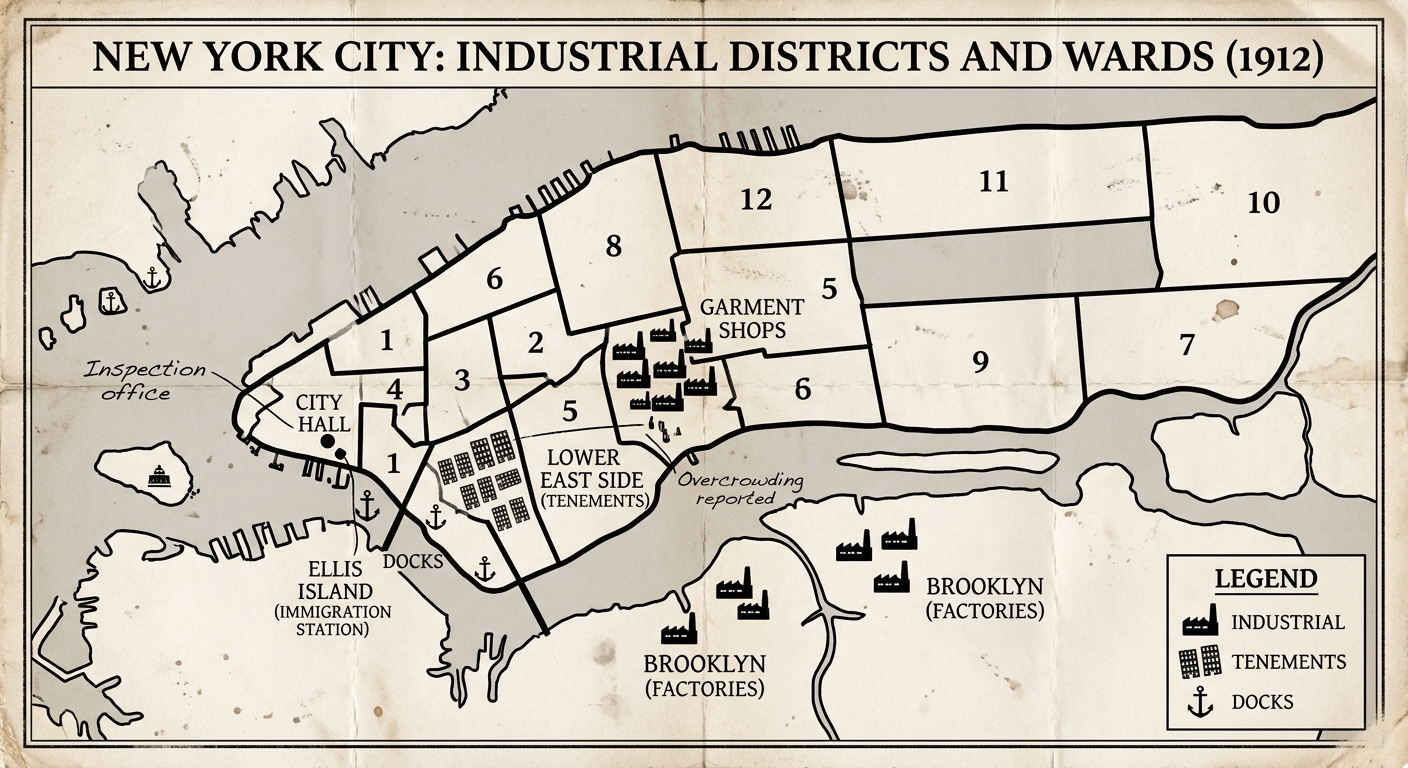
Based on the map, which location would most likely experience conflicts over immigration and jobs during this period?
Compare two areas on the map (for example, a tenement district and an industrial/factory district).
Explain how their locations could lead to different daily experiences for workers. Use at least two specific map details as evidence.
Contextualize the map by explaining how urbanization and industrialization could produce the spatial patterns shown (tenements, factories, docks, ward boundaries).
Then explain one way these patterns could contribute to changes in labor conditions or political reform efforts.
Which map detail most directly helps explain how political corruption could influence labor conditions?
Which statement is BEST supported by the map’s locations of tenement areas and garment shops?
This document is a reconstructed 1910 garment shop payroll ledger from New York City. Use the table (hours, piece rates, deductions, and notes) to analyze how industrial work was organized and paid. Then connect the economic evidence to labor conditions, immigration conflicts, and possible political corruption.
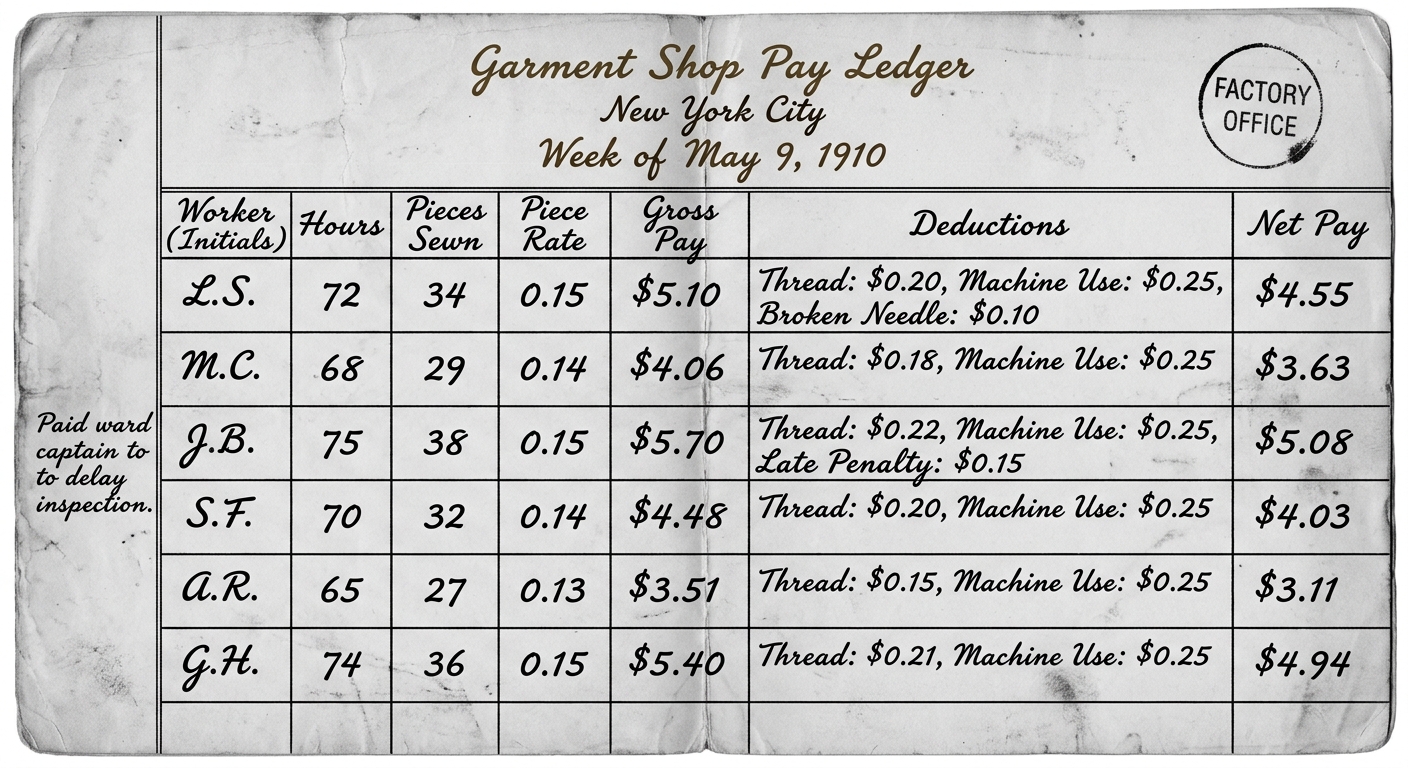
Using economic reasoning, describe one way increased immigration could contribute to conflicts over jobs and wages in cities.
Then connect your explanation to one piece of evidence from the ledger that helps show why workers might demand reform.
Based on the ledger’s wages and deductions, which conclusion is BEST supported about workers’ economic conditions?
Which feature of the pay system shown in the ledger most directly reflects a piece-rate wage system?
Explain one way the pay system shown (piece rates, hours, and deductions) could influence labor conditions in an industrial city. Use at least two specific details from the ledger as evidence.
Which detail from the document most directly suggests that political corruption could affect economic outcomes in the workplace?