1
1
1
1
1
1
1
1
Hiddenite is a pale green gemstone that was first discovered in North Carolina in 1879. The community in which hiddenite was found, called White Plains at the time, is near Stony Point in Alexander County. White Plains has since been formed into a town named Hiddenite. The gemstone takes its name from William Earl Hidden, a mineralogist hired by Thomas Edison to search the area for platinum. He did not find platinum, but he did send a piece of the unknown mineral to a skilled chemist. The chemist eventually identified the gemstone as a type of crystal and named the new discovery after the man who sent him the sample.
What was the original name of the community in which hiddenite was found?
What does sample mean in the sentence below from the text?
“The chemist eventually identified the gemstone as a type of crystal and named the new discovery after the man who sent him the sample.”
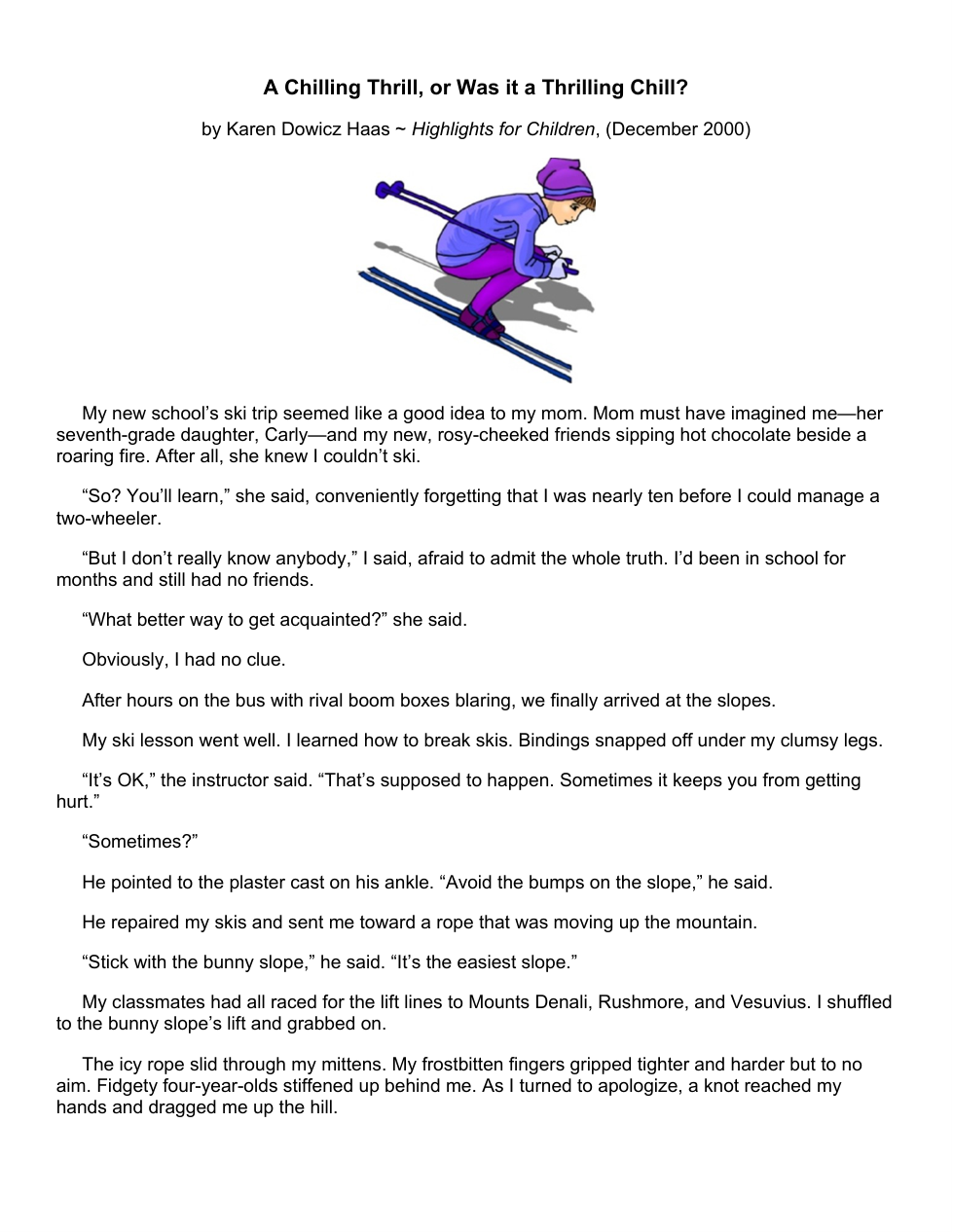 A Chilling Thrill
Or Was It A Thrilling Chill?
by Karen Dowicz Haas
 It’s a Chick, Not a Dog
by Jar al-Nabi al-Hilw
Translated from Arabic by Marilyn Booth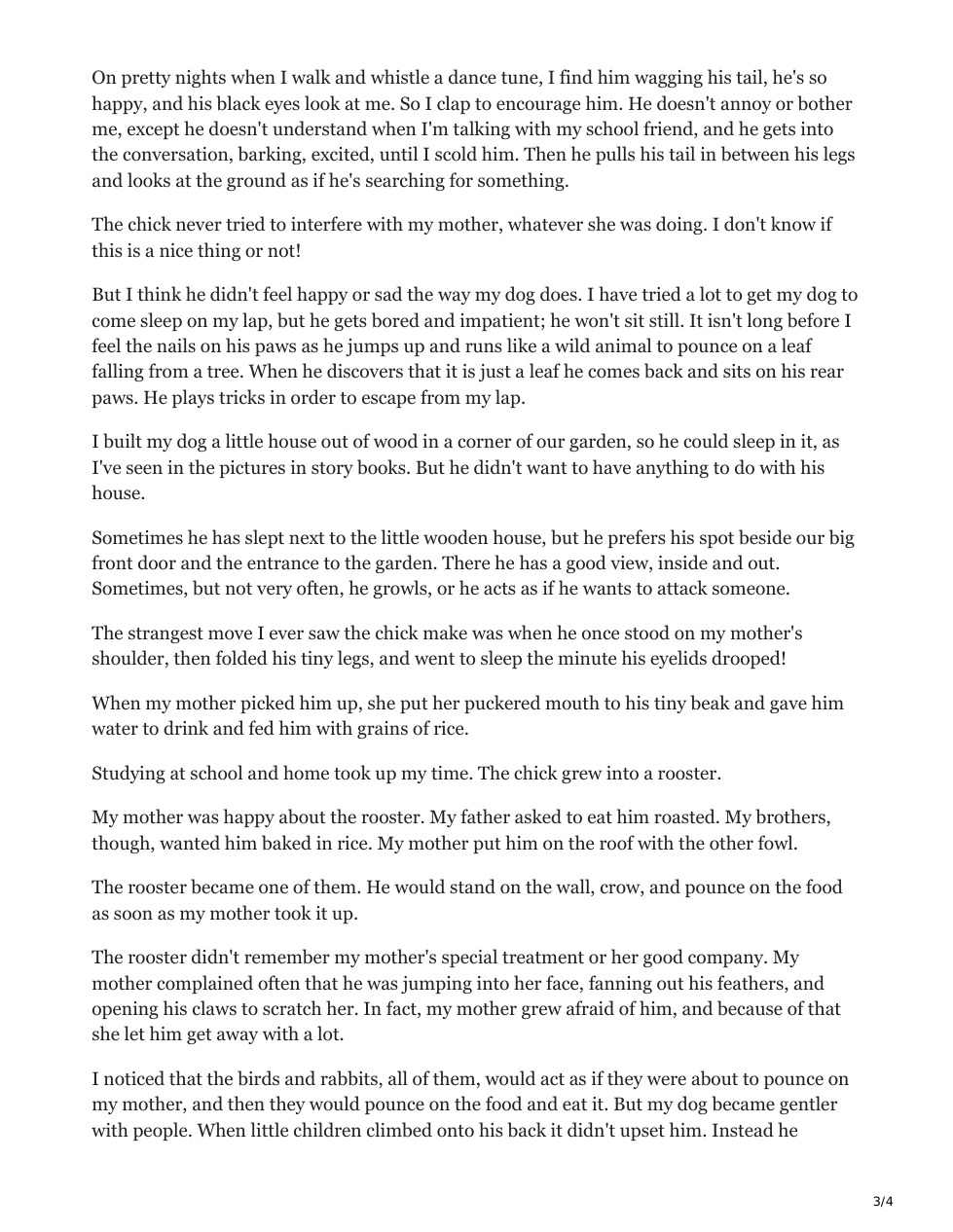
GRADE 6 READING—RELEASED ITEMS
by Carolyn Wells
A Spider and a Centipede went out to take a walk;
The Centipede said frankly, “I will listen while you talk,
But I may appear distracted, or assume a vacant stare,
Because to keep my feet in step requires my constant care.”
5
Said the Spider: “I appreciate your most peculiar case,
And your feet must be quite handy when you want to run a race;
But though you gain in some ways, in some other ways you lose;
And, of course, my friend, you must be quite extravagant in shoes.”
“Ah! yes. Ah! yes,” a heavy sigh escaped the Centipede;
“And I have other trials, too;—my life is hard indeed!
Why, sometimes when I’m very tired, a long, long time it takes
To ascertain1 with certainty which foot it is that aches.
10
“And when I go to dancing-class on Saturdays at three,
I find the First Position very difficult for me.
Though I put my best foot foremost, and good time I try to keep,
To my chagrin,2 I often find a foot or two asleep.
Athletics I attempted, but, alas! I must admit
That every exercise I tried I put my foot in it.
I think I’ll join a foot-ball team,—as many friends suggest,—
Before I’ve one foot in the grave and gout in all the rest.
20
But now I’ll say good-morning; for, my friend, I have to stop
To get my boots blacked neatly at this little boot-black’s shop;
And, as you may imagine, it will keep me here some time,
But, what is worse, I’ll have to pay him many a hard-earned dime.”
The Spider said good-morning, and pursued his way alone,
And as he went he murmured, in a thoughtful undertone:
“I’m a happy little Spider, and I’m very glad indeed,
That I was born an octoped and not a centiped!”
25
1ascertain: to understand
2chagrin: a feeling of disappointment

In "The Two Friends," the Centipede describes having many feet as both a blessing and a burden. Using at least two pieces of evidence from the poem, explain how the poet develops this idea. Be sure to use specific details or quotes from the text to support your answer.
Based on paragraphs 1 and 9, why do people still use the saying, “I want the real McCoy”?
What can be inferred from the information in paragraph 2?
What does the author mean when he says that the North American West “was built by the railroads” in paragraph 2?
What does apprentice mean, as used in paragraph 3?
How does paragraph 5 contribute to the idea that McCoy saw a need for improvement in lubricating engine parts?
What inference can be made about Elijah McCoy’s second lubricator as compared to the first?
What does the phrase “the real McCoy” mean, based on paragraph 9?
Which quote supports the idea that Elijah McCoy liked to share his talents with others?
What is the central idea the author is conveying in the text?
What was the author trying to convey by quoting Wikipedia’s own statement that some of its content was “complete rubbish” in paragraph 1?
What does the word skeptical mean in paragraph 3?
Why is it important to confirm information through multiple resources?
What does the word fabricated mean in paragraph 8?
How does paragraph 9 explain one of the major problems with Wikipedia’s articles?

According to paragraphs 17 and 18, what are deletionists?
Why does Wikipedia state that their articles are not “primary sources”?
Which detail supports the central idea of the text?
Which statement answers why MIT conducted the research study of concrete?
Which quote from the text suggests the future of concrete?
What is the meaning of the word innovative in the sentence below from paragraph 28?
“Their inventive phase will undoubtedly lead to a compelling innovative phase far from the Cambridge-based campus.”
Which is a possible drawback of the use of green concrete?
What is the impact of the author’s use of questions in paragraph 29?
What was the author’s purpose for writing this text?
Which statement summarizes this text?
Which theme is found in this selection?
What does paragraph 3 reveal about the relationship between the narrator and her mother?
How does the author’s choice of words in paragraph 9 affect the meaning of the text?
Which of the statements made by the narrator shows that she knows little about skiing?
What is the effect of using the word humiliating instead of the word embarrassing in paragraph 22?
What does the word maneuvering mean in paragraph 25?
Which statement below is evidence that Carly was glad she went on the ski trip with her school?
Which quote supports the theme of intelligence in animals?
What does the narrator mean in paragraph 2?
Which sentence contributes to the development of the setting?
How do paragraphs 32–34 contribute to the plot?
What is the mother indicating in paragraph 35?
How does the mother’s attitude change from the beginning to the end of the selection?
Why did the dog respond differently to the family than the chick did?
Which statement summarizes the selection?
Which quote suggests a theme of contentment?
Which quote suggests that the Centipede wants to benefit from having so many feet?
What does the figurative language mean in line 20?
“Before I’ve one foot in the grave and gout in all the rest.”
How do the Spider’s words in the final stanza relate to the rest of the poem?
How does the poet develop the point of view of the Spider?