According to the graph, about how many grams of KBr are needed to make a saturated soultion in 100 g of water at 30° C?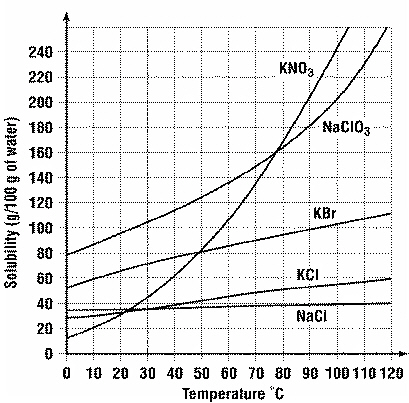
According to the graph, about how many grams of KBr are needed to make a saturated soultion in 100 g of water at 30° C? |
What type of solution contains all of the solute it can hold at a given temperature?
What type of solution contains less solute than it is able to hold at a given temperature?
If two liquids are soluble in each other, they are said to be _____.
What type of solution contains more solute than it can hold at a given temperature?
In a solution, the substance that is being dissolved is the ____. |
The substance in a solution that dissolves another substance is called ___. |
Does increasing temperature generally increase the solubility of a solid solute in a solvent?
What is the effect on the rate of solution if the surface area of a solid is increased?
What factors will increase the solubility of a gas in a liquid? Pick two.
According to the graph, about how many grams of KBr are needed to make a saturated soultion in 100 g of water at 30° C? |
According to the graph, which salt is more soluble in water KCl or KBr?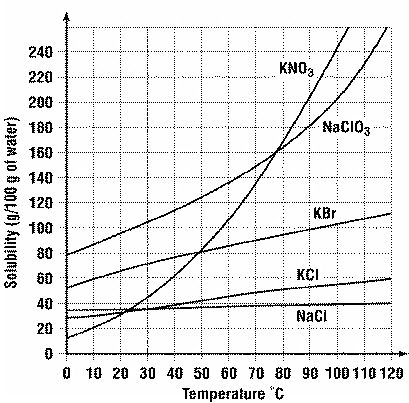
According to the graph at what temperature is the solubility of KBr the same as KNO3?
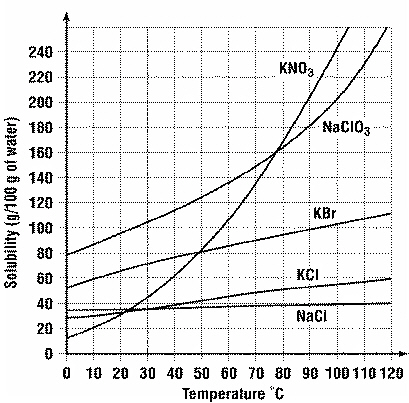
According to the graph, what kind of solution would you have if you dissolved 10 g of KCl in 100 g of water at 0°C?
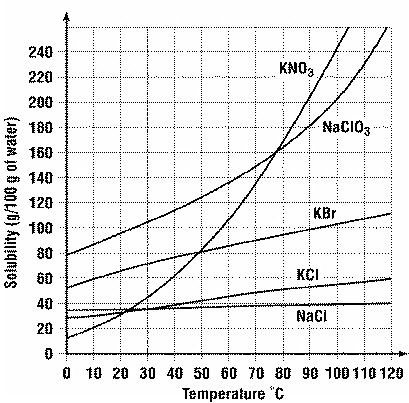
According to the graph, which of the following substance’s solubility increases the least as temperature goes up?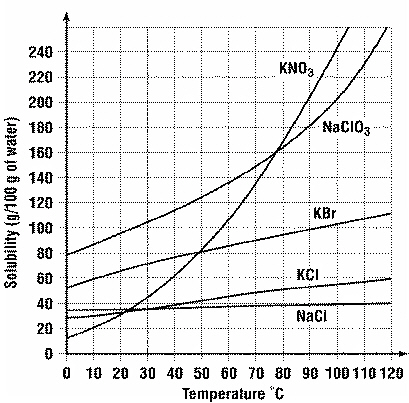
According to the graph, how many grams of KCl wil form a saturated solution in 375g of water at 80°C?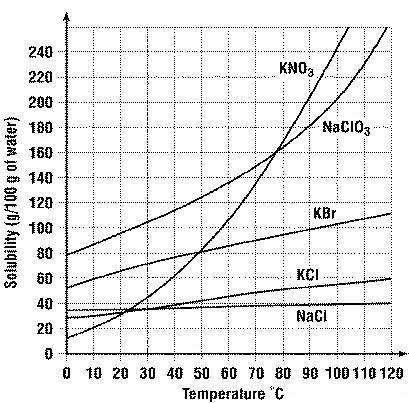
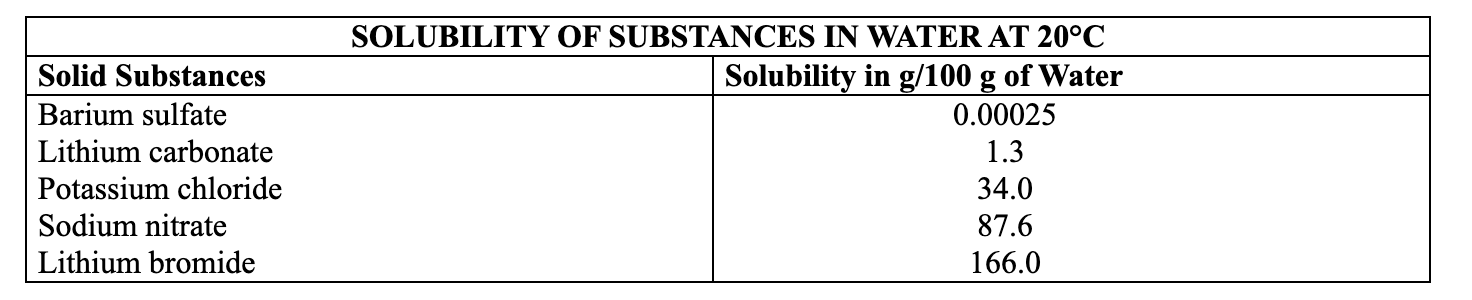
According to the chart, what type of solution would you have if 1.5 g of lithium carbonate is dissolved in 100 g of water at 20 °C?
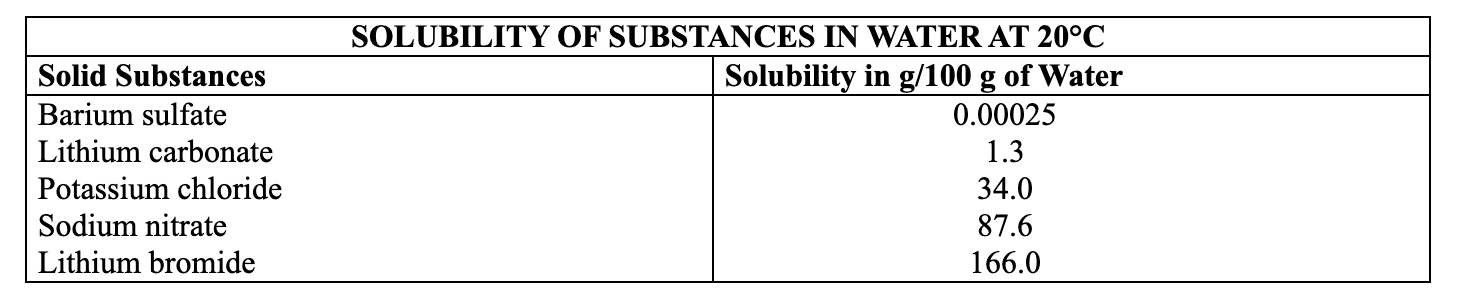
According to the chart, what type of solution would you have if 166.0 g of lithium bromide is dissolved in 100 g of water at 20 °C?
A mixture with particles that will settle out if left undisturbed is a(n) ___.
Since nitric acid is a ____ acid, it ionizes completely in solution
The negative logarithm of the hydrogen ion concentration is ___.
A solution in which the solvent is water is called ___.
What term refers to the ease with which an acid or base forms ions in solution?
What type of solution contains more hydrogen ions than it does hydroxide ions?
A solution is made by dissolving 17.0 g of Lithium iodide in enough water to make 500.0 mL of solution. What is the molarity of the solution?
A ___ solution contains more hydroxide ions that it does hydrogen ions. |
Given: H2O, NaOH, HC2H3O2, Mg(OH)2 or CH4, choose the strong base.
What will increase the reaction rate?
What volume of oxygen is needed to completely combust 2.36 L of methane gas (CH4)?
The substances produced when potassium hydroxide neutralizes hydrochloric acid are
The following reaction : 2Hg + O2 → 2HgO can be classified as what type of reaction?
Given the following combustion reaction of the hydrocarbon, Ethylacetylene (C4H6) , balance the equation and determine the coefficient of H2O.
| In the reaction between hydrochloric acid and potassium hydroxide, how many grams of water are produced if 3.000 moles of HCl are used? |
____________ are the products of a neutralization reaction between a strong acid & a strong base.
| In the reaction 2Na + Cl2 --> 2NaCl, how many grams of sodium chloride can be produced from 120.0 g of sodium in the presence of excess chlorine? |
One in a series of reactions that inflates airbags in automobiles is the decomposition of sodium azide (NaN3). |
What is the coefficient that belongs in front of carbon dioxide in the equation?
____C3H8 + ___O2 --> ____CO2 + ___H2O
What is the correct molar mass of calcium hydroxide?
The following reaction is an example of which type of reaction?
AgNO3(aq) + NaCl (aq) --> AgCl(s) + NaNO3(aq)
What is the formula mass of ammonium phosphate?
Coffee has a pH of about 5. Coffee is ____.
The molar mass of CO2 is 44 g/mol. How many moles are present in 110 g?
What is the molarity of an aqueous solution containing 40.0 g of glucose (C6H12O6) in 1.5 L of solution?
The molar mass of H2O is 18.015 g/mol. How many moles of water are present in 3.6 g?
The molar mass of NH3 is 17.0 g/mol. How many grams of NH3 are present in 3.50 moles?
What is the molarity of an aqueous solution containing 14.2 g of NaCl dissolved in 2000 mL of solution?
What are the coefficients to correctly balance the formula equation
Pb(NO3)2 (aq) + KI (aq) --> PbI2 (s) + KNO3(aq)
What are the coefficients to correctly balance the formula equation
AlCl3(aq) + Pb(NO3)2(aq) --> PbCl2(s) + Al(NO3)3(aq)
What is the balanced equation when aluminum reacts with copper(II)sulfate?
A container of gas at 550.0 mm Hg and 35.0°C is heated to 60.0°C. What is the new pressure in mm Hg? |
A container of gas at 760.0 mm Hg and 20.0°C is heated to 40.0°C. What is the new pressure in mm Hg?
A gas at 740.0 mm Hg pressure at 25.0 °C is cooled to –10.0 °C. What is the final pressure in mm Hg?
A gas at 925.0 mm Hg pressure at 50.00 °C is cooled to –25.00 °C. What is the final pressure in mm Hg?
Which expression represents the pH of a solution?
A sample of ammonia gas occupies a volume of 1.58 L at 22.0o C and a pressure of 0.983 atm. What volume will the sample occupy at 1.00 atm and 0 oC?
A sample of ammonia gas occupies a volume of 27.4 L at 14.0o C and a pressure of 1.20 atm. What volume will the sample occupy at 3.00 atm and 0 oC?
A sample of gas at 1.50 atm and 4.0 L is compressed to 2.5 L at a constant temperature. What is the new pressure?
A sample of gas at 2.50 atm and 6.50 L is compressed to 1.50L at a constant temperature. What is the new pressure?
____ change color in the presence of an acid or a base.
The formula for the products between sodium hydroxide and sulfuric acid are ___.
A sample of gas at 255 K occupies a volume of 1.55 L. If the temperature is raised to 298 K what will be the new volume?
A sample of gas at 313 K occupies a volume of 2.32 L. If the temperature is raised to 348 K what will be the new volume?
If 50.0 ml of a 0.500 M solution of HCl is diluted to 150.0 ml, what will the final molarity be?
A sample of sulfur dioxide gas has a volume of 1.16 L at a temperature of 23o C. At what temperature will the gas have a volume of 1.25 L?
A sample of sulfur dioxide gas has a volume of 9.50 L at a temperature of 320K. At what temperature will the gas have a volume of 2.55 L? |
What would the final volume of a solution be if 5.0 mL of a 0.040 M stock solution is diluted to 0.030 M?
A student collects 285 mL of oxygen gas at a temperature of 15.0°C and a pressure of 99.9 kPa. The next day the sample occupies 292 mL at a temperature of 11.0o C, What is the new pressure of the gas?
What explains the solubility of ionic substances in water?
What type of reaction is shown in the following chemical equation: 2H2O --> 2H2 + O2?
A student collects 355 mL of oxygen gas at a temperature of 27°C and a pressure of 127 kPa. The next day the sample occupies 257 mL at a temperature of 17o C, What is the new pressure of the gas?
A chemist is having some difficulty getting a yellow crystalline solid compound to dissolve in water. What strategy might she employ to increase the solubility of the solid?
Calculate the volume that a 0.323-mol sample of a gas will occupy at 265 K and a pressure of 0.900 atm.
A student pours a sample of a clear liquid – whose identify is unknown – into a test tube of water. The water and the liquid form two distinct layers, with the unknown on the bottom. What is true of the system?
| Determine the Kelvin temperature required for 0.0470 mole of gas to fill a balloon to 1.20 L under 0.988 atm pressure. |
Weak acids and bases produce what type of ions in solution?
Determine the temperature of 2.49 moles of gas contained in a 2.00L vessel at a pressure of 1.41 atm.
What is the final pressure in atm, if 10.0 L of gas at 25.0°C and 1.00 atm pressure is compressed to 2.00 L at 323°C?
KClO3 + C12H22O11 --> KCl + CO2 + H2O
If 3.0 moles of potassium chlorate are used, how many moles of water would be produced?
A substance that speeds up a chemical reaction without being permanently changed itself is a(n) ____. |
What is the final pressure in atm, if 5.25 L of gas at 75.0°C and 1.33 atm pressure is compressed to 2.75 L at 155 °C?
What is the pressure in atmospheres of a 0.108 mole sample of helium gas at a temperature of 20.0°C if its volume is 0.505 L?
KClO3 + C12H22O11 --> KCl + CO2 + H2O
If 25.0 g of carbon dioxide are produced, how many grams of sugar (C12H22O11) were used?
What pressure will be needed to change the volume of 22.4 L of helium at 25.0 kPa to a volume of 85.0L?
What pressure will be needed to reduce the volume of 77.4 L of helium at 98.0 kPa to a volume of 60.0L?
You have 200.0 cm3 of nitrogen (IV) oxide at a temperature of 303.0 K and a pressure of 101.0 kPa. What volume will the NO2 occupy at 255.0 kPa and 371.0 K?
The temperature of a sample of water increases from 20.0°C to 46.6°C as it absorbs 5650 J of heat. What is the mass of the sample? The specific heat of water is 4.18 J/g°C.
What is the percentage of oxygen in barium chromate?
KClO3 + C12H22O11 --> 8 KCl + CO2 + H2O |
You have 422.0 cm3 of nitrogen (IV) oxide at a temperature of 295.15 K and a pressure of 101.325 kPa. What volume will the NO2 occupy at 155.00 kPa and 317.15 K?
A substance that slows down a chemical process is called what?
KClO3 + C12H22O11 --> KCl + CO2 + H2O
How many moles of potassium chlorate are required to produce 18.0 g of water?
What happens to the rate of a reaction if the temperature is lowered?
What is the minimum energy required for an effective collision called?
What is a reaction in which oxygen combines with a substance and releases heat and light known as?
What is the primary reason that an increase in temperature results in an increase in reaction rates?
Ammonia (NH3) is used to make fertilizer. If you have 2.00 x 10 3g of N2 how many grams of ammonia can be produced?
N2 + 3H2 --> 2NH3
What are the coefficients to correctly balance the equation for the reaction of solid chromium reacting with ferrous nitrate to produce solid iron and chromium III nitrate?
To react, what must gas particles do?
What type of reaction would the reaction of solid chromium reacting with ferrous nitrate to produce solid iron and chromium III nitrate be classified as?
To slow down the rate of reaction, what would you do?
Calculate the number of moles in 250.0g of potassium chlorate.
What type of reaction is this & why?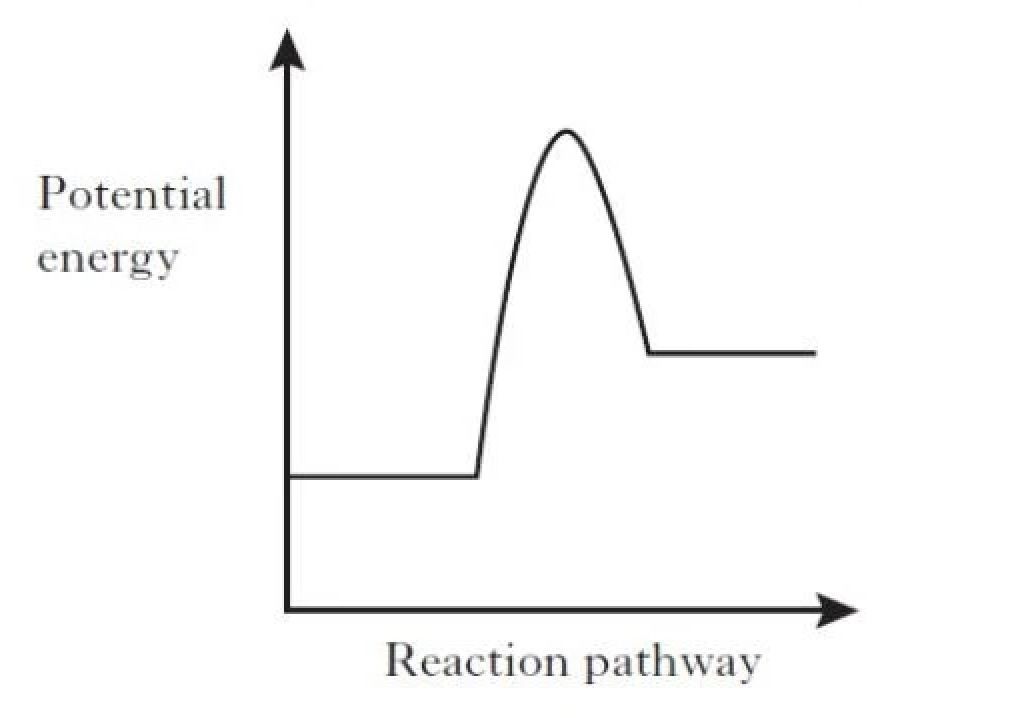
A 50.6 g sample of iron metal is heated from 19.7°C to 24.3°C. How many joules of heat will be absorbed if the specific heat of iron is 0.4494 J/g°C? |
Determine the molar mass of potassium acetate.
A sample of an unknown metal has a mass of 120.7 g. As the sample cools from 90.5°C to 25.7°C it releases 7020 J of energy. What is the specific heat of the sample?
Determine the number of moles in 25.50 g Ag.
A silver bar with a mass of 250.0 g is heated from 22.0°C to 68.5°C. How much heat does the silver bar absorb if the specific heat of silver is 0.235 J/g°C.
Calculate the heat of reaction (ΔH of reaction) for the following reaction. Put your answer in FOUR sig figs.
___CaCO3(s) ---> ___CaO(s) + ___CO2(g).
Given ΔH of formation at 25.0°C:
CaCO3(s): -1207.0kJ/mol,
CaO(s): -635.1 kJ/mol,
CO2(g): -393.5kJ/mol.
What is the percentage of carbon in C7H16?
If the temperature of 34.4 g of ethanol is heated from 25.0°C to 78.8°C, how much heat has been absorbed by the ethanol of the specific heat of ethanol is 2.44J/g°C?
Given 3.25 mol of AgNO3, determine the number of formula units. |
Reactions that occur when more energy is released in the forming of new bonds than is required to break bonds in the initial reactants is an example of what type of reaction?
What type of reaction is this & why?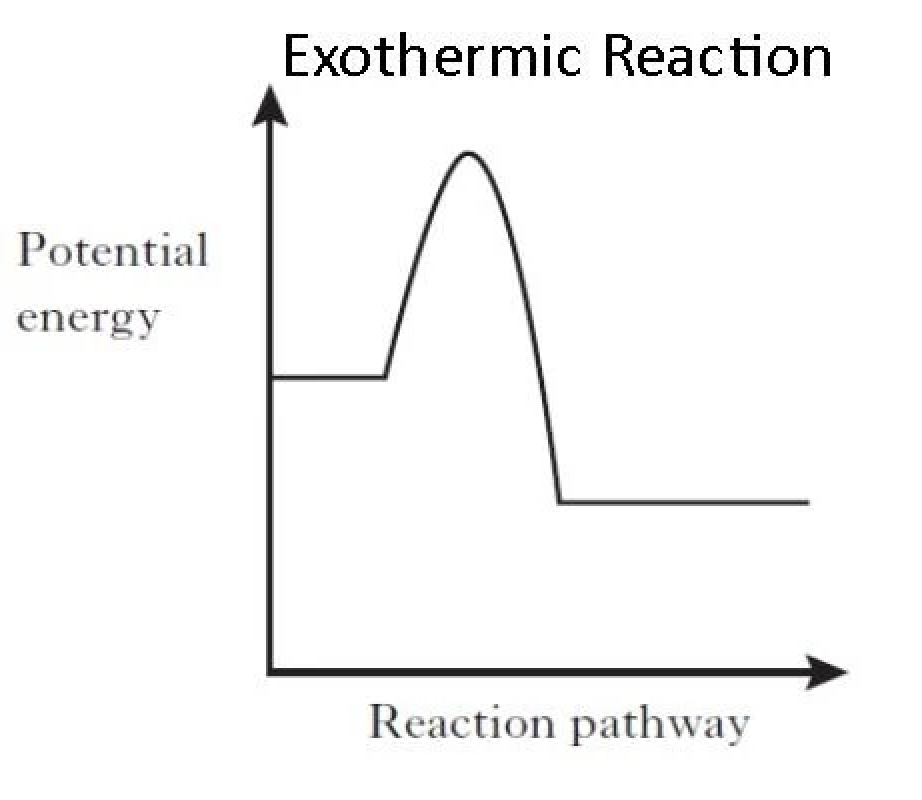
What are reactions that release energy into its surroundings known as?
The temperature of a sample of iron with a mass of 10.0 g changed from 50.4°C to 25.0°C with the release of 114 J of heat. What is the specific heat of iron?
How many atoms of Cu are in 4.00 moles?
A substance that does NOT conduct an electric current when it forms a solution is a(n) ____.
How many grams of CCl4 are in 4.00 moles? The formula mass of carbon tetrachloride is 153.8 g/mol.
What type of reactions occurs when more energy is required to break existing bonds in reactants than is released when new bonds form in the products?
What type of energy change is shown in the following reaction?
Sn + Cl2 --> SnCl2 ∆H = -325 KJ
Which of the following combinations would increase the solubility of a gas in a liquid?
How many grams of CH3Br could be made from 10.0 g of CH3OH and excess PBr3?
CH3OH + PBr3 --> CH3Br + P(OH)3
Find the percent composition of C12H22O11.
What is the molarity of a solution made by dissolving 34.0 g of sodium chloride in enough water to make 500 mL of solution?
Find the percent composition of calcium carbide.
How many grams of ZnCl2 are produced from 75.00 g of ZnO in the reaction
ZnO + HCl --> ZnCl2 + H2O ?
Find the empirical formula of a compound that is 65.45 % C, 5.45% H, and 29.09% O.
Find the percent composition of potassium perchlorate.
Which of the following will speed up the dissolving of a solid solute in water?
How many hydrogen atoms are there in 1.0 x 10² g of glucose, C6H12O6?
Find the percent composition of magnesium sulfide.
How many moles are in 1.2 X 1024 molecules of water?
Find the percent composition of magnesium sulfate.
If the temperature of 56.2 g of ethanol increases from 75.1o C to 89.3o C, how much heat has been absorbed by the ethanol? (The specific heat of ethanol is 2.44 J/g- oC). |
Calculate the molarity of a water solution of potassium chloride, given that 2.50 L of the solution contains 350 g of the solute.
A compound contains 36.1 g calcium and 63.9 g chlorine. What is the empirical formula of the compound?
How many moles of CH3Br could be made from 3.0 moles of PBr3 and excess CH3OH?
CH3OH + PBr3 --> CH3Br + P(OH)3
A compound is composed of 82.68% mercury, (Hg), and 17.32% nitrogen, (N), and has an experimental molar mass of 485.20 g/mol. What is the compound's empirical formula?
If the pressure exerted by a gas at 25.0o C in a volume of 0.0440 L is 3.81 atm, how many moles of gas are present? (Hint: R = 0.0821 L-atm/mol-K)
What would the final volume of a solution be if 25.0 mL of a 1.0 M stock solution is diluted to 0.50 M?
Determine the empirical formula for a compound that contains 35.98% aluminum and 64.02 % sulfur.
What will happen to the rate of reaction if the surface area of reactants is increased?
When one element replaces another element in a compound, the reaction is a ____ reaction.
What is the molarity of a solution containing 9.0 moles of a solute in 500.0 mL of solution?
Find the empirical formula of a compound that is 39.12 % C, 8.76% H, and 52.12% O.
What is the coefficient that belongs in front of oxygen in the balance equation for the combustion of propane (C3H8)?
What would the final volume of a solution be if 6.0 mL of a 0.050 M stock solution is diluted to 0.020 M?
Methane (CH4) contains 75% carbon. What percentage of methane is hydrogen?
If 40.0 ml of a 0.400 M solution of HCl is diluted to 50.0 ml, what will the final molarity be? |
The elemental analysis of a sample of ionic compound gave the following results: 2.82 g Na,
4.35 g Cl, and 7.83 g O. The empirical formula of this compound is:
What is the coefficient that belongs in front of water in the balance equation for the combustion of propane (C3H8)?
What is the empirical formula for a compound that is 27.3 % C and 72.7 % O?
What is the percentage of chromium in barium chromate?
Find the empirical formula of a compound that is 53.5 g C, 15.7 g H, 31.1 g N.
What are the coefficients to correctly balance the equation for the reaction between aluminum sulfate and potassium hydroxide?
What is the molecular formula of a compound that is composed of 83.64% tin (Sn) and 16.36% phosphorous (P)? The compound's experimental molar mass is: 479.98 g/mol.
 Which energy difference in the reaction profile below corresponds to the activation energy for the forward reaction?
What is the general rule for solubility?
If a crystal is added to an aqueous solution and it causes many crystals to come out of the solution, what type of solution was it originally? |
Calculate the molarity of a water solution of CaCl2 made by dissolving 612 g of CaCl2 in 5.04 L of solution. |
What is the percentage of barium in barium chromate? |
A colorless liquid composed of 46.68% N and 53.32 % O has a molar mass of 60.01 g/mol. Find the molecular formula.
The specific heat of ethanol is 2.44 J/g°C. How many joules of energy are required to heat 50.0 g of ethanol from -20.0°C to 68.0°C?
|
How much heat does it take to warm 50.00 g of pure water from 20.00°C to 80.00 °C? The specific heat of water is 4.180 J/g°C.