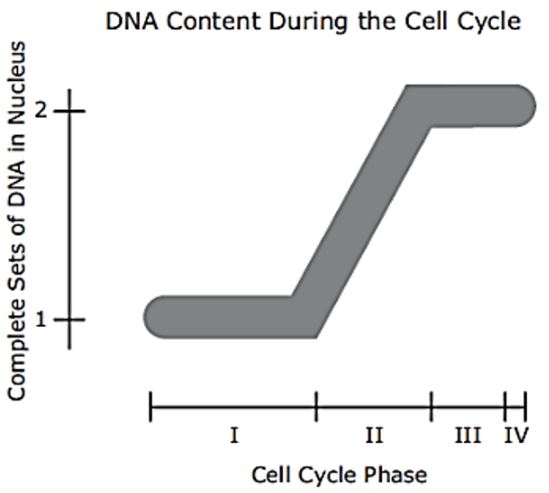
Label the model below representing the change in the DNA content of a cell during the cell cycle.
Move ONE correct answer to each box. Not all answers will be used.
Mmuae Afoforo a Wobɛpaw:
S Phase
G2 Phase
Cytokinesis
G1 Phase
Scientists have reported that more than 95% of the factors that lead to some types of cancers are caused by random DNA-copying errors. During which phase of the cell cycle do these DNA-copying errors most likely occur?
When cells lose their ability to regulate the cell cycle, they can divide at an accelerated rate an form a mass of cells. This mass of cells is referred to as --
Label the model below representing the change in the DNA content of a cell during the cell cycle.
Move ONE correct answer to each box. Not all answers will be used.
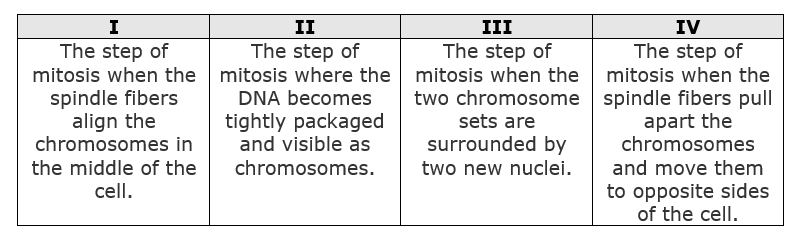
In the table above, a teacher wrote out descriptions of the different phases of mitosis. She then asked her students to put the phases in the correct order that they occur during mitosis. Which of the following would be the correct answer?
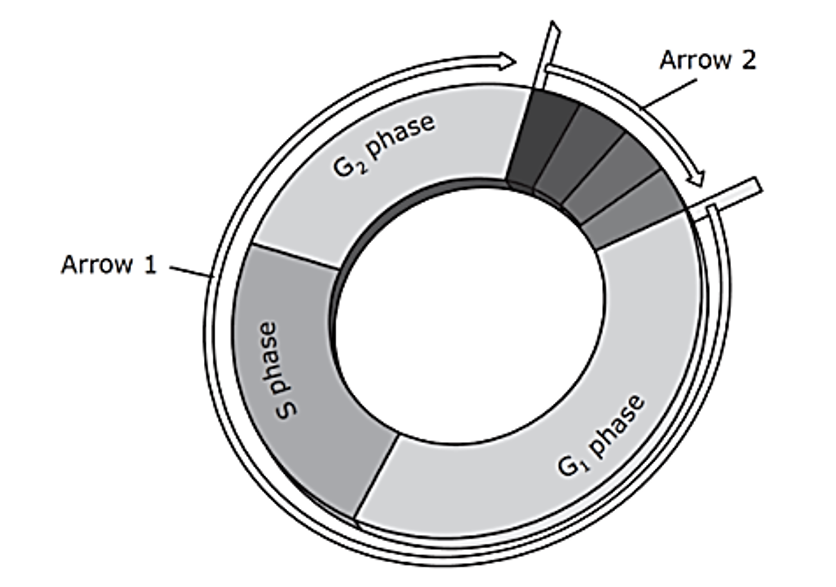
This model of the cell cycle includes two arrows that each represent a process in the cycle.
What do the two arrows represent?
Which of the following best describes the purpose of the cell cycle?
Which correctly describes what is occurring at the four different stages of the cell cycle?
Below is a student drawing of the cell cycle. The student made an error in their cell cycle diagram.
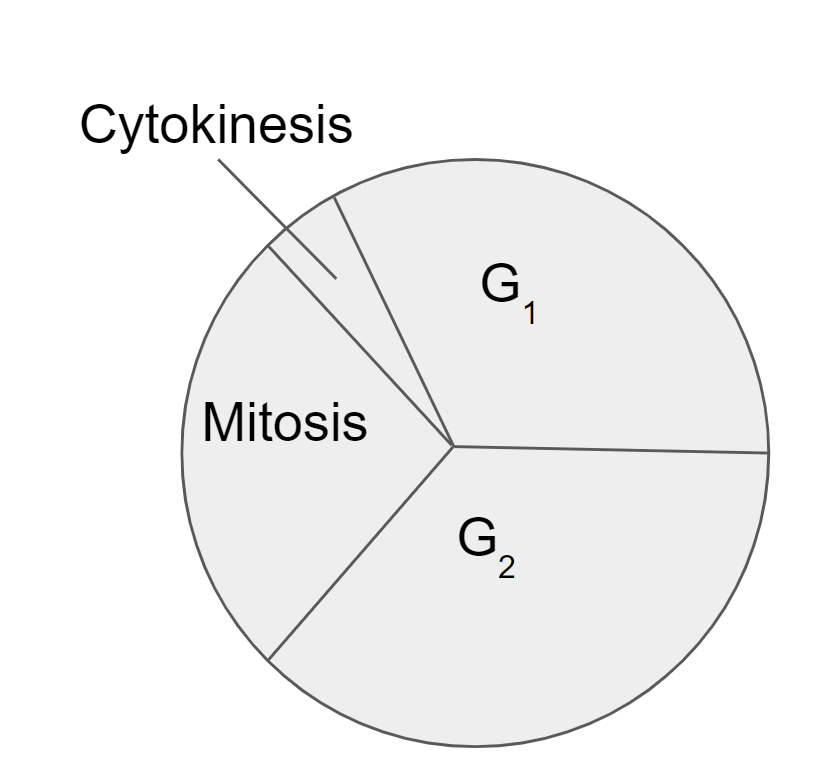
What is the name of the missing phase, AND explain what important event happens during that phase.
Read the question carefully. Then enter your answers in the box provided.
Cell division is regulated by a variety of internal and external signals. What reasons might a cell undergo cell division?
Select THREE answers.
A student observed an onion root tip cell under a microscope and made the following observations.
Sister chromatids are separating
Spindle fibers are attached at the centromere
There is no visible nucleolus
What phase of the cell cycle is this student MOST LIKELY observing?
A student was listing the steps of DNA replication. Her ideas are listed below, but they are out of order.
I. During S phase, the DNA double helix is unwound by an enzyme
II. Two identical strands of DNA are formed
III. During S phase, an enzyme adds complementary nucleotides to each strand of DNA
IV. The cell enters S phase with one set of DNA
What is the correct order for the steps of DNA replication?