Twa kɔ nsɛm atitiriw so
Log in
Sign up for FREE
arrow_back
Laabri

Copy of Copy of Friday (03/21) - Symbiosis Quiz + PS /CR Quiz (2/5/2026) (5/2/2026)

star
star
star
star
star
Last updated about 2 hours ago
10 Nsɛmmisa
Ɛhia
1
BIO.11.A
Ɛhia
1
B.C.12A
Ɛhia
1
B.C.12A
Ɛhia
1
B.C.12A
Ɛhia
2
Ɛhia
2
Ɛhia
1
B.C.9B
Ɛhia
2
Ɛhia
1
B.C.9B
Ɛhia
1
Asemmisa {{asɛmmisaAhyɛnsode}}
1.

LOW

Trichonympha are mutualistic microorganisms found in the gut of termites. Which statement BEST explains the relationship between Trichonympha and termites?

Asemmisa {{asɛmmisaAhyɛnsode}}
2.

LOW - STAAR 2023 #30

Spores of the fungus Ustilago maydis land and grow on sweet corn. The fungus then infects the plant tissue, extracting nutrients from the plant's cells.

The relationship between sweet corn and Ustilago maydis can best be described as .

Asemmisa {{asɛmmisaAhyɛnsode}}
3.

MED - STAAR 2021 #38

Researchers have observed striped hyenas and gray wolves hunting together in certain areas. One hypothesis suggests that changing hunting behavior aids both species in obtaining better and more resources.

In this hypothesis, the hyenas benefit because the wolves chase and take down large animals, such as goats, that the hyenas usually cannot catch alone. The wolves benefit from hyenas using their jaw strength to crack open large bones of prey to access additional nutrients from bone marrow.

Which table best identifies the ecological relationship among the gray wolf, hyena, and goats?

Asemmisa {{asɛmmisaAhyɛnsode}}
4.

LOW - STAAR 2022 #25

Leaf-cutter ants harvest leaves and carry them to fungi that convert plant material into a usable form for the ants to digest. The fungi depend on the leaves for nutrients. The ants also produce an antibiotic on their bodies that helps protect the fungi from harmful bacteria.

Which of these explains the relationship between the leaf-cutter ants and the fungi?

Asemmisa {{asɛmmisaAhyɛnsode}}
5.

HIGH - Similar to STAAR 2024 #26

Ecological relationships occur between two species that live close to each other. Two examples of ecological relationships are described.

Example 1: Bees gather nectar and pollen from flowering plants, providing food for the bees. As the bees move from different flowers, some of the pollen attached to the bee's bodies is spread and released. If the pollen falls on the flower of the plant of the same species, it may fertilize the plant and produce seeds.

Example 2: Orchids are flowering plants that grow on other plants. They typically grow in tall trees high in the canopy, where they can reach sunlight for photosynthesis. They get water and nutrients from rainwater runoff that carries organic material down the host plant's branches. No water or nutrients are taken from the host plant.

What is the main difference between the ecological relationships described in the two examples? Include the scientific term used to define each of the relationships.

Think about the question carefully. Then enter your answer in the space provided below.
Asemmisa {{asɛmmisaAhyɛnsode}}
6.

MED

In a dense forest, orchids are observed growing on the branches of tall trees. The orchids use the trees for support, allowing them to access more sunlight in the canopy. However, the trees do not gain any benefits or suffer any harm from the presence of the orchids.

The ecological relationship that is best represented by the interaction between the orchids and the trees is .

Asemmisa {{asɛmmisaAhyɛnsode}}
7.

MED

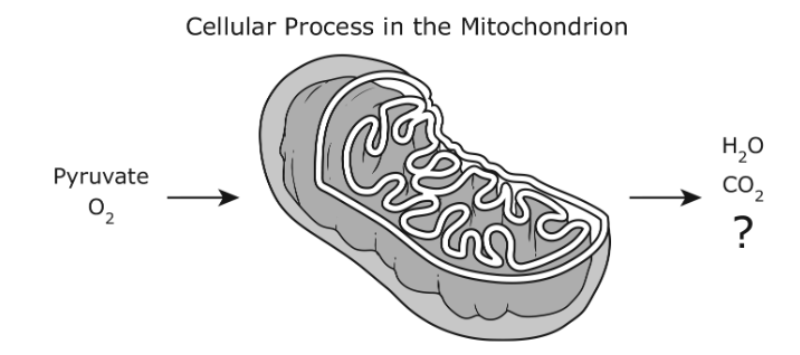
The diagram shows molecules that a mitochondrion uses and produces during a cellular process.

Which other molecule is a product of this process?

Asemmisa {{asɛmmisaAhyɛnsode}}
8.

HIGH - STAAR 2024 #22

A student is making a table to describe the process of photosynthesis and cellular respiration. Complete the table by identifying which process causes each result shown in the table.

  • Carbon dioxide is released to the atmosphere.

  • Energy is stored in carbon compounds.

  • Carbon dioxide is removed from the atmosphere.

  • Energy is released from carbon compounds

  • Cellular Respiration

  • Photosynthesis

Asemmisa {{asɛmmisaAhyɛnsode}}
9.

LOW

Which diagram correctly shows Photosynthesis?

Asemmisa {{asɛmmisaAhyɛnsode}}
10.

MED - STAAR 2023 #2

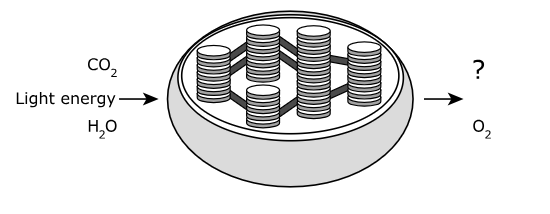
The diagram represents a cellular process.

Which molecule is a direct product of this cellular process?