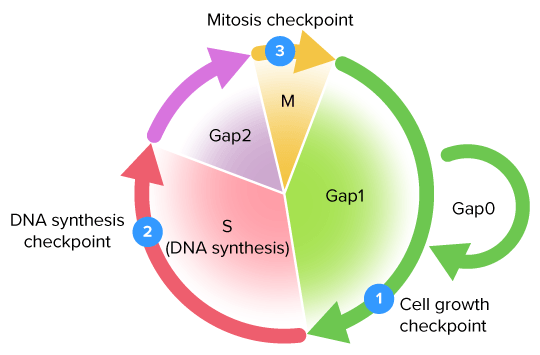
Cells move through a critical G1 checkpoint before entering the S phase of the cell cycle. If the cell’s DNA is damaged or not ready for replication, the checkpoint can delay progression or trigger apoptosis to prevent faulty DNA from being copied.
How does repairing DNA before mitosis protect future daughter cells?
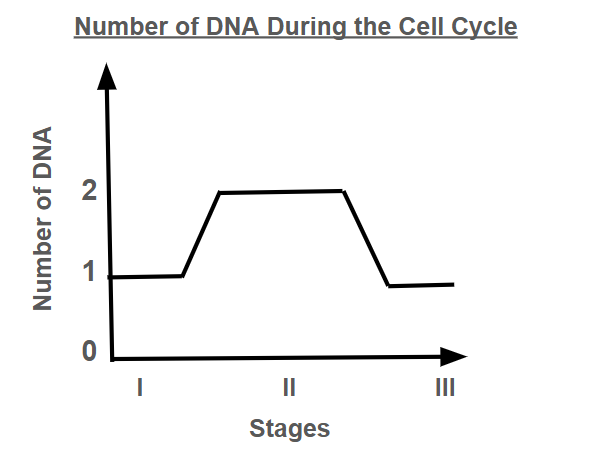
Scientists measured the total number of DNA molecules in samples of animal cells. Equal numbers of cells were examined during three different stages of the cell cycle. Stage II contains cells that were observed during the G2 phase of the cycle.

Which statement best describes the cells during Stage II?
A 38-year-old lab technician with over 10 years of radiation exposure has routinely worked with radioactive materials and unshielded X-rays without full protection. She also frequently uses tanning beds, exposing herself to UV light. She has now developed persistent, abnormal skin lesions and is undergoing a biopsy for possible cancer.
Which of the following BEST explains the biological mechanism by which her exposures may lead to cancer?
Which table shows two steps of DNA replication?
Throughout the cell cycle, checkpoints at G1, S and G2 ensure that a cell only proceeds to the next phase if conditions are correct. If a disruption occurs at one of these checkpoints—such as when DNA damage is detected but not repaired—the cell will typically —
![]()
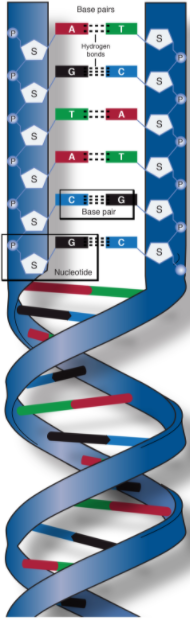
The 2 backbones (sides) of DNA made up of , and the steps / rungs are made of .
In normal cells, cyclins are proteins that help control when a cell divides. Once the cell finishes dividing, the cyclins are broken down so the cell doesn’t keep dividing again too soon.
What would most likely happen if cyclins were not broken down and remained constantly active in a cell?

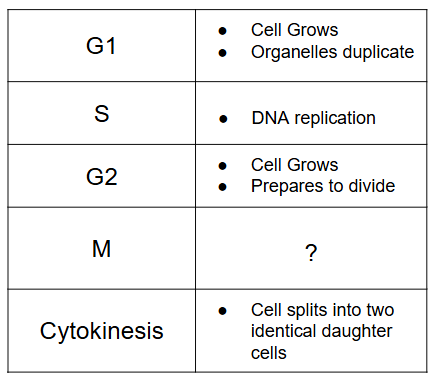
Which information should be added to the table?
After the cell cycle, the two resulting cells are.......
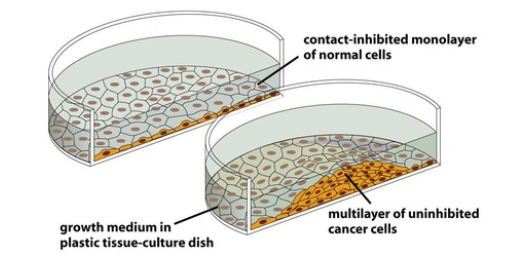
Contact inhibition (no more growth after contact) is a normal process that helps healthy cells control their growth. Cells will divide only when there is space. When they touch other cells and fill the area, they stop growing. We call this anchorage dependance (cells must stick to something in order to multiply). This helps the cells form just one organized layer, called a monolayer.

What is most likely to happen if a cell loses anchorage dependence?
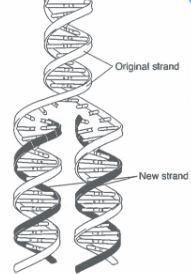
What process is being shown in the figure below?
![]()
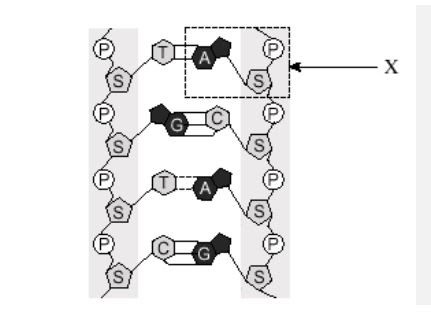
The boxed structure labeled X is a(n)_________________________.
Cancer cells have several unique biological behaviors that distinguish them from normal cells. Which of the following characteristics is found only in cancer cells?
The activities in the cell cycle occur during specific phases. In which phase of the cell cycle is DNA replicated?
Cats have 38 chromosomes in their body (somatic) cells. During the cell cycle, these chromosomes must be copied to ensure each new cell receives a complete set of DNA.
In which part of the cell cycle are these chromosomes replicated?

What is the end result of DNA Replication?
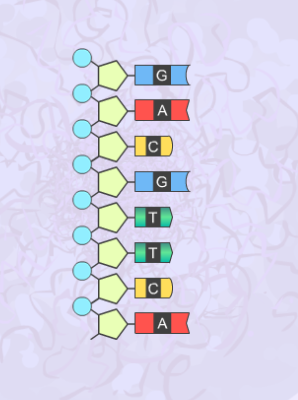
What sequence of nitrogenous bases would be complementary to the model below?
![]()
A 16-year-old biology student learns about a patient who started developing several tumors at a young age because they inherited a mutation in a gene called TP53.
Normally, this gene makes a protein called p53 that works like a “guardian” of the cell cycle by stoping cells with damaged DNA from dividing.
But in this patient, the TP53 gene is broken and can’t make a working p53 protein, so the damaged cells keep dividing and form tumors.
What is the main consequence of a nonfunctional (not working) p53 protein?
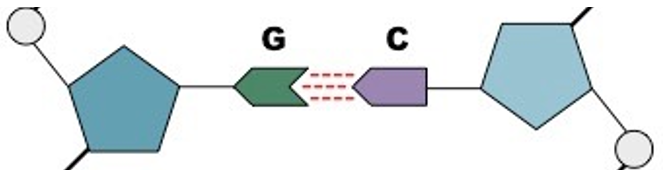
What type of bond is between the nitrogen bases?
What are the proper complementary base-pairs?
Match the following vocabulary to their definitions
| Draggable item | arrow_right_alt | Corresponding Item |
|---|---|---|
Metaphase | arrow_right_alt | When the chromosomes become packed/condensed. The nuclear membrane (nucleus) disappears. |
Anaphase | arrow_right_alt | The spindle fibers align the chromosomes in the middle. |
Telophase | arrow_right_alt | When the spindle fibers pull the 2 sets of chromosomes apart/away to opposite ends of the cell. |
Cytokinesis | arrow_right_alt | Two nuclear membranes (nuclei) begin to form inside of the cell. |
Prophase | arrow_right_alt | When the cell actually splits into two identical daughter cells. |
Which table best compares the events that occur during different stages of the cell cycle?
Apoptosis is the process of that destroys cells. A cell goes into apoptosis . Instead of causing harm, the cell quietly breaks down in a safe and controlled way. This protects the body from dangerous cells that could cause diseases like .
A student is examining onion root tip cells under a microscope and notes the following:
Chromosomes are lined up across the center of the cell
Spindle fibers are attached to the centromeres
The nuclear membrane is completely gone
Each chromosome is clearly visible and organized in a straight line
Which phase of the cell cycle is the student MOST LIKELY observing?
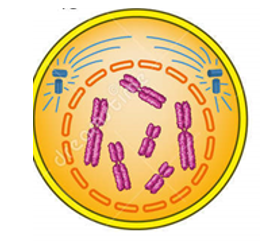
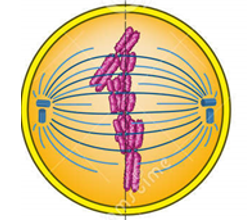
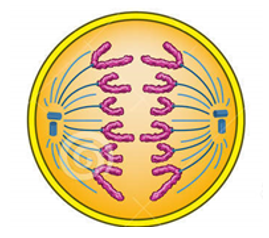
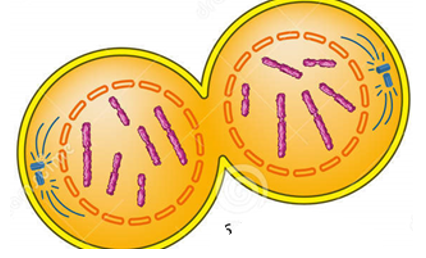
Match the following vocabulary words to their pictures.
| Draggable item | arrow_right_alt | Corresponding Item |
|---|---|---|
Metaphase | arrow_right_alt | |
Telophase | arrow_right_alt | |
Prophase | arrow_right_alt | |
Anaphase | arrow_right_alt |
Using knowledge gained from Erwin Chargaff, answer the following:
In a sample of DNA, the percentage of Adenine equals 31.5%. Therefore...
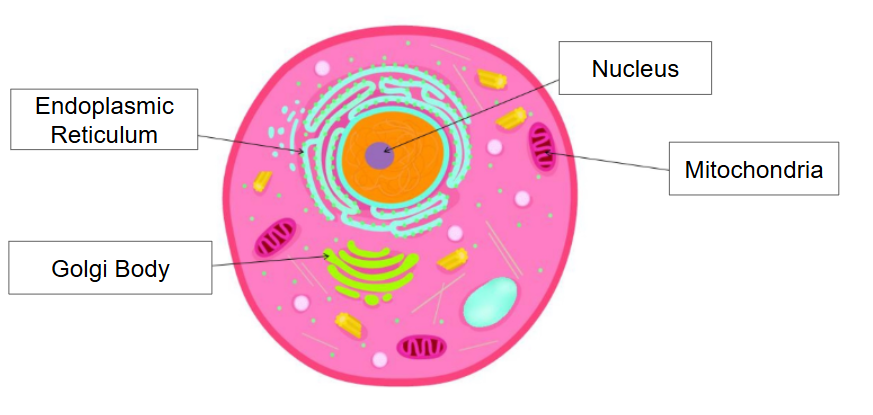
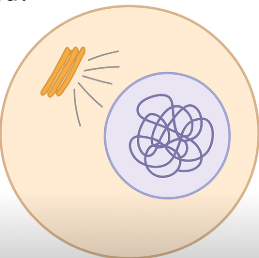
A mutation disrupts the structures responsible for organizing microtubules during cell division. As a result, spindle fibers fail to form correctly, and chromosomes cannot separate properly during mitosis.
![]()
Which structure is directly affected?
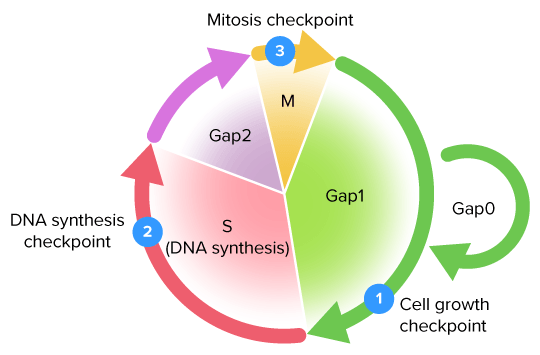
The diagram shows the checkpoints that help make sure two identical daughter cells are formed during the cell cycle.
![]()
At which checkpoint does the cell check that all duplicated chromosomes are lined up correctly so each new cell gets the same number of chromosomes?
![]()
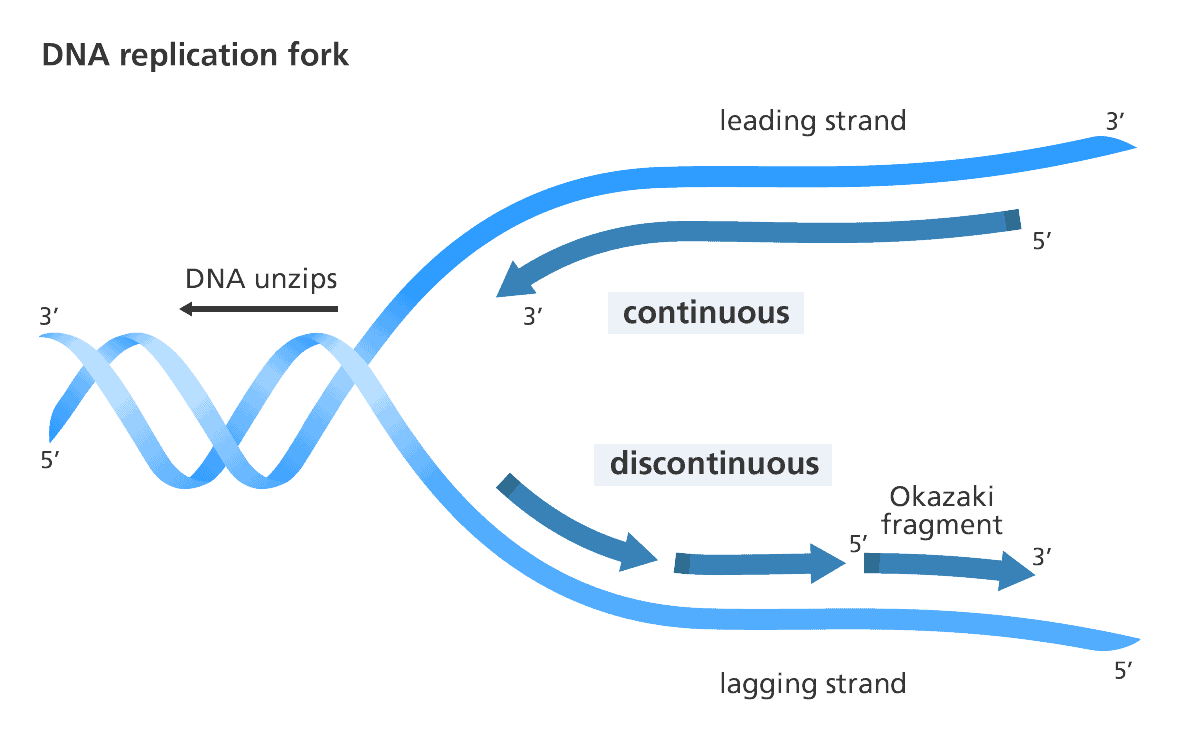
Which statement best describes how the leading strand is made during DNA replication?
During which phase of the cell cycle is DNA copied, and how is the lagging strand synthesized?