In 1789, the mutineers of a British ship set the captain and the crew adrift. Twenty seven adults and one baby arrived at an island called Pitcairn and their descendants lived on that island for decades. This event caused a drastic reduction in the population size which decreased the genetic variation in the population.
Martin Fugate had an extremely rare disease, called Methemoglobinemia, which caused his skin to appear blue. Once he was married, to his cousin Emily (a carrier of the disease), the two moved to a secluded part of Kentucky and had children. After 200 years almost 65% of the people in this area exhibited rare blue skin.
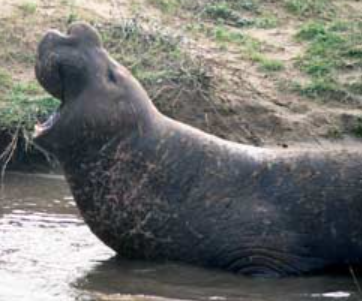
Northern elephant seals have reduced genetic variation probably because humans hunted them in the 1890s and reduced their population size to as few as 20 individuals at the end of the 19th century. Their population has since rebounded to over 30,000. They have much less genetic variation than a population of southern elephant seals that was not so intensely hunted.
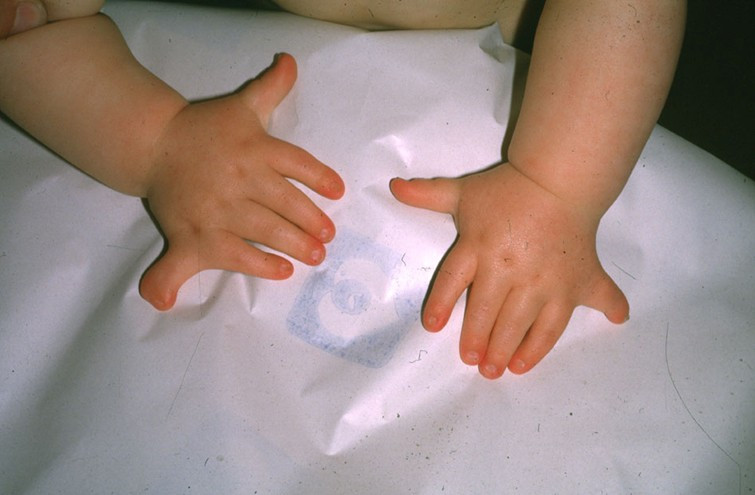
In Eastern Pennsylvania, there is an Amish community of around 200 individuals who migrated from Germany established this community. The Amish tend to marry within their group and live in isolation, causing genetic mutations to persist over generations. An example of this is Ellis-van Creveld syndrome, a rare disorder marked by extra fingers or toes (polydactyly), dwarfism, and occasionally congenital heart defects. The prevalence of Ellis-van Creveld syndrome is significantly higher among the Amish community compared to larger populations.
Test Review
A GRADUAL change in organisms within a population over a LONG period of time is called .
These changes over time are not decided by individuals within a species, rather occurs when the environment determines which individuals are fit or unfit.
Test Review
Fill in the blanks using the word bank:
adaptation fit traits
Fur color, wing shape, and neck length are examples of
If a trait helps an organism survive and reproduce, it is considered an
Organisms with adaptations are
Test Review
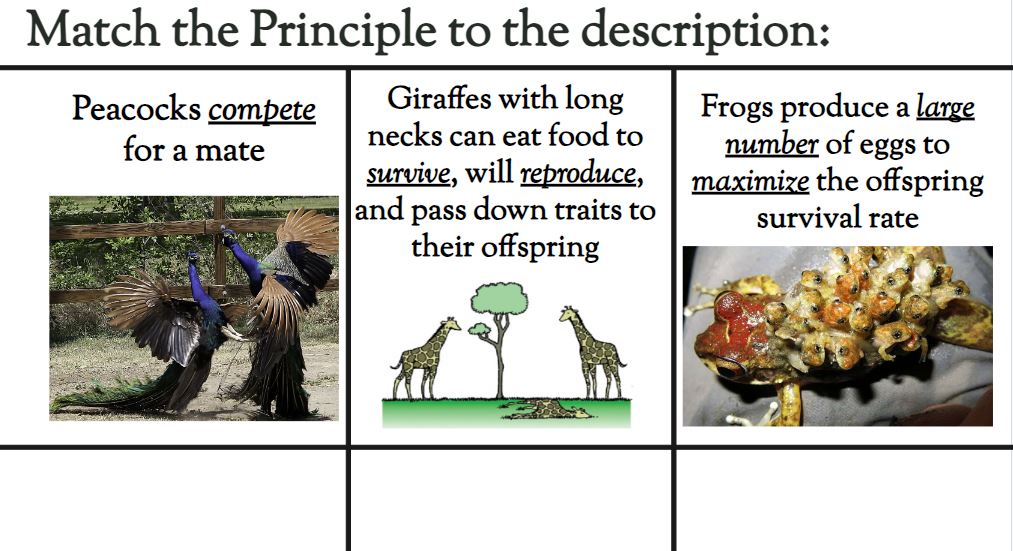
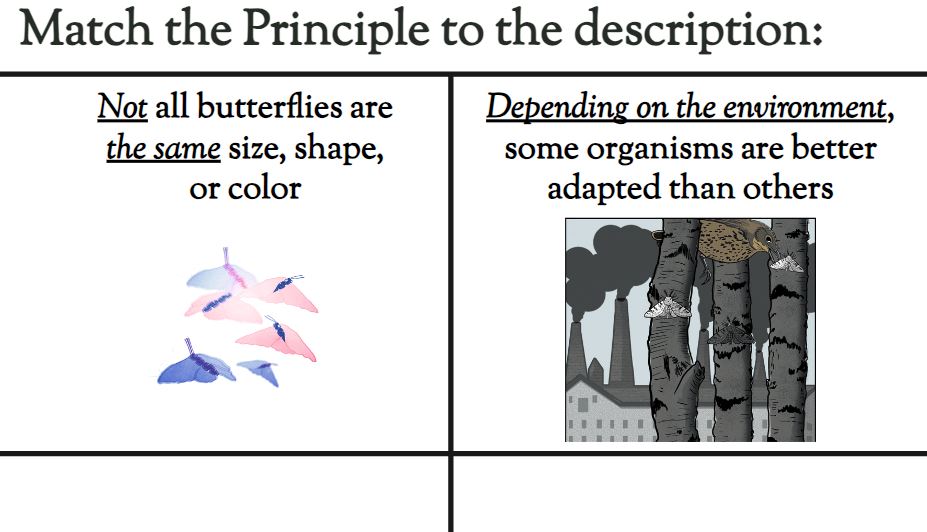
Which Principle?
Test Review
In nature, struggle for survival results in between organisms of a species.
Not all members of a species are identical due to differences in the population creating .
Based on the various traits, naturally some organisms will have beneficial (good) traits which are referred to as .
These traits help the organism survive and reproduce which makes the organism in terms of evolution.
competition
fit
adaptations
traits
variation
Test Review
Which Principle?
Sort the following statements of Natural Selection:
(1 of each color per category)
Stuck? Click here to check the Key Facts of Natural Selection from the notes!
Have adaptations
Do not have adaptations
Do not survive
Survive
Do not reproduce and pass down traits
Reproduce and pass down traits
Population increases
Population decreases
FIT ORGANISMS
UNFIT ORGANISMS (not fit)