Log in
Sign up for FREE
arrow_back
Library

Copy of Crystal Systems; Unit Cells (5/28/2026)

star
star
star
star
star
Last updated about 3 hours ago
16 questions
Crystal Systems
1
2
1
1
1
2
1
1
Unit Cells
1
2
1
1
1
2
1
1

What are the different uses of lasers?


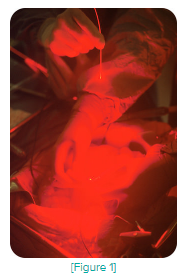
The development of modern lasers has opened many doors to both research and applications. A laser beam was used to measure the distance from the Earth to the moon. Lasers are important components of CD players. As the image above illustrates, lasers can provide precise focusing of beams to selectively destroy cancer cells in patients. The ability of a laser to focus precisely is due to high-quality crystals that help give rise to the laser beam. A variety of techniques are used to manufacture pure crystals for use in lasers.

Crystalline Solids

The majority of solids are crystalline in nature. A crystal is a substance in which the particles are arranged in an orderly, repeating, three-dimensional pattern. Particles of a solid crystal may be ions, atoms, or molecules, depending on the type of substance. The three-dimensional arrangement of a solid crystal is referred to as the crystal lattice. Different arrangements of the particles within a crystal cause them to adopt several different shapes.

Crystal Systems

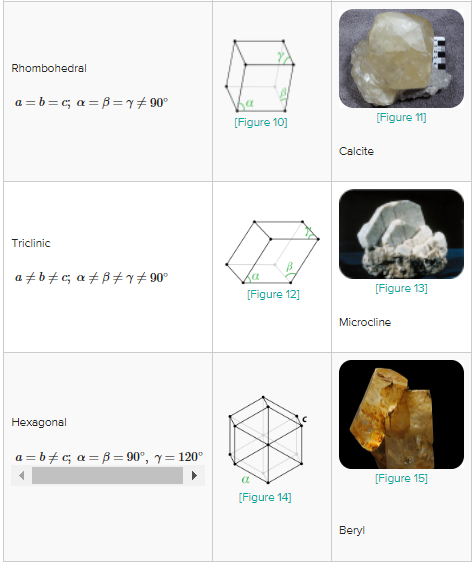
Crystals are classified into general categories based on their shapes. A crystal is defined by its faces, which intersect with one another at specific angles, which are characteristic of the given substance. The seven crystal systems are shown below, along with an example of each. The edge lengths of a crystal are represented by the letters a, b, and c. The angles at which the faces intersect are represented by the Greek letters α, β, and γ. Each of the seven crystal systems differs in terms of the angles between the faces and in the number of edges of equal length on each face.

Summary

  • A crystal is a substance in which the particles are arranged in an orderly, repeating, three-dimensional pattern.
  • The crystal lattice is the three-dimensional arrangement of a solid crystal.
Question 1
1.
A crystal is a substance in which the particles are arranged in an orderly, repeating _______ dimensional pattern.
Question 2
2.

Question 3
3.
Crystals are generally classified into one of _______ different cyrstal systems.
Question 4
4.
With crystals, the letters a, b, and c represent the _______ of a crystal.
Question 5
5.
The particular three-dimensional arrangement of particles in a crystal is called the _______.
Question 6
6.
The Greek letters, below, signify the _______ between the _______ . (You may have to click on the image, below, to make it larger).
Question 7
7.
Calcite is an example of a _______ crystal system.
Question 8
8.
Particles of a solid crystal may be occupied by _______ depending on the system.

Summary

  • A unit cell is the smallest portion of a crystal lattice that shows the three-dimensional pattern of the entire crystal.
  • There are three different types of unit cells in the cubic crystal system.
Question 9
9.
The cubic crystal system is composed of _______ different types of unit cells.
Question 10
10.

Question 11
11.
We use _______ to measure atoms.
Question 12
12.
The size of a lithium atom is _______.
Question 13
13.

Question 14
14.
A unit cell is the smallest portion of a _______ that shows the same _______ of the entire crystal.
Question 15
15.

Question 16
16.
The _______ of the anion or cation will determine how the ions pack together in a crystal. The answer is, size (you're welcome).
Select all that are crystal systems
Monoclinic
Diclinic
Orthorhombic
Hexagonal
Cuboid
Triclinic

How can we measure size of atoms?
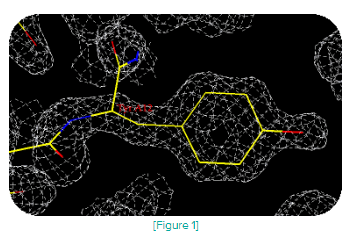

We have many data tables available to us in chemistry. If we wanted to know the size of the lithium atom, we can easily look it up and find that this atom is 134 picometers across. If we remove the outer electron, the lithium ion is now only 90 picometers in size. How do we know this? We don’t have a ruler small enough to measure these tiny distances. But we can use a technique called x-ray diffraction to shine beams of x-rays through a crystal of a lithium compound. By measuring how much the beams are bent after they come through the crystal, we can calculate the size of the molecule. This technique works both for small materials like lithium compounds and equally well for very large protein molecules.

Unit Cells

A unit cell is the smallest portion of a crystal lattice that shows the three-dimensional pattern of the entire crystal. A crystal can be thought of as the same unit cell repeated over and over in three dimensions. Figure below illustrates the relationship of a unit cell to the entire crystal lattice.
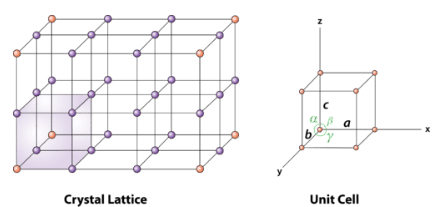

[Figure 2] A unit cell is the smallest repeating portion of a crystal lattice.

Unit cells occur in many different varieties. As one example, the cubic crystal system is composed of three different types of unit cells: (1) simple cubic, (2) face-centered cubic, and (3) body-centered cubic. These are shown in three different ways in Figure below.
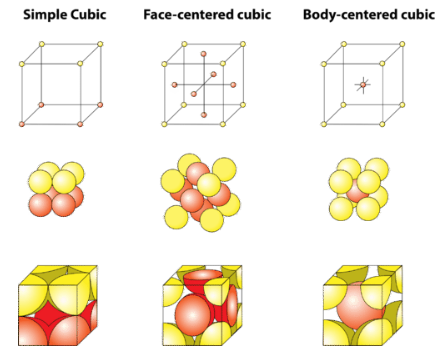


[Figure 3] Three unit cells of the cubic crystal system. Each sphere represents an atom or an ion. In the simple cubic system, the atoms or ions are at the corners of the unit cell only. In the face-centered unit cell, there are also atoms or ions in the center of each of the six faces of the unit cell. In the body-centered unit cell, there is one atom or ion in the center of the unit cell in addition to the corner atoms or ions.

Pay special attention to the last diagram for each type of cell. You will notice that the atoms or ions at the edges of each face or at the corners are not complete spheres. In the simple cubic cell, each corner atom is shared by 8 differenent unit cells. The same situation exists for the edge or corner particles in the face-centered and body-centered cubic forms. In addition, each of the particles in the center of the face-centered cubic cell is shared by 2 unit cells. Body-centered cells have an additional atom in the middle of the cell which is contained entirely in that cell.

Note that we have only considered the unit cells of a cubic crystal. Other crystal forms also have unit cells. These unit cells are listed below:
  • rhombohedral, hexagonal, triclinic – one unique form each
  • tetragonal – simple and body-centered
  • monoclinic – simple and base-centered
  • orthorhombic – simple, face-centered, body-centered, base-centered
What are the three different types of unit cells?
Simple
Complex
Two-Faced
Face centered
Three-Dimensional
Body centered
Each unit cell exists as an entity by itself.
True
False
All unit cells are identical.
True
False