Log in
Sign up for FREE
arrow_back
Library

Copy of Structure of Water and Ice (5/28/2026)
star
star
star
star
star
Last updated about 3 hours ago
17 questions
Structure of Water
2
1
1
1
1
1
1
1
1
Structure of Ice
1
2
1
1
1
2
1
Required
1

Structure of Water


How much of the Earth's surface is covered with water?

In his well-known poem “The Rime of the Ancient Mariner,” Samuel Coleridge wrote “Water, water everywhere, Nor any drop to drink.”  The narrator was talking about being out on the ocean, but not having any water because he had killed an albatross (apparently bringing bad luck to everyone on the ship).  About 75% of the Earth’s surface is water.  The major constituent of the human body (over 60%) is water.  This simple molecule plays important roles in all kinds of processes.


Structure of Water

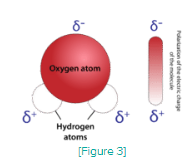
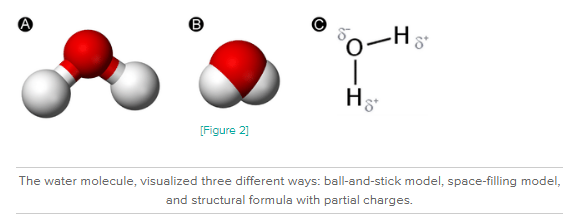
Water is a simple molecule consisting of one oxygen atom bonded to two different hydrogen atoms.  Because of the higher electronegativity of the oxygen atom, the bonds are polar covalent (polar bonds).  The oxygen atom attracts the shared electrons of the covalent bonds to a significantly greater extent than the hydrogen atoms.  As a result, the oxygen atom acquires a partial negative charge (δ−), while the hydrogen atoms each acquire a partial positive charge (δ+).  The molecule adopts a bent structure because of the two lone pairs of electrons on the oxygen atom.  The H-O-H bond angle is about 105°, slightly smaller than the ideal 109.5° of an sp3 hybridized atomic orbital.
The bent shape of the water molecule is critical because the polar O-H bonds do not cancel one another and the molecule as a whole is polar.  Figure below illustrates the net polarity of the water molecule.  The oxygen is the negative end of the molecule, while the area between the hydrogen atoms is the positive end of the molecule.
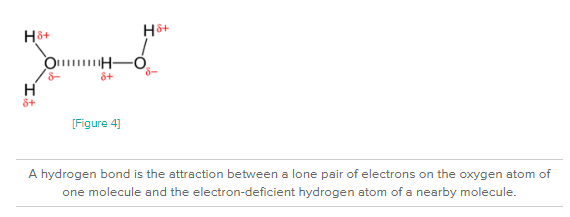
Polar molecules attract one another by dipole-dipole forces as the positive end of one molecule is attracted to the negative end of the nearby molecule.  In the case of water, the highly polar O-H bonds results in very little electron density around the hydrogen atoms.  Each hydrogen atom is strongly attracted to the lone-pair electrons on an adjacent oxygen atom.  These are called hydrogen bonds and are stronger than conventional dipole-dipole forces.
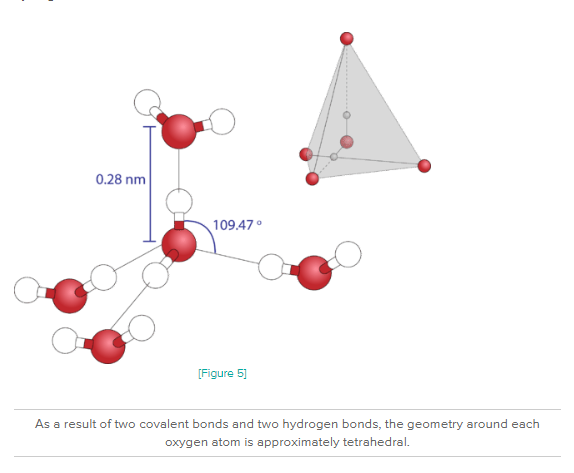
Because each oxygen atom has two lone pairs, it can make hydrogen bonds to the hydrogen atoms of two separate other molecules.  Figure below shows the result – an approximately tetrahedral geometry around each oxygen atom consisting of two covalent bonds and two hydrogen bonds.
Summary

  • Water is a molecular compound consisting of polar molecules that have a bent shape.
  • The oxygen atom acquires a partial negative charge while the hydrogen atom acquires a partial positive charge.
Question 1
1.
Due to the high _______ of oxygen, in a water molecule, it has a partial negative charge, which the hydrogen atoms have a _______ charge.
Question 2
2.
The bonds between the hydrogen and oxgen atoms in a water molecule are _______ bonds due to the high electronegativity of oxygen.
Question 3
3.
When an atom has a high electronegativity, it tends to _______ electrons more than atoms with lower electronegativities.
Question 4
4.
Due to the fact that oxygen pulls the electrons in the covalent bonds formed between them and hydrogen atoms toward them, which creates a higher electron density around the oxygen atom, a water molecule, as a whole, is _______.
Question 5
5.
_______ forces attract polar molecules to one another.
Question 6
6.
The area of a water molecule with the lowest electron density is around the _______ .
Question 7
7.
Water molecules "stick together" or are attracted to one another through special and very strong dipole-dipole forces called _______.
Question 8
8.
One water molecule can interact with or stick together with up to _______ other water molecules (see figure 5).
Question 9
9.
A water molecule has a _______ shape.

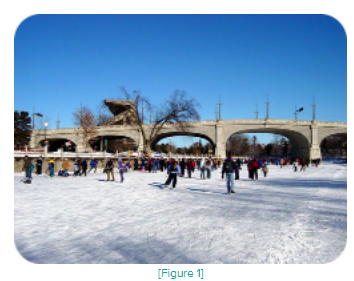
Have you ever been ice skating?


Ice is an interesting and useful material.  It can be used to cool food and keep it fresh.  It can provide recreation, such as ice-skating.  Ice can do great damage when it freezes – roads can buckle, houses can be damaged, water pipes can burst.   All this happens because of a unique property of water and ice.  When water freezes, it expands in volume as ice is formed.


Structure of Ice

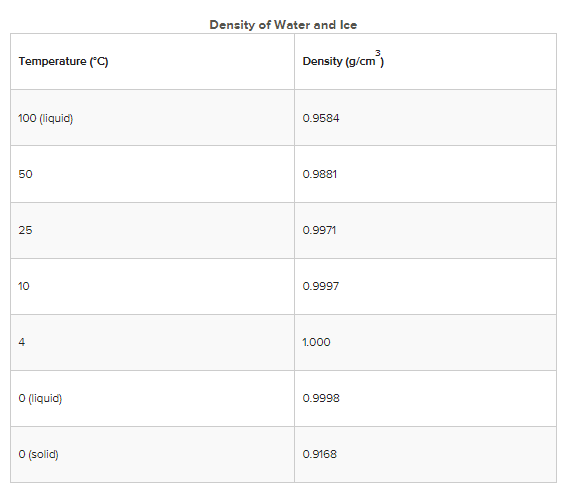
Liquid water is a fluid.  The hydrogen bonds in liquid water constantly break and reform as the water molecules tumble past one another.  As water cools, its molecular motion slows and the molecules move gradually closer to one another.  The density of any liquid increases as its temperature decreases.  For most liquids, this continues as the liquid freezes and the solid state is denser than the liquid state.  However, water behaves differently.  It actually reaches its highest density at about 4°C.
Between 4°C and 0°C, the density gradually decreases as the hydrogen bonds begin to form a network characterized by a generally hexagonal structure with open spaces in the middle of the hexagons (see Figure below).
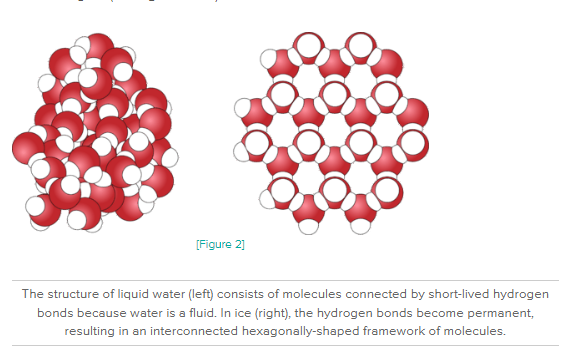
Ice is less dense than liquid water and so it floats.  Ponds or lakes begin to freeze at the surface, closer to the cold air.  A layer of ice forms, but does not sink as it would if water did not have this unique structure dictated by its shape, polarity, and hydrogen bonding.  If the ice were to sink as it froze, entire lakes would freeze solid.  Since the ice does not sink, liquid water remains under the ice all winter long.  This is important, as fish and other organisms are capable of surviving through winter.  Ice is one of only a very few solids that is less dense than its liquid form.

Summary

  • Ice is less dense than liquid water.
  • The intermolecular structure of ice has spaces that are not present in liquid water.
Question 10
10.
The _______ of water increases when it freezes.
Question 11
11.
Normally, when the temperature of a liquid decreases, its _______ will also decrease. Also, the _______ state of most substances have a higher density than their liquid state.
Question 12
12.
For water, at four degrees Celsius, its _______ is at its highest point.
Question 13
13.
As the temperature of water moves lower than four degrees Celsius, its density _______.
Question 14
14.
The reason that solid water floats on liquid water is because the _______ of solid water is lower than liquid water.
Question 15
15.

Question 16
16.
The bonding that is responsible for the structure of ice is _______ and _______.
Question 17
17.

What is responsible for ice floating in liquid water (select all that apply)?
water's hydrogen bonding
the shape of a water molecule
the density of ice
the density of water
None of these are correct
Mr. Poe is an awesome guy.
True
False