Copy of Claims, Evidence, and Reasoning (5/28/2026)
star
star
star
star
star
Last updated about 3 hours ago
12 questions
Note from the author:
2
1
3
2
2
2
3
2
3
2
2
2
Above each reading section is an audio track that will read the text aloud. If you use it, follow along with the reading.
Under each section of the reading are sets of questions that are based on the prior reading.
There is a light bulb under many of the questions; if you click it, it will provide a hint.
If you need help, send me a private message on BB.
Above each reading section is an audio track that will read the text aloud. If you use it, follow along with the reading.
Under each section of the reading are sets of questions that are based on the prior reading.
There is a light bulb under many of the questions; if you click it, it will provide a hint.
If you need help, send me a private message on BB.
Introduction
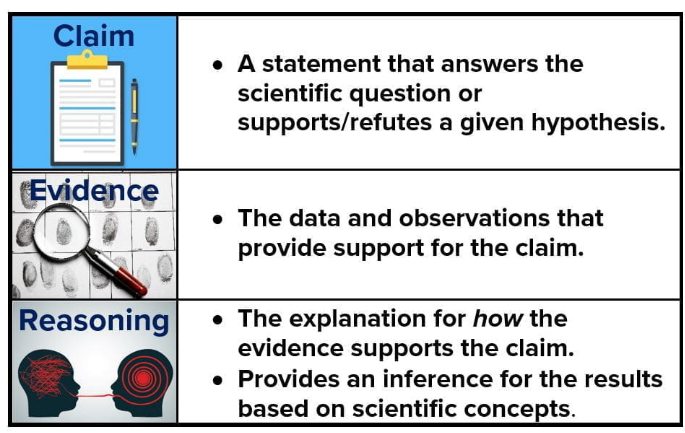
Claim, evidence, and reasoning: these three words form an outline for writing about science. Specifically, these words help us think like a scientist—they help us organize our ideas when writing a conclusion about a scientific question. But what does a claim-evidence-reasoning (CER) response look like? How is one written? This lesson will help you learn more about CER responses and provide practice for writing this type of response.
Scientific Questions
The first step in finding an answer is to make sure you have a testable science question. Sometimes questions need to be clarified so they can be tested.
Let’s look at an example of a question: Which brand of paper towel is the strongest?
In this example, brand and paper towel have clear meanings, but what about the term strongest? It is not clear what the “strength” of a paper towel means. Strength could be tested in several different ways, so this term needs to be defined. Let's define “strength” as the number of pennies one sheet of wet paper towel can hold before ripping. Let’s look at the testable question now: “Which brand of paper towel can hold the greatest number of pennies when wet?” Now that the question is testable, an investigation can be conducted, results can be analyzed, and a claim can be written.
Question 1
1.
Question 2
2.
Explain why the following question is not testable as it is written. Then skip two spaces (hit "return/enter" twice) and rewrite the question so that it is testable.
Which toy is the most fun to play with?
Scientific Claim
A claim is a statement that answers a scientific question. However, a claim cannot simply be an idea or an opinion. A claim can only be made if there is evidence to support it. In science, evidence is often gathered during an investigation. Once evidence has been gathered, a claim can be written. Here are guidelines for writing claims:
Begin with a one-sentence summary of the results (conclusion).
Answer the scientific question.
Include the relationship between the independent and dependent variables.
Do not start the claim with “yes” or “no.”
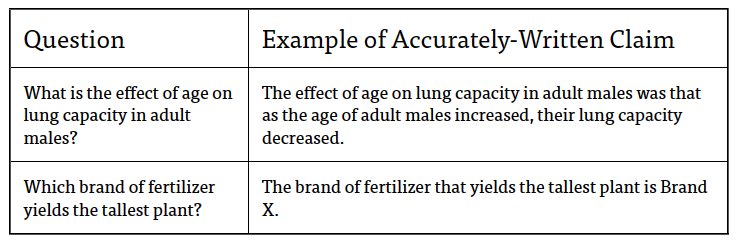
Let’s look at some scientific questions and claims.
The examples in the table above are examples of claims written correctly—they meet the criteria listed above the table. Notice that in the example about lung capacity, the sentence includes the original question as a stem for the claim. Both examples accurately state the relationship between the variables.
Examples of Claims Written Incorrectly
Now let’s look at some other claims that students wrote for these same scientific questions.
Imagine one of your classmates wrote a claim for the question, “What is the effect of age on lung capacity in adult males?” Your classmate wrote this claim: “Older people have lower lung capacity.”
This claim does not answer the question being tested. The question specifically asks about adult males, not all people or all ages. The claim must state the results of the question tested and include the relationship between the specific variables.
Now let’s look at the second question, “Which brand of fertilizer yields the tallest plant?” This time, imagine your lab partner wrote this claim: “Yes, fertilizer makes plants grow taller.”
Question 3
3.
Using the criteria listed below the first paragraph in this section, explain at least one error your lab partner made by writing the claim, “Yes, fertilizer makes plants grow taller.”
As you may have noticed, your lab partner's claim has many errors. For example, it starts with “yes.” Also, It does not provide an answer to the scientific question which was related to the brand of fertilizer. Moreover, your lab partner’s claim does not state the relationship between the independent variable (brand of fertilizer) and the dependent variable (height of plant).
Question 4
4.
Remember, claims should provide a concise but specific answer to the testable question. Claims should also clearly state the relationship between the variables studied. Avoid vague words like “change” or “affect.” Instead, state specifically how the variables changed.
Evidence
The second part of a CER response is the evidence. To write accurate claims, you first have to collect evidence. Evidence can include qualitative observations, quantitative data, or a combination of both. The evidence portion of the response should be where facts are stated. When using evidence to support a claim, be sure to follow these guidelines:
Use enough specific, relevant evidence to show the relationship between variables.
Answer the scientific question.
Let’s look at an example.
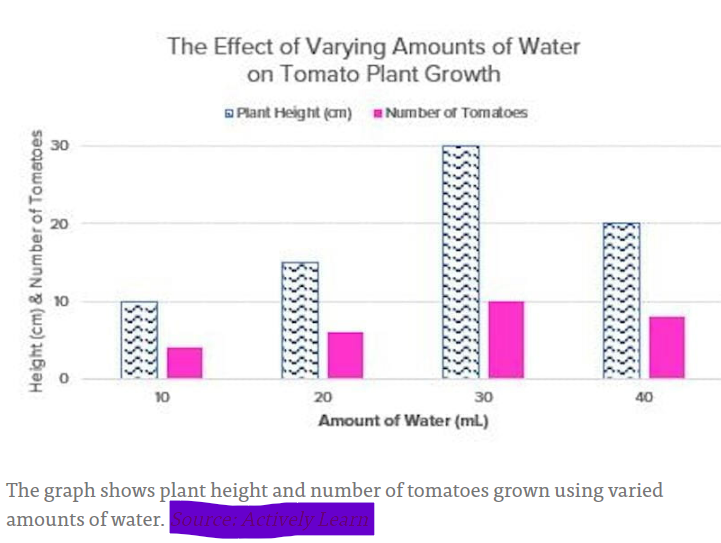
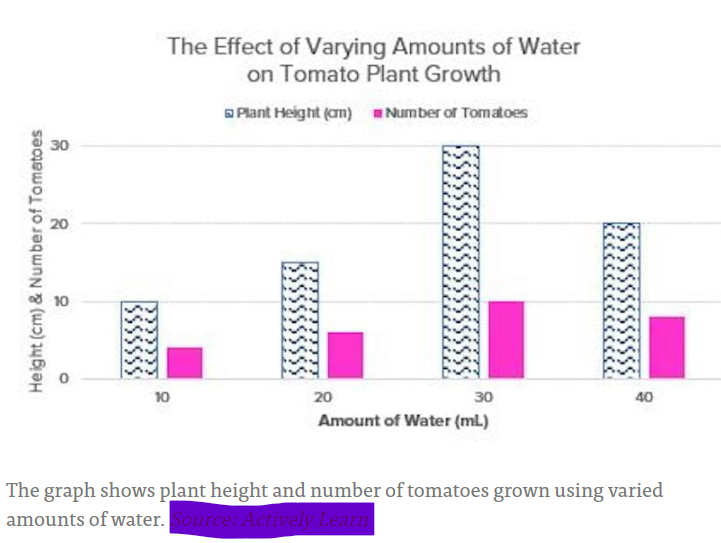
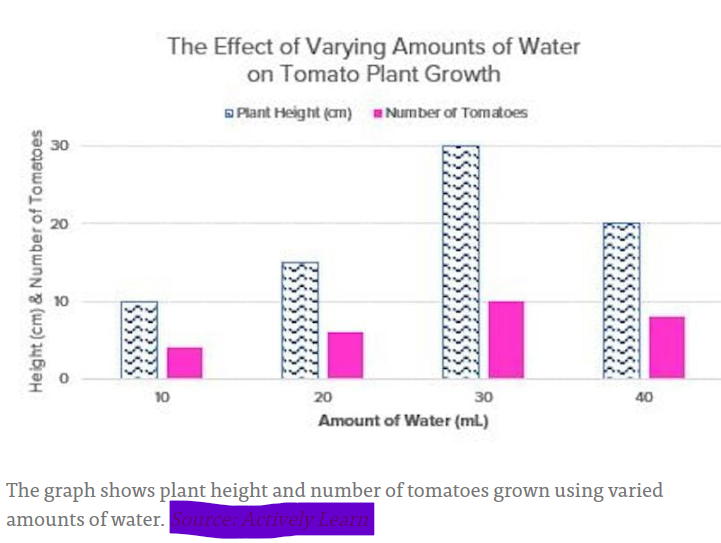
A student asks the scientific question, “How does the amount of water affect plant growth?” Plant growth is defined as both the height of the plant and the number of tomatoes it produces. The student conducts an investigation and collects data, which is shown in the graph below.
Remember the question being investigated is, “How does the amount of water affect plant growth?” To write a claim about this question, you need to analyze the evidence.
Question 5
5.
After analyzing the data, you can make a claim. Remember: a claim should answer the scientific question by stating the relationship between the variables.
Question 6
6.
After stating the claim, show the claim to be true with evidence. Remember: the evidence used to support a claim should be relevant, specific, and show the answer to the scientific question.
Question 7
7.
Reasoning
The final part of a CER response is the reasoning. Reasoning explains the connection between the evidence and the claim. It should be based on scientific concepts or definitions. Let’s look at a sample CER response for the plant growth investigation. Look at the corresponding margin notes to see which part of the response is the claim, evidence, and reasoning.
CER Response: The effect of the amount of water on plant growth was that as the amount of water increased to 30 mL, the plant growth increased, more than 30 mL of water resulted in stunted growth. The evidence was that with 10 mL of water, the height was 10 cm, and the plant produced four tomatoes. As the amount of water reached 30 mL, the height and number of tomatoes increased. 30 mL of water resulted in the maximum height of 30 cm and a production of 10 tomatoes. Finally, with 40 mL of water, the height reached only 20 cm while the plant produced only eight tomatoes. The evidence shows that the amount of water for maximum growth was 30 mL as this produced the greatest height and number of tomatoes. Plants seem to have an optimal amount of water to yield the best growth results, which was 30 mL of water for this plant. An inference for these results could be that plants need water for photosynthesis because plants combine water, sun energy, and carbon dioxide to make glucose. The glucose can then be used for growth. Using more water than what is needed for the plant does not improve growth as shown by the evidence, since 40 mL of water led to less growth than 30 mL of water.
Reread the reasoning portion of this response and think about its purpose.
Question 8
8.
CER Combined
Let’s walk through all the steps of writing a CER response with another investigation example.
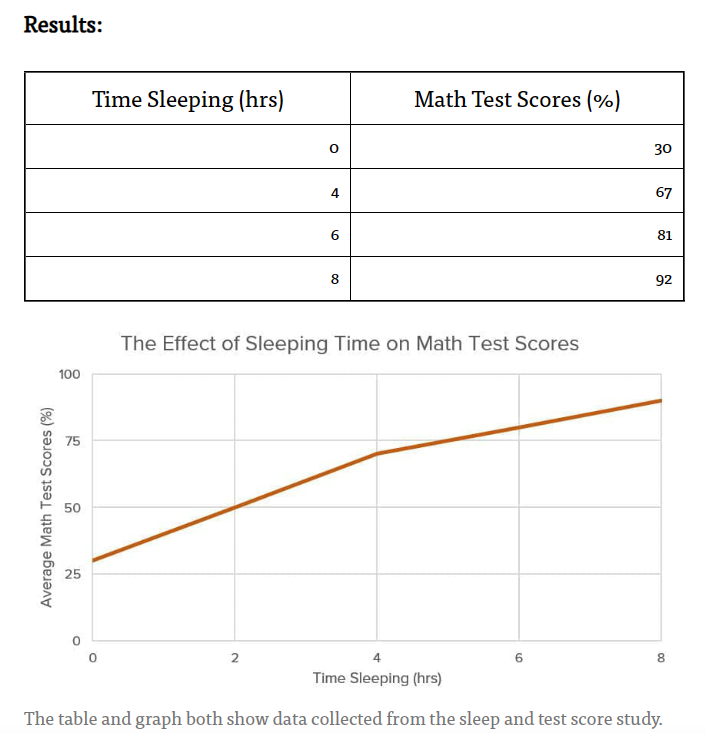
Question: How does the amount of sleep affect math test scores?
CER Response: As the number of hours of sleep increased, the math test scores increased. The evidence that supports this claim is shown by the positive trend in the graph. With only four hours of sleep, the math test score was 67%. With six hours of sleep, the score increased to 81%. With eight hours of sleep, the math test score increased to 92%. The data shows that sleep improves test scores. An inference for these results is that sleep improves brain function. As shown by the evidence, more sleep makes it easier to recall math facts and solve math problems.
Question 9
9.
Draggable item
arrow_right_alt
Corresponding Item
arrow_right_alt
arrow_right_alt
arrow_right_alt
You Try It!
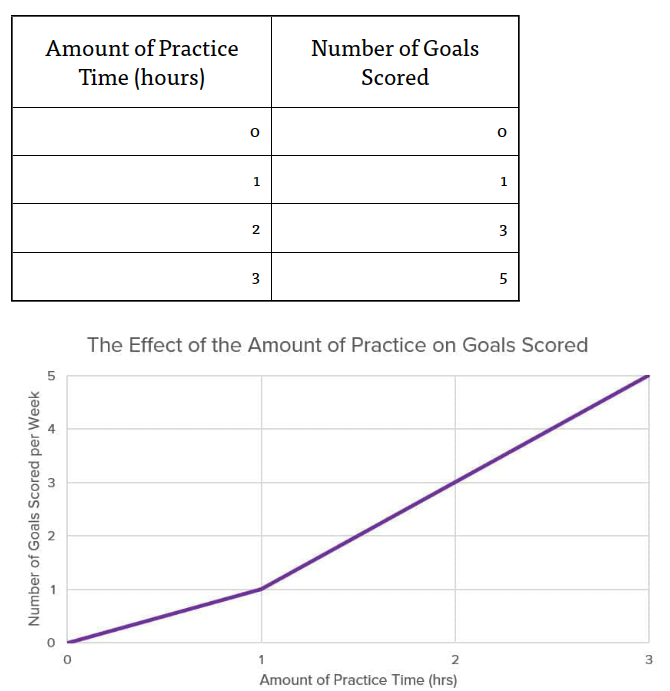
Imagine that you are the striker on a soccer team. You are curious to find out if the amount of time you spend practicing each week can affect the number of goals you score in soccer matches.
Testable question: How does the amount of time spent practicing affect the number of goals scored in a week?
You collect the following evidence:
The Effect of Amount of Practice on the Number of Goals Scored in a Week
Using the data in the table and graph above, write a Claim-Evidence-Reasoning response for the soccer investigation, “How does the amount of time spent practicing affect the number of goals scored in a week?” in the provided spaces below.
Question 10
10.
Claim (1-2 sentences)
Question 11
11.
Evidence (1-2 sentences)
Question 12
12.
Reasoning (1-2 sentences)
Which statement describes how a scientific question should be written?
It should be stated in general terms.
It should include an answer.
It should be testable.
It should have at least three parts.
Examine this testable question: “How does temperature of water affect the dissolving time of drink mixes?”
Which claim is in the correct format?
Yes, dissolving time is affected by temperature.
The temperature affects dissolving time.
As the temperature of water increased, the dissolving time of drink mixes decreased.
Dissolving time varies with temperature, so changing the temperature changes the dissolving time.
Based on the graph above, which amount of water resulted in the greatest plant height and number of tomatoes?
20 mL
40 mL
30 mL
10 mL
Which statement best describes an appropriate claim for the data shown?
No, the amount of water did not affect the growth of the plant.
As the amount of water increased to 30 mL, plant growth increased.
As the amount of water increased to 40 mL, plant growth increased.
Yes, the amount of water affected the growth of the plant.
The correct claim from question 7 was, "As the amount of water increased to 30 mL, plant growth increased."
Which of the following sentences are relevant, supporting evidence for this claim? Select all that are correct.
30 mL of water produced 10 tomatoes.
The species of the plant was Solanum lycopersicum.
40 mL of water produced 8 tomatoes.
The amount of water was changed from 10 mL to 40 mL.
The number of tomatoes varied from 4 to 10.
30 mL of water resulted in a plant height of 30 cm.
Which statement best describes the purpose of the reasoning portion of a CER response?
It explains an inference for the results as connected to a scientific concept.
It lists the qualitative observations and quantitative data from the experiment.
It provides a testable question to be studied.
It provides a statement that answers a scientific question.
Match each statement with the correct label.
Reasoning
As the number of hours of sleep increased, the math test scores increased.
Claim
With eight hours of sleep, the math test score increased to 92%.
Evidence
An inference for these results is that more sleep makes it easier to recall math facts.