1
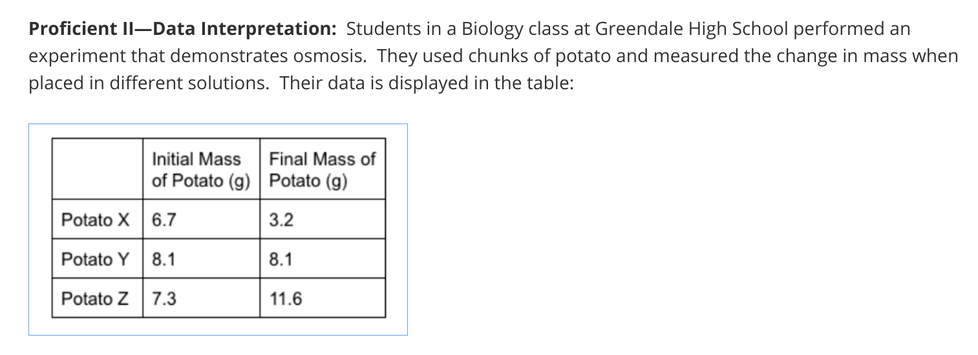
Which Trial shows the result of the potato cells in an ISOTONIC solution?
Which Trial shows the result of the potato cells in an ISOTONIC solution?
1
1
1
Basic I—Matching: Match the part of the cell membrane with description. (½ pt each).
| Draggable item | arrow_right_alt | Corresponding Item |
|---|---|---|
Peripheral protein | arrow_right_alt | Acts as a boundary: BARRIER, and allows small materials to move in and out: TRANSPORT |
Phospholipid | arrow_right_alt | Allows large materials to move in and out: TRANSPORT |
Channel | arrow_right_alt | Receives messages that direct cell work and receives like a lock and key message: COMMUNICATION |
Receptor | arrow_right_alt | Identifies the cell--like a nametag, important for the immune system: COMMUNICATION |
Basic II—Multiple Choice: Select the best answer from the choices below (1 pt each).
Which of the seven criteria of life is the cell membrane MOST ESSENTIAL for maintaining?
When materials diffuse, they:
A cell moves particles from a region of lower concentration to a region of higher concentration by ________________ with the use of ATP energy?
The movement of material across the membrane during diffusion stops when:
The cell membrane contains channels and receptors that help move materials from one side to the other. What are these channels made of?
Osmosis is the movement of________.
For each beaker below, decide which direction the material (water, sugar or salt in the beaker solution) will diffuse. Circle either INTO the cell or OUT of the cell for each beaker.
Proficient I—Diffusion: Water, sugar and salt are able to be transported across the membrane. Complete the diagram for a cell below:
Calculate the amount of solutes present in the solution.
Use and label arrows to illustrate which substance(s) is/are moving into or out of the cell.
Which Trial shows the result of the potato cells in an ISOTONIC solution?
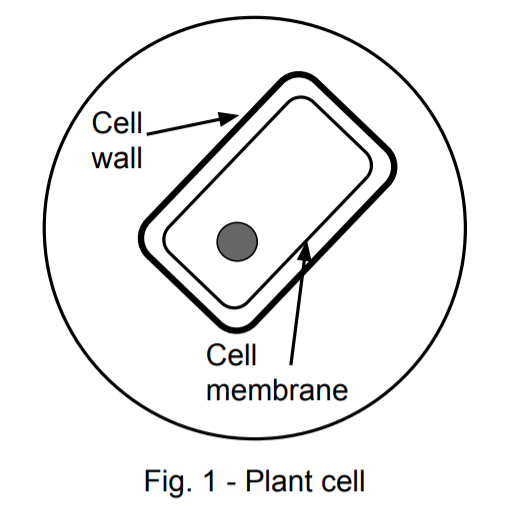
When looking under the microscope, potato cells looked similar to Fig 1.
In the circles below, sketch what the potato cell may look like after being placed in each solution.
Advanced: Creating and Explaining Diagrams ( 3pts)
Draw a cross section of cell membrane in the space below. Include these items:
Draw tails on the phosphate heads
Add 2 channel proteins
Add 1 receptor protein
Label the cytoplasm
Label the hydrophobic area
Label the hydrophilic area
Add to your diagram. (2pts)
1. Carbon dioxide
Add CO2 to your diagram using ▲s. Distribute the CO2 so that the molecule will diffuse out of cell.
Draw an arrow and label the arrow to show which part of cell membrane the CO2 molecule would pass through.
2. Glucose
Add GLUCOSE to your diagram using ⬡s. Distribute the GLUCOSE so that the molecule will diffuse into the cell.
Draw an arrow to show which part of cell membrane the glucose molecule would pass through.
Draw exocytosis below and explain when it would be used.
you chose your answer for #10 because...
Which Trial shows the result of the potato cells in a HYPOTONIC solution?
You chose your answer for #12 because...