HS-LS1-3 Plan and conduct an investigation to provide evidence that feedback mechanisms maintain homeostasis.
Learning Goals (I can...):
1. Explain how concentration gradients and membrane permeability affect the rate of transport.
2. provide examples of pumps and other membrane structures that are used in active transport.
3. provide a short list of similarities and differences between active and passive transport.
In the next section, you will watch a video related to active transport.
As you watch, think about the following questions:
What do you think is occurring?
What part of the cell is involved?
What is needed in order for the observed process to occur?
Briefly explain what you think happened in the video.
(I have to grade this, manually)
What happened?
In the video, you saw an example of how the immune system works to destroy foreign cells and substances.
The large cell in the center was a human macrophage, a part of the immune system. The little cells shaped like donuts were red blood cells from a sheep. The human macrophage engulfed the sheep blood cells because it did not recognize them (remember the glycoproteins and glycolipids are used to identify the cell) and attacked them as invading or foreign cells. When cells engulf material such as other cells or invading bacteria, this is a form of active transport.
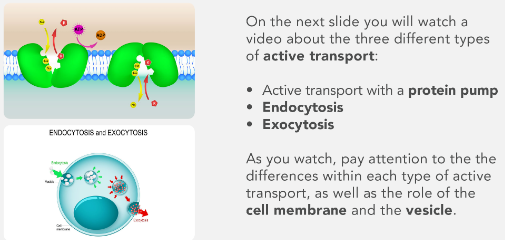
Use the information from the video to help you match the vocabulary terms to their definition.
| Přetahovatelná položka | arrow_right_alt | Odpovídající položka |
|---|---|---|
exocytosis | arrow_right_alt | used when molecules pass through the cell membrane against the concentration gradient with the use of ATP |
protein pump | arrow_right_alt | occurs when a vesicle merges with the cell membrane to bring material into the cell |
passive transport | arrow_right_alt | occurs when a vesicle merges with the cell membrane to release material from the cell |
endocytosis | arrow_right_alt | the movement of molecules across a cell membrane using ATP |
active transport | arrow_right_alt | movement of molecules across a cell membrane without the use of ATP |
A protein pump is located in the .
Why does sodium and potassium ions need a protein pump to pass through the cell membrane (select all that apply)?
Molecules moving against the concentration gradient move from an area of to and area of .
Protein pumps are efficient because they...(select all that apply)
Watch the video below. As you watch, pay attention to the following, pause the video when you hear it, and record the information where it asks for it below the video:
Similarities between active and passive transport
Differences between active and passive transport
Types of passive transport
Types of active transport
Provide two similarities between active and passive transport.
Use the information from the video(s) to help you answer the following:
Requires ATP (input of energy). | Moves down the concentration gradient. | Moves up the concentration gradient. | Used to move materials through the cell membrane. | |
|---|---|---|---|---|
Active Transport | ||||
Passive Transport |
Provide two examples of active transport.
Provide two examples of passive transport.
_____ occurs when a vesicle merges with the cell membrane to release proteins (select all that apply).
If molecules are moving from an area of low concentration to high concentration, _____ is needed (select all that apply).
Endocytosis relies on which two structures to move molecules in and out of the cell (select all that apply)?
Which of the following is NOT an example of active transport (select all that apply)?
A protein pump is an example of endocytosis since it brings molecules into the cell.
Explain why active transport is necessary for a cell to survive. (I have to regrade this.)
Provide one thing that you feel like you do not fully understand from this activity.
After having completed this activity, my confidence regarding this concept has: