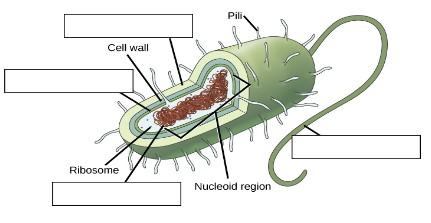
Label the parts of the cell to the left, in the numbered blanks below.
1
Asemmisa {{asɛmmisaAhyɛnsode}}
10.
1
Asemmisa {{asɛmmisaAhyɛnsode}}
11.
1
Asemmisa {{asɛmmisaAhyɛnsode}}
12.
1
Asemmisa {{asɛmmisaAhyɛnsode}}
13.
Use the reading and the diagram on the left to complete the statements, questions, and diagram.
Do not attempt to look things up by utilizing a websearch - formative tells me when you have done this (many times, I have not said anything, other times I have) - please use the provided material.
Use the reading and the diagram on the left to complete the statements, questions, and diagram.
Do not attempt to look things up by utilizing a websearch - formative tells me when you have done this (many times, I have not said anything, other times I have) - please use the provided material.
Learning Objectives:
Describe the structure of eukaryotic cells
Compare prokaryotic cells with eukaryotic cells
Have you ever heard the phrase “form follows function?” It’s a philosophy that many industries follow. In architecture, this means that buildings should be constructed to support the activities that will be carried out inside them. For example, a skyscraper should include several elevator banks. A hospital should have its emergency room easily accessible.
Our natural world also utilizes the principle of form following function, especially in cell biology, and this will become clear as we explore eukaryotic cells (Figure 4.8). Unlike prokaryotic cells, eukaryotic cells have:
1) a membrane-bound nucleus;
2) membrane-bound organelles, such as the endoplasmic reticulum, Golgi apparatus, chloroplasts, mitochondria, and others; and
3) single-stranded chromosomes.
Because a membrane surrounds eukaryotic cell’s nucleus, it has a “true nucleus.” The word “organelle” means “little organ,” and, as we already mentioned, organelles have specialized functions, just as your body's organs have specialized functions. We will discuss the function of each organelle in a later activity.
At this point, it should be clear to you that eukaryotic cells have a more complex structure than prokaryotic cells.
Cells are the basic
There are two basic categories of cells - they are:
Eukaryotes are much more complex than prokaryotes. Three things that are found in eukaryotic cells that are not found in prokarytic cells are:
1.
2.
3.
Organelles are structures that have
Name examples of prokaryotic and eukaryotic organisms
Compare and contrast prokaryotic and eukaryotic cells
Describe the relative sizes of different cells
Explain why cells must be small
A cell is the basic unit of structure and function of all living things. Whether comprised of one cell (like bacteria) or many cells (like a human), we call it an organism. Thus, cells are the basic building blocks of all organisms.
Several cells of one kind that interconnect with each other and perform a shared function form tissues. These tissues combine to form an organ (your stomach, heart, or brain), and several organs comprise an organ system (such as the digestive system, circulatory system, or nervous system). Several systems that function together form an organism (like a human being). Here, we will examine the structure and function of cells.
Cells fall into one of two broad categories: prokaryotes and eukaryotes. We classify only the predominantly single-celled organisms bacteria and archaea as prokaryotes. Animal cells, plants, fungi, and protists are all eukaryotes.
Components of Prokaryotic Cells
All cells share four common components:
1) a plasma membrane, an outer covering that separates the cell’s interior from its surrounding environment;
2) cytoplasm, consisting of a jelly-like cytosol within the cell in which there are other cellular components;
3) DNA, the cell's genetic material; and
4) ribosomes, which synthesize proteins.
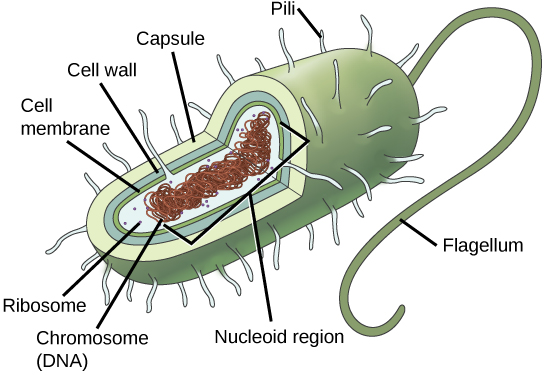
However, prokaryotes differ from eukaryotic cells in several ways. A prokaryote is a simple, mostly single-celled (unicellular) organism that lacks a nucleus, or any other membrane-bound organelle. We will shortly come to see that this is significantly different in eukaryotes. Prokaryotic DNA, which is in the form of a single circular chromosome, is in the cell's central part: the nucleoid (Figure 4.5).
Figure 4.5 This figure shows the generalized structure of a prokaryotic cell. All prokaryotes have chromosomal DNA localized in a nucleoid, ribosomes, a cell membrane, and a cell wall. The other structures shown are present in some, but not all, bacteria.
Most prokaryotes have a peptidoglycan (which is a type of polysaccharide) cell wall and many have a polysaccharide capsule (Figure 4.5). The cell wall acts as an extra layer of protection, helps the cell maintain its shape, and prevents dehydration. The capsule enables the cell to attach to surfaces in its environment. Some prokaryotes have flagella, pili, or fimbriae. Flagella are used for locomotion. Pili exchange genetic material during conjugation, the process by which one bacterium transfers genetic material to another through direct contact. Bacteria use fimbriae to attach to a host cell.
Prokaryotes are predominatly made up of
Animal cells, plant cells, fungal cells, and protists are classified as
Select all of the structures that all cells share:
Prokaryotic DNA is in the form of a
Flagella, which is a whip-like structure, is used for
Prokaryotes have a cell wall that is constructed of
Genetically, bacteria possess an interesting characteristic, the ability to transfer genetic information (DNA) from one bacteria to another by direct contact. This is referred to