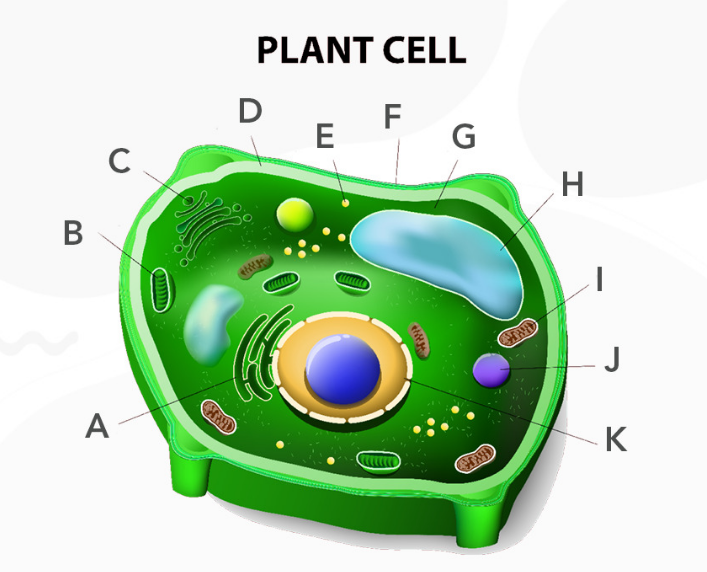
Two major types of eukaryotic cells are plant and animal cells.
Examine the image below (to zoom on it, click on the image). What are some similarities? What are some differences?
Learning Goals:
Identify the organelles in plant cells.
Identify the function of organelles in plant cells.
Identify the location of organelles in plant cells.
Compare and contrast plant and animal cells.
You will now take a virtual tour of a jungle in Costa Rica. As you explore the panoramic image of the terrain, think about where you would find plant and/or animal cells - in which organisms?
In the upper-right of the panoramic image, below, click the arrows to open the 360 panoramic image to view it fullscreen. When you are finished viewing it, click the escape key.
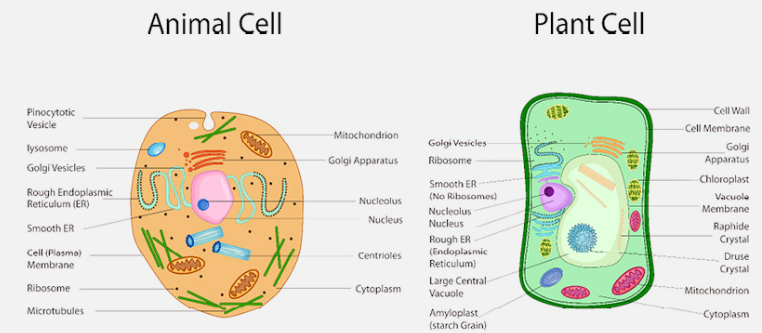
Two major types of eukaryotic cells are plant and animal cells.
Examine the image below (to zoom on it, click on the image). What are some similarities? What are some differences?
Provide a list of three similarities between plant and animals cells from the image.
Provide a list of three differences between plant and animals cells from the image.
Plants are multicellular organisms made up of eukaryotic cells. In a food web (which we will discuss in a much later unit), plants are known as producers. This name refers to the fact that they are able to make their own food (sugars) using energy from light (usually the sun), water, and carbon dioxide gas. This process is called photosynthesis.
One of the ways that a plant cell is different from an animal cell is that plant cells have specialized organelles for performing photosynthesis. Animal cells do not make their own food - they must consume (or eat) it. They must rely upon plants and other animals for their energy.
What process does a plant cell perform that animal cells cannot?
What does this process produce?
Next, you will watch a video about some organelles in plant cells. As you watch, pay attention to each organelle discussed and their:
general appearance
location with reference to the nucleus, cell membrane, and other organelles.
function of the organelles
You will use the video to perform a question - match the organelles with their function.
| Draggable item | arrow_right_alt | Corresponding Item |
|---|---|---|
Golgi body (apparatus, complex) | arrow_right_alt | Organelle that hold the DNA of the cell. |
Ribosome | arrow_right_alt | Has ribosomes embedded on its surface and assists in protein synthesis. |
Cell Membrane | arrow_right_alt | Organell that makes lipids for the cell. |
Vacuole (central vacuole) | arrow_right_alt | Organelle that assists in cell division (mitosis and meiosis) |
Mitochondria | arrow_right_alt | Organelle that packages proteins in vesicles for transport across the cell. |
Cell Wall | arrow_right_alt | Stores mostly water in a plant cell to help create turgor pressure within the cell. |
Chloroplast | arrow_right_alt | Organelle that converts sugar into usable energy (ATP) for the cell. |
Cytoplasm | arrow_right_alt | Primary organelle that performs protein synthesis. |
Smooth Endoplasmic Reticulum (smooth ER) | arrow_right_alt | Fluid-like material that fills the space within the cell membrane; contains the organelles and cushions them. |
Nucleus | arrow_right_alt | Rigid part of certain cells (plant and fungi) that is on the outside of the cell membrane. Provides extra structure for the cell. |
Centrosomes | arrow_right_alt | On the outside of all cells; controls what can enter and leave the cell. |
Rough Endoplasmic Reticulum (rough ER) | arrow_right_alt | Converts energy in light into carbohydrates (sugars) |
Next, you will use an interactive activity to review the location of the organelles within a plant cell.
Select "Plant Cell" and find the name of each organelle below the cell diagram. Try to locate the organelle within the cell yourself. Then click on the name of the organelle to see its location highlighted in the cell model.
After this interactive, you will have a short five question "quiz" in which you will have to identify some of the organelles in a plant cell. Pay close attention for the following - vacuole, nucleur membrane, chloroplast, cell wall, cell membrane, mitochondria, endoplasmic reticulum, and the Golgi apparatus.
Identify the following cellular structures in the image on the left.
a. Cell Wall
b. Cell Membrane
c. Nuclear Membrane
d. Mitochondria
e. Chloroplast
f. Endoplasmic Reticulum
g. Golgi Apparatus
Next, you will watch a video that explores some of the major differences between plant and animal cells. As you watch the video, pay attention to the differences in these cell types, in terms of:
functions
organelle types
shape and structure
What do you already know about plant cells and how they differ from animal cells?
In your own words, explain how plant cells' rigid wall make plants very different from animals.
In your own words, explain how plant cells' large central vacuole differs from the vacuoles found in some animal cells.
Use the information learned from this activity to complete the following table by using the "T" feature to type the needed information in each box.
A plant cell is round in shape.
Which of the following organelles is found in both the plant and animal cell (select all that apply)?
Which of the following organelles is responsible for collecting sunlight and converting it into sugars (food) for the plant cell (select all that apply)?
Which organelle is responsible for the rigid support for a plant cell?
Turgor pressure is caused by the cell wall within the plant cell.
After having completed this activity, how has your confidence regarding this concept changed?
Provide a list of one or two things that you learned from this activity.
Which of the following is NOT true of lycophytes (select all that apply)?
Which of the following accurately describes a chief difference between eukaryotic and prokaryotic cells (select all that apply)?