Copy of Photosynthesis: The Chloroplast and Leaves (5/28/2026)
star
star
star
star
star
Last updated about 3 hours ago
22 questions
The Chloroplast and Photosynthesis
1
1
1
1
1
1
1
1
3
2
3
2
2
1
Leaves and Photosynthesis
1
1
1
2
1
1
1
1
Learning Goals:
Structure and function of chloroplast.
Parts of the chloroplast used in photosynthesis.
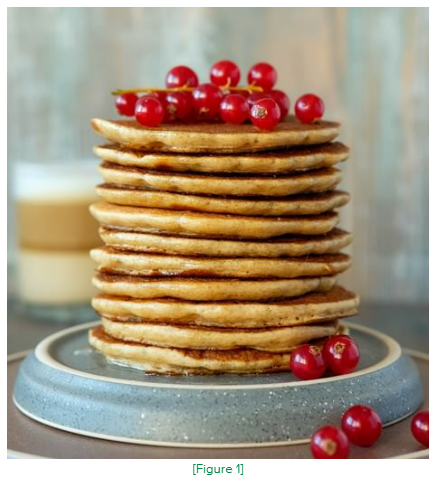
What do pancakes and chloroplasts have in common?
The chloroplast is the site of photosynthesis. Part of the photosynthesis reactions occurs in an internal membrane within the organelle. The chloroplast contains many of these internal membranes, making photosynthesis very efficient. These internal membranes stack on top of each other, just like a stack of pancakes.
Stages of Photosynthesis
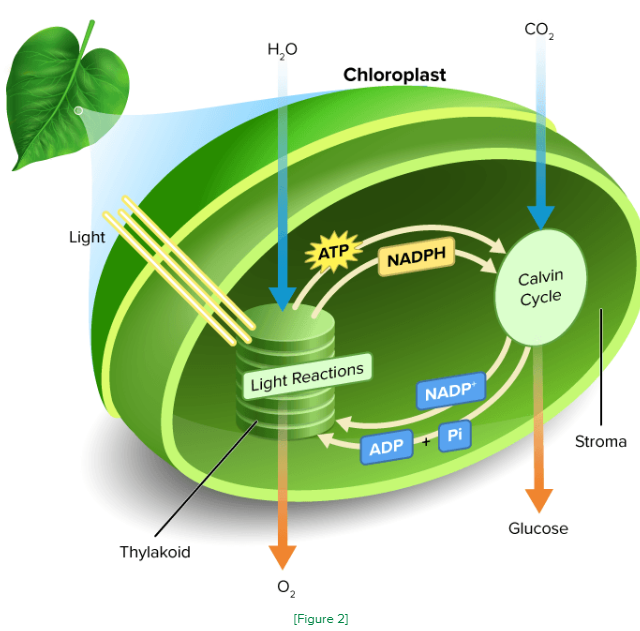
Photosynthesis occurs in two stages, which are shown in the Figure below.
Stage I is called the light reactions. This stage uses water and changes light energy from the sun into chemical energy stored in ATP and NADPH (another energy-carrying molecule). This stage will use some of the energy absorbed from light to split apart water (H2O). This releases two H+ and one O-. The two H+ will later be used to build glucose in the second stage of photosynthesis. The O- will be linked to another O- to form O2 (oxygen gas) which is released as a waste product. These reactions also produce two energy carrying molecules - ATP and NADPH that will power the reactions of the second statge. The light reactions take place in the granum (multiple staked thylakoids).
Stage II is called the Calvin cycle. This stage uses energy in the NADPH and ATP formed in the light reactions, to link three CO2 molecules with some of the H+ ions formed by the spliting of water in the light reactions. This will eventually form one molecule of glucose. The Calvin cycle takes place in the stroma (the empty space between the thylakoids and the inner membrane of the chloroplast).
Before you read about these two stages of photosynthesis in greater detail, you need to know more about the chloroplast, where the two stages take place.
The Chloroplast
Chloroplasts: Theaters for Photosynthesis
Photosynthesis, the process of turning the energy of sunlight into ‘‘food,’’ is divided into two basic sets of reactions, known as the light reactions and the Calvin cycle, which uses carbon dioxide. As you study the details in other concepts, refer frequently to the chemical equation of photosynthesis: 6 CO2 + 6 H2O →(Light Energy)→ C6H12O6 + 6 O2. Photosynthesis occurs in the chloroplast, an organelle specific to plant cells.
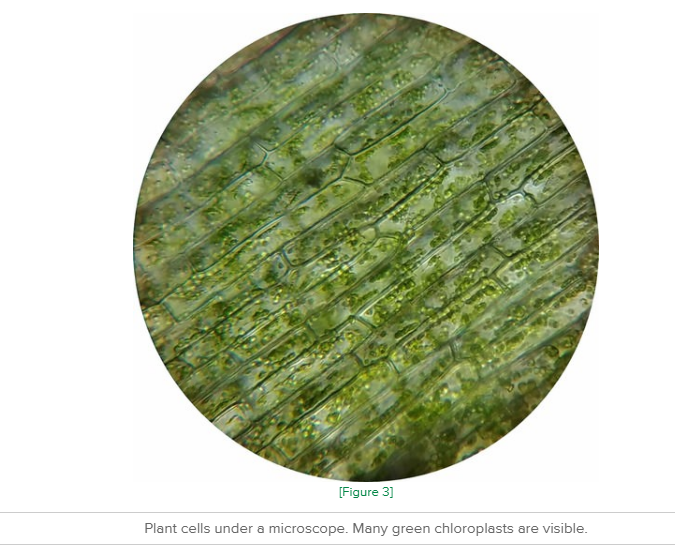
If you examine plant cells, shown in the Figure below, under a microscope, you will see within each cell dozens of small green ovals. These are chloroplasts, the organelles which conduct photosynthesis in plants and algae. Chloroplasts closely resemble some types of bacteria and even contain their own circular DNA and ribosomes. When we say that photosynthesis occurs within chloroplasts, we speak not only of the organelles within plants and algae but also of some bacteria – in other words, virtually all photosynthetic autotrophs.
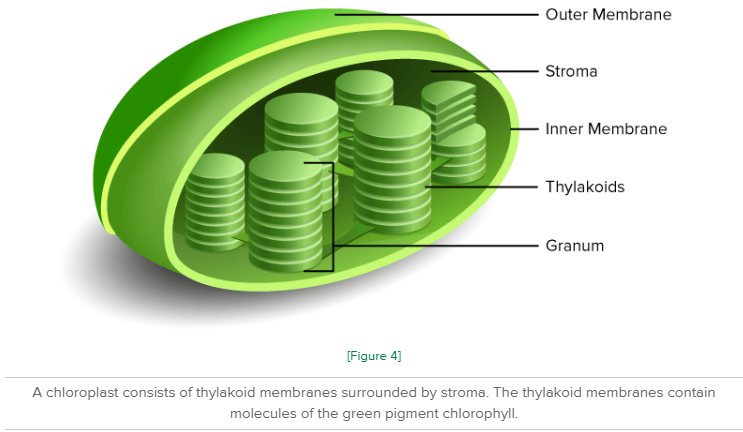
Each chloroplast contains neat stacks called grana (singular, granum). The grana consist of sac-like membranes, known as thylakoid membranes. These membranes contain photosystems, which are groups of molecules that include chlorophyll, a green pigment that absorbs light that is needed to drive these reactions. The light reactions of photosynthesis occur in the thylakoid membranes. The stroma is the space outside the thylakoid membranes. This is where the reactions of the Calvin cycle take place. In addition to enzymes, two basic types of molecules - pigments and electron carriers – are key players in this process and are also found in the thylakoid membranes.
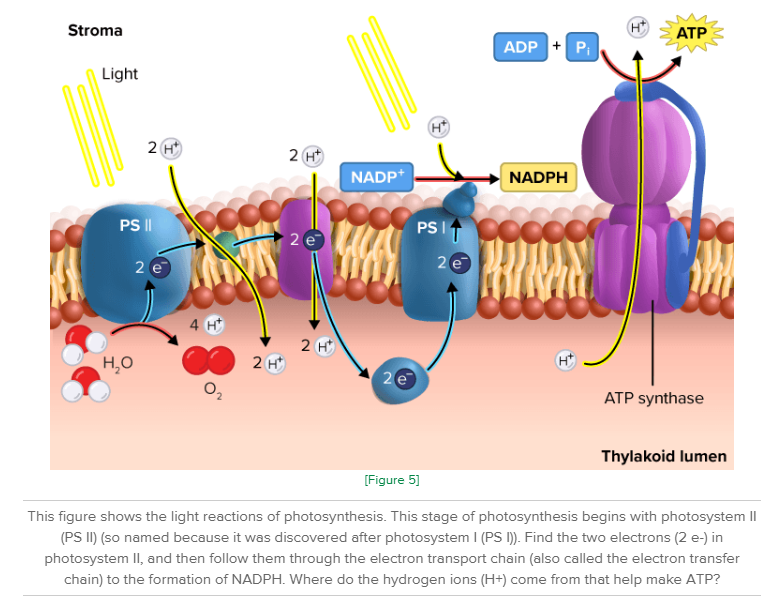
Electron carrier molecules are usually arranged in electron transport chains (ETCs). These accept and pass along energy-carrying electrons in small steps (Figure below). In this way, they produce ATP and NADPH, which temporarily store chemical energy. Electrons in transport chains behave much like a ball bouncing down a set of stairs – a little energy is lost with each bounce. However, the energy “lost” at each step in an electron transport chain accomplishes a little bit of work, which eventually results in the synthesis of ATP.
Summary
Photosynthesis occurs in two stages, the light reactions and the Calvin cycle.
Photosynthesis occurs in the chloroplast, an organelle specific to plant cells.
The light reactions of photosynthesis occur in the thylakoid membranes of the chloroplast.
Electron carrier molecules are arranged in electron transport chains that produce ATP and NADPH, which temporarily store chemical energy.
Question 1
1.
The initial role of chlorophyll is to _______.
Question 2
2.
The _______ is the site of photosynthesis.
Question 3
3.
Question 4
4.
Photosystems located in the _______ membrane contain photosynthetic pigments that absorb light energy.
Question 5
5.
Question 6
6.
Question 7
7.
The part of photosynthesis that uses carbon dioxide is _______.
Question 8
8.
What are the stacks of small disc-like structures present in the chloroplast: _______
Question 9
9.
Photosynthesis has _______ stages. The first are the _______. The second stage is referred to as the _______.
Question 10
10.
The first stage of photosynthesis uses _______ to breakdown _______ to release two H+ and one O- .
Question 11
11.
The second stage of photosynthesis is powered by two molecules - ATP and NADPH - that are formed in the _______. This stage will link the H+ ions formed in stage 1 with three _______ to form one molecule of _______.
Question 12
12.
Complete the following chemical reaction of photosynthesis:
Chloroplasts have a number of structures. Grana are constructed of mutiple stacked, sac-like, _______. These structures contain the pigment that is used to absorb light; this pigment is called _______.
Question 14
14.
The electron transport chain (ETC) is used to produce _______.
Learning Goals:
Structure and function of different kinds of specialized tissues in leaves - mesophyll, veins, and epidermis.
Role of stomata and guard cells to control transpiration and gas exchange.
Oxygen — the oxygen that we breathe — is just a waste product of what reaction?
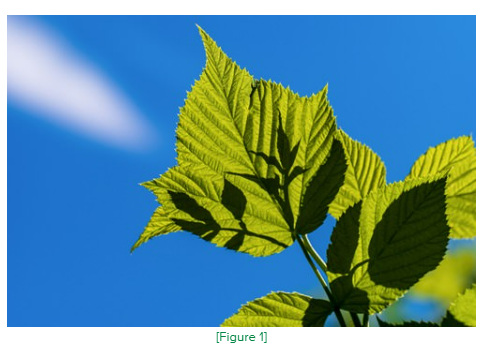
Every split second that sunlight hits that leaf, photosynthesis is initiated, bringing energy into the ecosystem. It could be said that this is one of the most important - if not the absolutely most important - biochemical reactions. And it all starts with the leaf.
Factories for Photosynthesis
Photosynthesis is the process that uses energy from the sun, together with carbon dioxide and water, to make glucose and oxygen. The primary role of photosynthesis is to make the carbohydrate, suggesting that oxygen, which is released back into the atmosphere, is just a waste product.
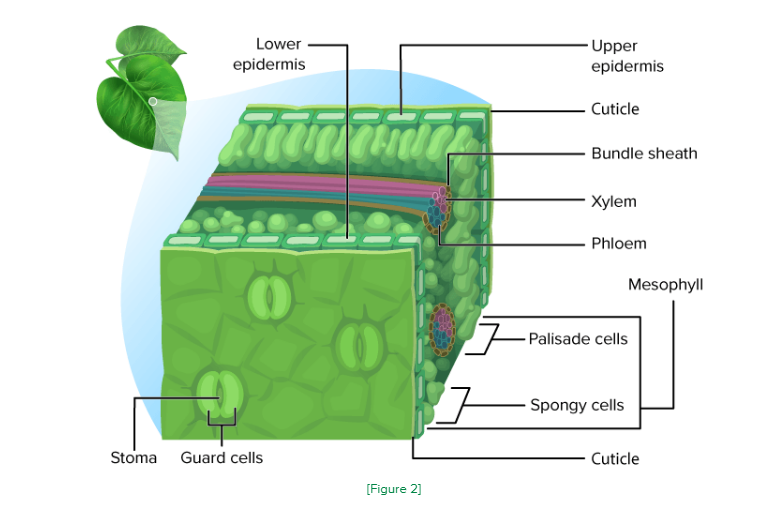
You can think of a single leaf as a photosynthesis factory. A factory has specialized machines to produce a product. It’s also connected to a transportation system that supplies it with raw materials and carries away the finished product. In all these ways, a leaf resembles a factory. The cross section of a leaf in the Figure below lets you look inside a leaf “factory.”
A leaf consists of several different kinds of specialized tissues that work together to make food by photosynthesis. The major tissues are mesophyll, veins, and epidermis.
Mesophyll makes up most of the leaf’s interior. This is where photosynthesis occurs. Mesophyll consists mainly of parenchyma with chloroplasts.
Veins are made primarily of xylem and phloem. They transport water and minerals to the cells of leaves and carry away dissolved sugar.
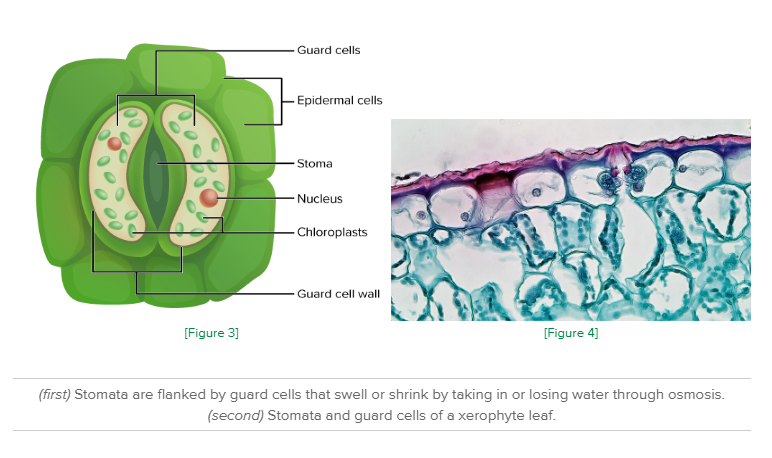
The epidermis of the leaf consists of a single layer of tightly-packed dermal cells. They secrete waxy cuticle to prevent evaporation of water from the leaf. The epidermis has tiny pores called stomata (singular, stoma) that control transpiration and gas exchange with the air (see Figure below). For photosynthesis, stomata must control the transpiration of water vapor and the exchange of carbon dioxide and oxygen. Stomata are flanked by guard cells that swell or shrink by taking in or losing water through osmosis. When they do, they open or close the stomata (see Figure below).
Summary
Specialized cells and tissues in leaves work together to perform photosynthesis.
The major tissues in a leaf are mesophyll, veins, and epidermis.
Question 15
15.
Question 16
16.
Question 17
17.
Question 18
18.
Question 19
19.
_______ is the process in which certain living things use energy in sunlight to synthesize glucose from carbon dioxide and water.
Question 20
20.
Organisms that make food for themselves are known as _______.
Question 21
21.
Question 22
22.
Select all of the structures that are involved in the light reactions of photosynthesis.
stroma
membrane surrounding the chloroplast
thylakoid membrane
bundle sheath
guard cells
Groups of molecules that include chlorophyll and are present in chloroplasts is/are (select all that apply):
chromoplasts
NADPH's
photosystems
Select all of these that are not a component of the chloroplast:
stroma
cristae
granum
The end product of photosynthesis is (select all that apply):
Starch
Glucose
Fructose
Galactose
Types of organisms that carry out photosynthesis include (select all that apply):
fungi
humans
insects
plants
protists
A by-product of photosynthesis that the plant releases into the atmosphere is oxygen.
True
False
Plants use energy from the sun to create (select all that apply):
carbon dioxide
carbon compounds
new plants
new growth
Photosynthesis takes place in a single chemical reaction.
True
False
Which of the following are direct products of photosynthesis (select all that apply)?