Log in
Sign up for FREE
arrow_back
Library

Copy of Fermentation Virtual Lab (5/28/2026)

star
star
star
star
star
Last updated about 3 hours ago
30 questions
Untitled Section
3
1
1
1
3
1
4
5
Exit Ticket
Required
0
Required
0

Pre-Lab Reading


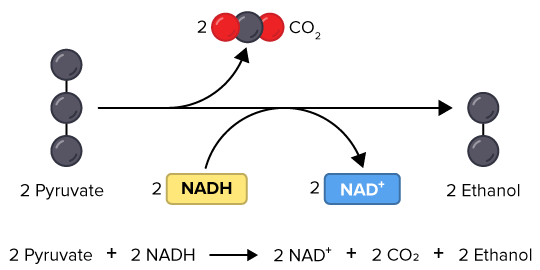
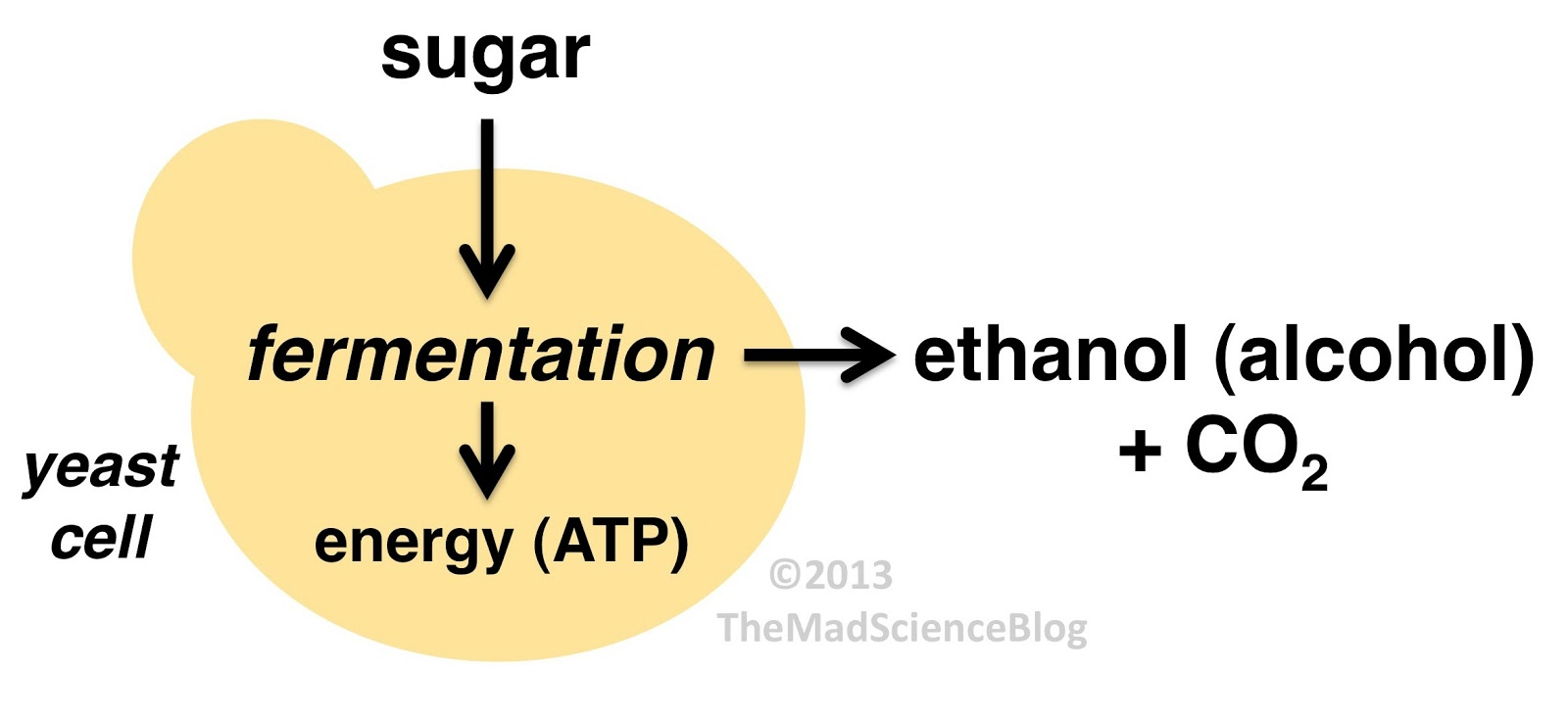
In alcoholic fermentation, pyruvate changes to alcohol (ethanol) and carbon dioxide (CO2). This is shown in the Figure below. NAD+ also forms from NADH, allowing glycolysis to continue making ATP. While fermentation will permit the cell to continue to produce ATP, fermentation does not actually produce it — it will only convert NADH into NAD+ to permit glycolysis to continue. Therefore, fermentation must be coupled with glycolysis in order to produce a net of 2 ATP's. Fermentation tends to occur in anaerobic conditions, meaning that the overall content of oxygen in the environment is lower than the content of carbon dioxide.

Alcoholic fermentation is carried out by yeasts and some bacteria. Like most processes that happen in a cell, fermentation is mediated (creates conditions that make it easier to occur) by an enzyme — in this case, the enzyme that yeast cells use is called zymase.


Saccharomyces cerevisiae is the most frequently encountered yeast in fermented beverages and foods based on fruits and vegetables, an observation reflected in the existence of more than eighty varieties for the species (known as "subspecies").

All species and subspecies of saccharomyces cerevisiae ferment glucose, and many ferment other plant-associated carbohydrates such as sucrose, maltose, and raffinose, but none can ferment the animal sugar lactose. Both simple carbohydrates (monosaccharides) and complex carbohydrates (polysaccharides) can be used in alcohol fermentation. However, since a monosaccharide (i.e., glucose) is much smaller than a polysaccharide (i.e., starch in flour), monosaccharides are easier to break down during fermentation than polysaccharides. Therefore, yeast breaking down glucose or sucrose will result in a higher fermentation rate than if starches are used.

In the tropics, Schizosaccharomyces pombe is frequently the dominant yeast in the production of traditional fermented beverages where a natural fermentation is allowed to occur, especially those produced from cereals such as maize and millet.
1
1
1
1
1
1
1
1
1
1
1
1
1
1
1
1
1
1
1
1

Questions

It is recommended that you review the reading at the top of this formative, as well as all evidence from this lab.
Question 21
21.

When do yeast cells use fermentation (anaerobic respiration) instead of cell respiration (aerobic respiration)?

Question 22
22.
What process is fermentation coupled with to produce ATP? _______
Question 23
23.
How many total ATP’s are produced when cells perform fermentation? _______
Question 24
24.
What enzyme do yeast cells produce that catalyzes the breakdown of sugars to form ethanol and carbon dioxide? _______
Question 25
25.

Why did the flask that was set-up with glucose result in a higher rate of fermentation than the set-up with flour? (use the evidence)

Question 26
26.
What gas was produced during this lab? _______
Question 27
27.

Explain how the answer to the prior question was confirmed. (use the evidence/rational)

Question 28
28.

When each apparatus was initially set-up the gas that was trapped in each flask by the balloon was identical to the composition of gasses in the air around us (78% nitrogen, 21% oxygen, 0.93% argon, 0.04% carbon dioxide, other gasses). Knowing this did the yeast cells perform fermentation the entire time that each apparatus was set-up? Please explain.

Question 29
29.

Provide a list of one or two things that either you learned or any confusions that may have been clarified by this activity.

Question 30
30.

Lab Protocol

Materials:
  • Water
  • Yeast (saccharomyces cerevisiae)
  • Glucose
  • Flour
  • Heater
  • Five Erlenmeyer Flasks
  • Five Balloons
  • Red and Blue Litmus Paper
Five Set-Ups:
1. Water + Yeast
2. Water + Yeast + Glucose
3. Water + Yeast + Glucose (heated x3 minutes)
4. Water + Glucose
5. Water + Yeast + Flour

Procedure:
  • The contents of each flask are mixed according to the above contents.
  • The mouth of each flask is sealed with a balloon to prevent anything from entering or exiting each flask.
  • Each set-up is permitted to sit x24 hours – provides enough time for fermentation to occur, if it is to occur.
  • After 24 hours, we will measure the amount of gas that is in each balloon – what is the gas?
Testing the Gas Produced:
  • The gas in the balloons will be dissolved in water.
  • Red Litmus Test – red litmus paper will remain red in an acid solution and turn blue in an alkaline solution.
  • Blue Litmus Test – blue litmus paper will remain blue in an alkaline solution and turn red in an acidic solution.
  • What was the gas produced?

Instructions

Contents:
  • Record the contents of each flask and anything else that happens to them.
  • For blanks 1, 3, 5, 7, and 9 you will be recording what went into each flask.
Claim:
  • In this section, you are predicting whether you believe each set-up will result in fermentation occurring or not.
  • Record "yes" if you believe it will occur.
  • Record "no" if you believe it will not occur.
  • For blanks 2, 4, 6, 8, and 10 you will be recording "yes" or "no" depending on whether you believe the contents of each flask will result in fermentation.
Evidence:
  • Record what happened in each set-up.
  • You can wait until the explanation of each set-up to do this.
  • Make sure that you do not include reasoning or an explaining in this section.
  • For blank 11 - record the evidence from the balloon on flask 1 and the litmus tests.
  • For blank 13 - record the evidence from the balloon on flask 2 and the litmus tests.
  • For blank 15 - record the evidence from the balloon on flask 3 and the litmus tests.
  • Follow this same pattern for blanks 17 and 19.
Testing the Gas:
  • Any gas captured by the balloons at the end of the lab will be dissolved in water.
  • To help identify what type of gas was produced, they will be tested using red and blue litmus paper.
  • Red Litmus Test – red litmus paper will remain red in an acid solution and turn blue in an alkaline solution.
  • Blue Litmus Test – blue litmus paper will remain blue in an alkaline solution and turn red in an acidic solution.
Reasoning:
  • In this section, you are explaining the evidence and what happened.
  • You can wait until the explanation of each set-up to do this.
  • For blank 12 - explain what the evidence from blank 11 means.
  • For blank 13 - explain what the evidence from blank 13 means.
  • Follow this same pattern for blanks 16, 18, and 20.

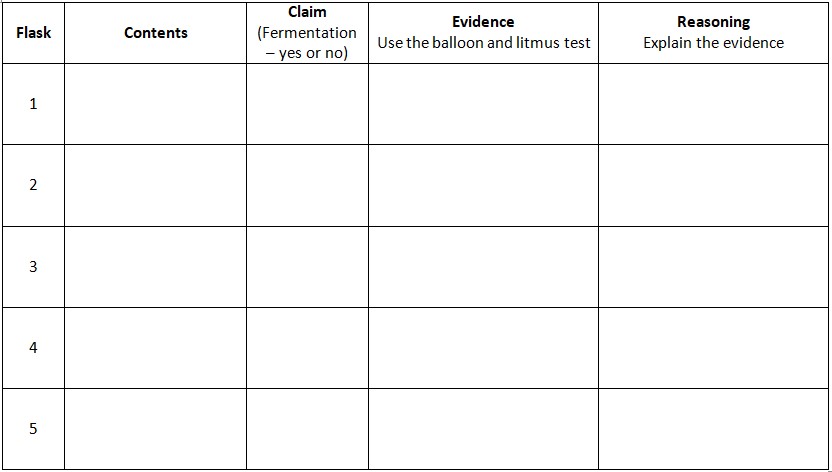
To perform this virtual lab, click the link to open the website (see below). Split your screen so that you can see the lab and the formative. Record all of the necessary information using the data table below.

Link - Virtual Lab: Yeast Fermentation Experiment (cuhk.edu.hk)
Question 1
1.
_______
Question 2
2.
_______
Question 3
3.
_______
Question 4
4.
_______
Question 5
5.
_______
Question 6
6.
_______
Question 7
7.
_______
Question 8
8.
_______
Question 9
9.
_______
Question 10
10.
_______
Question 11
11.

Evidence for flask 1.

Question 12
12.

Reasoning of the evidence for flask 1.

Question 13
13.

Evidence for flask 2.

Question 14
14.

Reasoning of the evidence for flask 2.

Question 15
15.

Evidence for flask 3.

Question 16
16.

Reasoning of the evidence for flask 3.

Question 17
17.

Evidence for flask 4.

Question 18
18.

Reasoning of the evidence for flask 4.

Question 19
19.

Evidence for flask 5.

Question 20
20.

Reasoning of the evidence for flask 5.

After having completed this activity, my confidence regarding this concept has
significantly increased
moderately increased
slightly increased
slightly decreased
moderately decreased
significantly decreased