Log in
Sign up for FREE
arrow_back
Library

Copy of Protein Synthesis (5/28/2026)

star
star
star
star
star
Last updated about 3 hours ago
17 questions
1
1
1
1
1
1
1
1
1
1
1
1
2
1
1
2
2
Translation is the process by which the information contained within mRNA is used to synthesize proteins. The process involves ribosomes moving along mRNA to translate its nucleotide sequence into a polypeptide sequence. Triplets of nucleotides (groups of three bases; see the image below) called codons specify which amino acid will be added to the growing polypeptide chain.
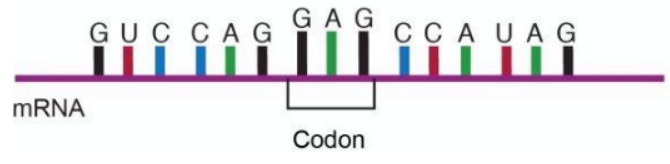

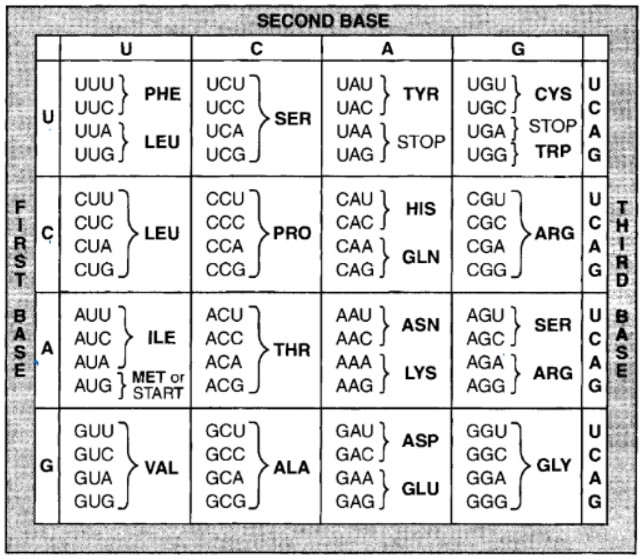
On mRNA, there are three types of codons: start codons, which signal where translation should begin; stop codons, which signal where it should end; and codons that specify which amino acid should be inserted. The start codon is AUG, which codes for the amino acid methionine (Met). There are three stop codons: UAA, UAG, and UGA.

During translation, transfer RNA (tRNA) molecules carry specific amino acids. The tRNA has an anticodon that is complementary to the mRNA codon, allowing it to bind. This allows the correct amino acid to be added according to the mRNA sequence.

DNA must first be transcribed into mRNA before translation can occur. The DNA double helix unwinds and mRNA is synthesized in a process complementary to the DNA nucleotide sequence.

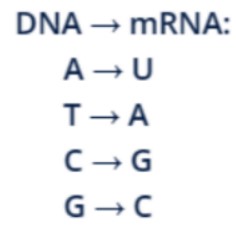
Because DNA uses base pairing, a G matches with a C, and an A matches with a T. Therefore, when RNA polymerase reads DNA to make mRNA, it incorporates a base that is similar to but different from T — U replaces T and, like T, it pairs with A (see the image below). This produces mRNA with a sequence complementary to one DNA strand, which the ribosome can then read to direct the production of an amino acid chain (polypeptide) that will eventually become a protein.
Question 1
1.
What is the start codon? _______
Question 2
2.

What does it do?

Question 3
3.

What is a codon?

Question 4
4.
Where are codons found? _______
Question 5
5.
How many stop codons are there? _______
Question 6
6.

Convert this piece of DNA into mRNA (transcription):
ATT CCC GGG ATA CGA GTC ACA

Question 7
7.

Translate mRNA: AUU AAA UGA AUG UUU AAA GGG to Amino acid sequence

Question 8
8.

Translate the following mRNA sequence into Amino acids:
AAC UAU CGC CAC

Question 9
9.

Translate the following DNA sequence into Amino acids:
ATT CCC GGG

Question 10
10.

Translate the following DNA sequence into Amino acids:
AAA CGC ATA CCA

Question 11
11.

Translate the following DNA sequence into Amino acids:
TAC GCG TTA TAG ATC

Use this sequence to answer the following two questions (12 and 13).

mRNA: AUG CUC AAG UGC UUC

Question 12
12.

What is the polypeptide (amino acid chain) that will result from the mRNA ?

Question 13
13.

From what DNA strand was the mRNA transcribed?

Question 14
14.

DNA → mRNA
DNA: CAT CCA ACC ATA CCC CTA TAC CCA TAT CCT CCC ACT AAA CCG
mRNA?
Put a space between each codon.

Question 15
15.

mRNA → Aminos
What will be the amino acids from the mRNA from question 14?

Question 16
16.

Select the aminos that are incorrect.

mRNA AUC AUG AUC UAC AUU GAU CGA AAU GGG UAG
Aminos: Met - Ile - Tyr - Ile - Glu - Arg - Asp- Gly
Question 17
17.

What is incorrect with the following:

mRNA: UCU AUU UCU GGU CGU UGU AUU AUG GAG AAU UGU GAG GAG GCU ACU
Aminos: Ser-Iso-Ser-Gly-Arg-Cys-Iso-Met-Glu-Asp-Cys-Glu-Glu-Ala-Thr

When you have completed this, move on to the Mutation Intro assignment:

Mutations Intro Reading w/Ques - https://app.formative.com/formatives/63cdc1234f077c06baec89fe