Log in
Sign up for FREE
arrow_back
Library

Copy of Mendelian Inheritance Reading w/Ques (5/28/2026)
star
star
star
star
star
Last updated about 3 hours ago
15 questions
Untitled Section (Copy)
Required
1
Reading Questions
1
1
1
1
1
1
1
2
1
1
1
1
1

What you will learn

  • Traits in humans that have Mendelian patterns of inheritance
  • Single-gene autosomal traits and their inheritance
  • What are pedigree charts and how they are used in studying inheritance patterns
  • Sex-linked traits and their inheritance in humans

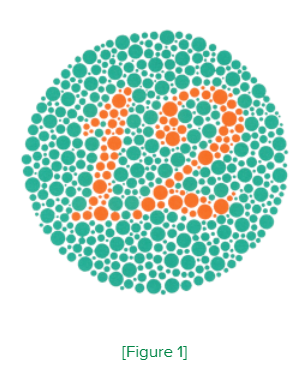
What number can you see?

Red-green color blindness is a common inherited trait in humans. About 1 in 10 men have some form of color blindness (including your teacher, Mr. Poe), however, very few women are color blind. Why?

Mendelian Inheritance in Humans

Characteristics that are encoded in DNA are called genetic traits. Different types of human traits are inherited in different ways. Some human traits have simple inheritance patterns like the traits that Gregor Mendel studied in pea plants. Other human traits have more complex inheritance patterns.

Mendelian inheritance refers to the inheritance of traits controlled by a single gene with two alleles, one of which may be dominant to the other. Not many human traits are controlled by a single gene with two alleles, but they are a good starting point for understanding human heredity. How Mendelian traits are inherited depends on whether the traits are controlled by genes on autosomes or the X chromosome.

Autosomal Traits

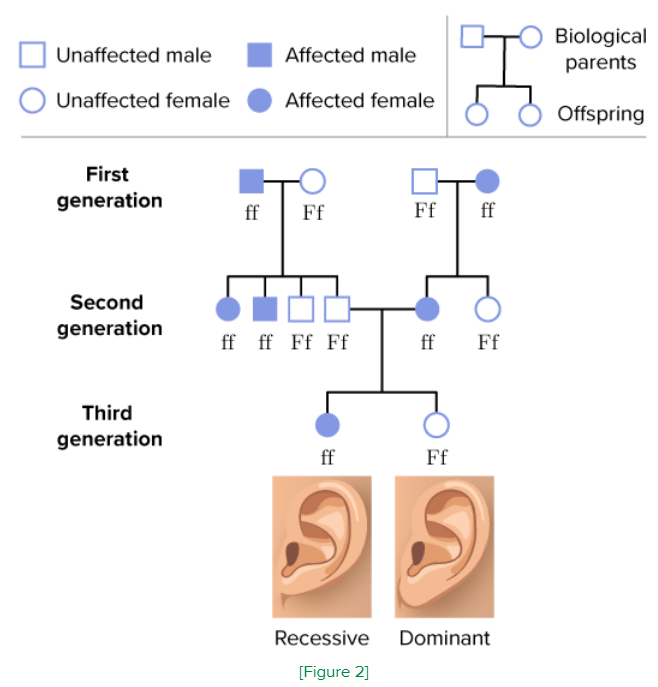
Autosomal traits are controlled by genes on one of the 22 human chromosomes known as autosomes. Consider earlobe attachment. A single autosomal gene with two alleles determines whether you have attached earlobes or free-hanging earlobes. The allele for free-hanging earlobes (F) is dominant to the allele for attached earlobes (f).

The chart in the Figure below is called a pedigree. It shows how the earlobe trait was passed from generation to generation within a family. Pedigrees are useful tools for studying inheritance patterns.


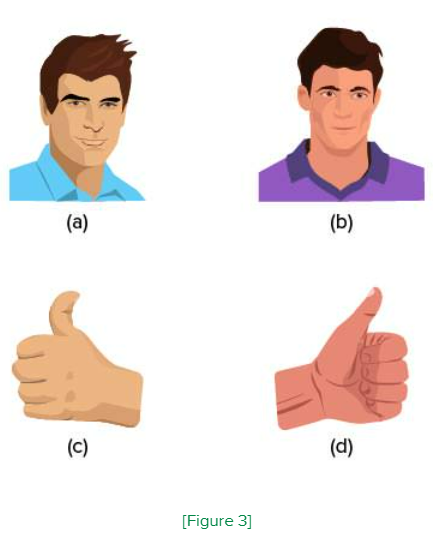
Other single-gene autosomal traits include widow's peak and hitchhiker's thumb. The dominant and recessive forms of these traits are shown in the Figure below. Which form of these traits do you have? What are your possible genotypes for the traits?

Sex-Linked Traits

Traits controlled by genes on the sex chromosomes are called sex-linked traits, or X-linked traits in the case of the X chromosome. Single-gene X-linked traits have a different pattern of inheritance than single-gene autosomal traits. Do you know why? It’s because males have just one X chromosome. In addition, they always inherit their X chromosome from their female parent, and they pass it on to all their female offspring but none of their male offspring.

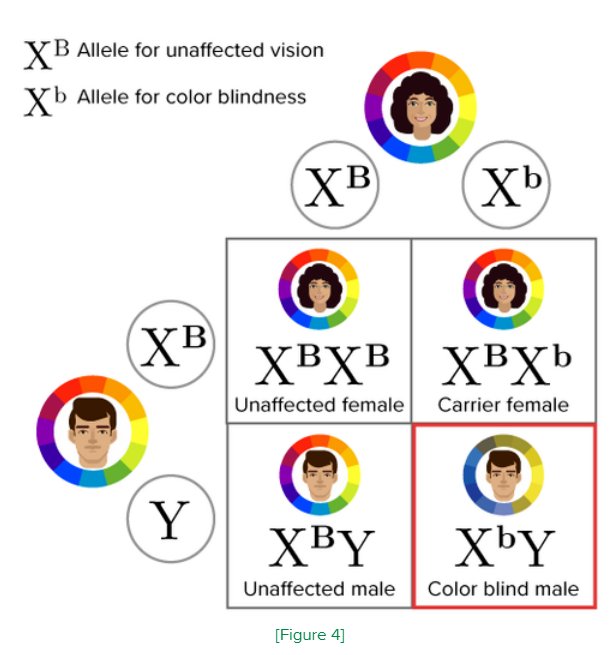
Because males have just one X chromosome, they have only one allele for any X-linked trait. Therefore, a recessive X-linked allele is always expressed in males. Because females have two X chromosomes, they have two alleles for any X-linked trait. Therefore, they must inherit two copies of the recessive allele to express the recessive trait. This explains why X-linked recessive traits are less common in females than males. An example of a recessive X-linked trait is color blindness. People with this trait cannot distinguish between the colors red and green. More than one recessive gene on the X chromosome codes for this trait, which is fairly common in males but relatively rare in females (Figure below).

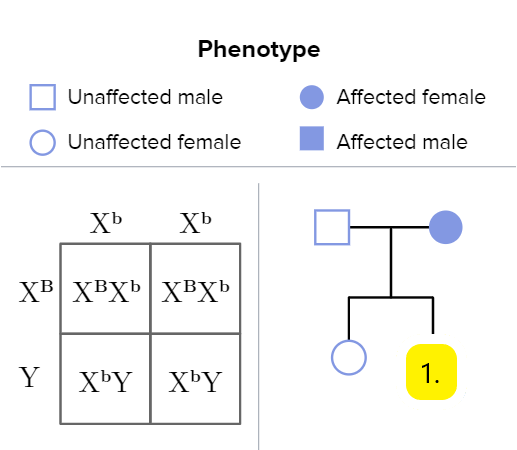
Shown below is a pedigree chart of the inheritance of color blindness in a family. Can you predict the missing phenotype in the chart with the help of the given Punnett square?
1
Question 1
1.

Summary

  • A minority of human traits are controlled by single genes with two alleles.
  • They have different inheritance patterns depending on whether they are controlled by autosomal or X-linked genes.
Question 2
2.
The most common chromosome that sex-linked disorders are linked to is the _______.

The reading questions are in the next section. After you successfully answer this question, click on "next" at the bottom-right to locate them.

I have added the reading to this section so that you could use it to assist you in answering the questions at the bottom of this page. All of them questions are based, primarily, on the reading...but don't be shocked if one of them relates to the video.


Red-green color blindness is a common inherited trait in humans. About 1 in 10 men have some form of color blindness (including your teacher, Mr. Poe), however, very few women are color blind. Why?

Mendelian Inheritance in Humans

Characteristics that are encoded in DNA are called genetic traits. Different types of human traits are inherited in different ways. Some human traits have simple inheritance patterns like the traits that Gregor Mendel studied in pea plants. Other human traits have more complex inheritance patterns.

Mendelian inheritance refers to the inheritance of traits controlled by a single gene with two alleles, one of which may be dominant to the other. Not many human traits are controlled by a single gene with two alleles, but they are a good starting point for understanding human heredity. How Mendelian traits are inherited depends on whether the traits are controlled by genes on autosomes or the X chromosome.

Autosomal Traits

Autosomal traits are controlled by genes on one of the 22 human chromosomes known as autosomes. Consider earlobe attachment. A single autosomal gene with two alleles determines whether you have attached earlobes or free-hanging earlobes. The allele for free-hanging earlobes (F) is dominant to the allele for attached earlobes (f).

The chart in the Figure below is called a pedigree. It shows how the earlobe trait was passed from generation to generation within a family. Pedigrees are useful tools for studying inheritance patterns.


Other single-gene autosomal traits include widow's peak and hitchhiker's thumb. The dominant and recessive forms of these traits are shown in the Figure below. Which form of these traits do you have? What are your possible genotypes for the traits?

Sex-Linked Traits

Traits controlled by genes on the sex chromosomes are called sex-linked traits, or X-linked traits in the case of the X chromosome. Single-gene X-linked traits have a different pattern of inheritance than single-gene autosomal traits. Do you know why? It’s because males have just one X chromosome. In addition, they always inherit their X chromosome from their female parent, and they pass it on to all their female offspring but none of their male offspring.

Because males have just one X chromosome, they have only one allele for any X-linked trait. Therefore, a recessive X-linked allele is always expressed in males. Because females have two X chromosomes, they have two alleles for any X-linked trait. Therefore, they must inherit two copies of the recessive allele to express the recessive trait. This explains why X-linked recessive traits are less common in females than males. An example of a recessive X-linked trait is color blindness. People with this trait cannot distinguish between the colors red and green. More than one recessive gene on the X chromosome codes for this trait, which is fairly common in males but relatively rare in females (Figure below).

Shown below is a pedigree chart of the inheritance of color blindness in a family. Can you predict the missing phenotype in the chart with the help of the given Punnett square?

Summary

  • A minority of human traits are controlled by single genes with two alleles.
  • They have different inheritance patterns depending on whether they are controlled by autosomal or X-linked genes.

Question 3
3.
Color-blindness is considered what type of trait in humans? _______
Question 4
4.
Charateristics that are associated with DNA are referred to _______.
Question 5
5.
The type of inheritance pattern that refers to those traits that are controlled by one gene that have two different alleles is _______.
Question 6
6.
Autosomal traits are associated to the 22 types of _______ and controlled by their genes.
Question 7
7.
Free-hanging or attached earlobe trait is an example of an _______ trait.
Question 8
8.
A _______ is used to display inheritance patterns and how traits are passed through the generations.
Question 9
9.
Sex-linked traits are associated with the _______ chromosome.
Question 10
10.
For a female to have a sex-linked trait they must have _______ (looking for a number) of the alleles associated with the trait.

However, for a male to have a sex-linked trait they only need to have _______ (looking for a number) of the alleles associated with the trait.
Question 11
11.
According to the video, _______ is a sex-linked trait.
Question 12
12.
According to the video, a male will have the following two sex chromosomes: _______.
Question 13
13.
According to the video, hemophilia is a _______ sex-linked disorder.
Question 14
14.
According to the video, for a female to be a carrier for a sex-linked trait, they must have _______ alleles for the trait.
Question 15
15.
Which sex is more likely to have a sex-linked trait? _______
In the pedigree to the left, a cross between a female affected with color blindness and a male that is not affected with color blindness. Use the information in the diagram to the left to determine what the phenotype of the offspring labeled #1.

_______