You will be asked to take an image of your work and submit it with this formative.
HS-LS3-2. Make and defend a claim based on evidence that inheritable genetic variations may result from: (1) new genetic combinations through meiosis...
HS-LS3-3. Apply concepts of statistics and probability to explain the variation and distribution of expressed traits in a population.
Objectives (I CAN…):
Use probability techniques to explain the variation of expressed traits in a population.
Use probability techniques to explain the distribution of expressed traits in a population.
Work the Punnett squares out on paper.
You will be asked to take an image of your work and submit it with this formative.
HS-LS3-2. Make and defend a claim based on evidence that inheritable genetic variations may result from: (1) new genetic combinations through meiosis...
HS-LS3-3. Apply concepts of statistics and probability to explain the variation and distribution of expressed traits in a population.
Objectives (I CAN…):
Use probability techniques to explain the variation of expressed traits in a population.
Use probability techniques to explain the distribution of expressed traits in a population.
Question 1
1.
In guinea pigs, Black fur (B) is dominant to white fur (b), which is recessive.
Complete a cross between a guinea pig that is heterozygous for black fur (Bb) with a guinea pig that is homozygous recessive for white fur (bb) - Bb x bb.
After you complete the cross, answer the following fill-in-the-blank questions.
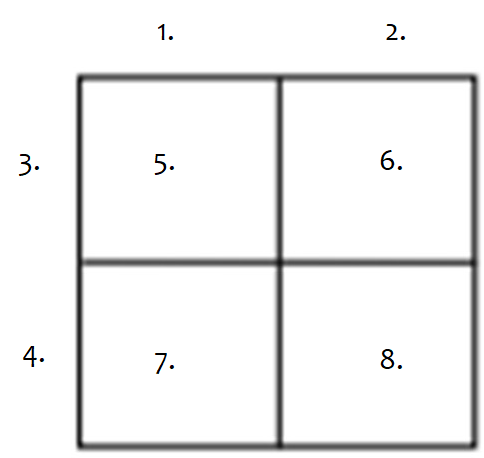
1. _______ 2. _______ 3. _______ 4. _______
5. _______ 6. _______ 7. _______ 8. _______
Expected number of offspring:
_______ Black fur (BB, Bb)
_______ White fur (bb)
Question 2
2.
In guinea pigs, Black fur (B) is dominant to white fur (b), which is recessive.
Complete a cross between two guinea pigs that are both heterozygous for black fur.
After you complete the cross, answer the following fill-in-the-blank questions (match up the information per the numbers on the Punnett square and the blanks below).
1. _______ 2. _______ 3. _______ 4. _______
5. _______ 6. _______ 7. _______ 8. _______
Expected number of offspring:
_______ Black fur
_______ White fur
Question 3
3.
In cattle, having horns (H) is dominant to hornless (h), which is recessive.
Complete a cross between a true breeder for horned with a true breeder hornless cattle.
After you complete the cross, answer the following fill-in-the-blank questions.
1. _______ 2. _______ 3. _______ 4. _______
5. _______ 6. _______ 7. _______ 8. _______
Expected number of offspring:
_______ Horned
_______ Hornless
Question 4
4.
In tomatoes, red fruit (R) is dominant over yellow fruit (r). A plant that is homozygous for red fruit is crossed with a plant that has yellow fruit. What would be the genotypes and phenotypes of the F1 generation?
Parents _______ x _______
After you complete the cross, answer the following fill-in-the-blank questions.
1. _______ 2. _______ 3. _______ 4. _______
5. _______ 6. _______ 7. _______ 8. _______
F1 generation genotypes: _______
F1 generation phenotypes: _______
Question 5
5.
In humans, being a tongue roller (R) is dominant over non-roller (r). A man who is a non-roller marries a woman who is heterozygous for tongue rolling.
Father's genotype: _______
Father's phenotype: _______
Mother's genotype: _______
Mother's phenotype: _______
What is the probability (percentage or fraction) of having a child that is a tongue roller? _______
Question 6
6.
Take and image of your work and attach it here.
To the left is an image button (), click it, and then click, "take an image" in the small window that opens. You can use this to take and post an image of your work.