Log in
Sign up for FREE
arrow_back
Library

Copy of Monohybrid Cross 3 (Quarks and Zocks) (5/28/2026)

star
star
star
star
star
Last updated about 3 hours ago
7 questions
6
3
2
7
7
8
7
Question 1
1.
For each genotype below, indicate whether it is (use the abbreviations in the parentheses):
  • heterozygous (He)
  • homozygous dominant (HD)
  • homozygous recessive (HR)
Tt _______; BB _______; dd _______; ff _______; Ff _______; tt _______

DD _______; FF _______; TT _______; Bb _______; bb _______ ; Yy _______
Question 2
2.
Determine the phenotype for each genotype below, if:

Blue body color is dominant to yellow body color
BB _______ Bb _______ bb _______

Rubic shape is dominant to club shape
RR _______ Rr _______ rr _______
Question 3
3.
For each phenotype, provide the genotypes that are possible:

Tall (T) is dominant to dwarf (t) - if you have more than one genotype in a blank, separate them with a comma, semi-colon, or the word "and".

Tall _______ dwarf _______

Red body color (R) is dominant to pink body color (r) - if you have more than one genotype in a blank, separate them with a comma, semi-colon, or the word "and".

Red body color _______ Pink body color _______
Question 4
4.
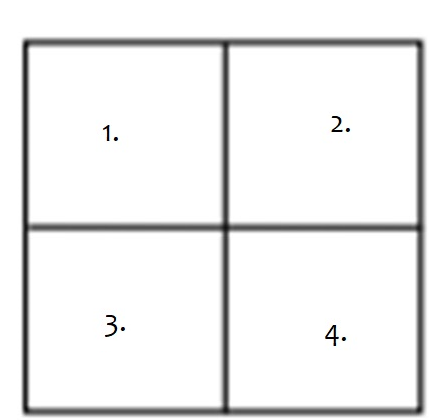
A young quark met a young quarkette at a dance. The quark is homozygous dominant for rubic shape, but the quarkette is homozygous recessive for club shape. Complete a Punnett square to show the possible offspring that would result if they had little quarks.

Genotype of #1 _______ Phenotype of #1 _______
Genotype of #2 _______ Phenotype of #2 _______
Genotype of #3 _______ Phenotype of #3 _______
Genotype of #4 _______ Phenotype of #4 _______

What is the probability of having a little quark with rubic shape?
_______ out of _______ or _______ %
What is the probability of having a little quark with club shape?
_______ out of _______ or _______ %
Question 5
5.
A zock met a zockette at a dance. They are both heterozygous for their red body color. Complete a Punnett square to show the possible offspring that would result if they had little zocks.

Genotype of #1 _______ Phenotype of #1 _______
Genotype of #2 _______ Phenotype of #2 _______
Genotype of #3 _______ Phenotype of #3 _______
Genotype of #4 _______ Phenotype of #4 _______

What is the probability of having a little zock with red body color?
_______ out of _______ or _______ %
What is the probability of having a little zock with pink body color?
_______ out of _______ or _______ %
Question 6
6.
Everyone in the quark's family has blue body color, which is the dominant body color for quarks. His family believes that they are purebreds because of this, as everyone in their family, as far back as anyone can remember, has had blue body color. He married the quarkette that he met at the dance, but she has yellow body color. Complete a Punnett square to show the possible offspring that would result from these two.

Genotype of #1 _______ Phenotype of #1 _______
Genotype of #2 _______ Phenotype of #2 _______
Genotype of #3 _______ Phenotype of #3 _______
Genotype of #4 _______ Phenotype of #4 _______

What is the probability of having a little quark with blue body color?
_______ out of _______ or _______ %
What is the probability of having a little quark with yellow?
_______ out of _______ or _______ %

Would their children be considered purebreds? _______ Why? _______
Question 7
7.
Assume that a zock that is heterozygous for being tall marries a zockette who is homozygous recessive for this characteristic and is dwarf. Complete a Punnett square to show the possible offspring for these two.

Genotype of #1 _______ Phenotype of #1 _______
Genotype of #2 _______ Phenotype of #2 _______
Genotype of #3 _______ Phenotype of #3 _______
Genotype of #4 _______ Phenotype of #4 _______

What is the probability of having a little zock that is tall?
_______ out of _______ or _______ %
What is the probability of having a little zock that is dwarf?
_______ out of _______ or _______ %
Use your Mendelian Genetics note-taking sheet and any examples of how to do Punnett squares and monohybrid crosses to help you with these questions.

General review of some terms and concepts:

Characteristic - general feature (often physical).
Trait - different forms of the characteristic.
  • One characteristic usually has two traits.

Gene - controls one characteristic.
Alleles - different forms of the gene.
Dominant allele - confers the dominant trait; if one or more are present, the dominant trait will be present.
Recessive allele - confers the recessive trait; if two are present, the recessive trait will be present.

Genotype - the combination of alleles for a gene; three possible general genotypes.
  • Homozygous dominant - two dominant alleles - example: AA (purebred is often used to describe this).
  • Heterozygous - one dominant; one recessive allele - example: Aa.
  • Homozygous recessive - two recessive alleles - example: aa (purebred is often used to describe this).
Phenotype - the trait; controlled by the genotype)
  • One or more dominant alleles → dominant phenotype (trait).
  • Two recessive alleles → recessive phenotype (trait).
Allele Abbreviations - determined by the first letter of the dominant trait.
  • If yellow is dominant and blue is recessive → Y - yellow; y - blue.
  • Use the uppercase letter for the dominant allele and the lowercase letter for the recessive allele.