Copy of Human Chromosomes and Genetic Linkage (5/28/2026)
star
star
star
star
star
Last updated about 3 hours ago
18 questions
Human Chromosomes
1
1
1
1
1
1
2
1
Genetic Linkage
1
1
1
2
1
1
1
1
1
1
Human Chromosomes
What you will learn
What are chromosomes and how many chromosomes are present in human somatic cells
What are autosomes and sex chromosomes
How many genes are present in the human genome
Coiled bundles of DNA and proteins, containing hundreds or thousands of genes. What are these things?
Chromosomes. These ensure that each cell receives the proper amount of DNA during cell division. And usually people have 46 of them, 23 from each parent.
Chromosomes and Genes
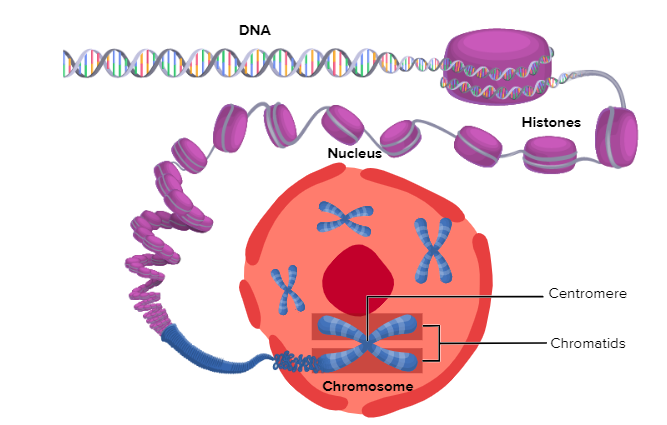
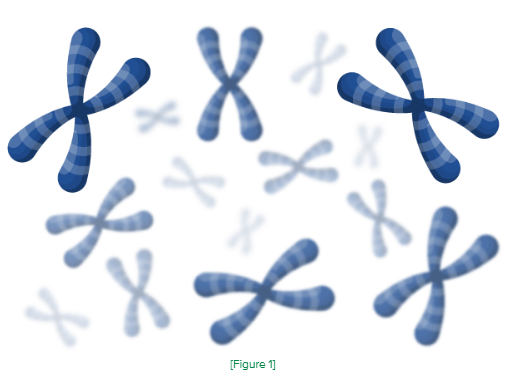
Each species has a characteristic number of chromosomes. Chromosomes are coiled structures made of DNA and proteins called histones. Chromosomes are the form of the genetic material of a cell during cell division.
Genetically, humans are characterized by 23 pairs of chromosomes.
Autosomes
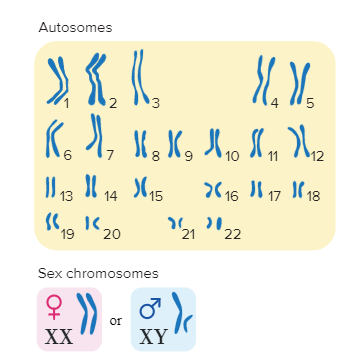
Of the 23 pairs of human chromosomes, 22 pairs are autosomes (numbers 1ā22 ) and the 23rd pair consists of sex chromosomes, X and Y. Autosomes are chromosomes that contain genes for characteristics that are unrelated to sex. These chromosomes are the same in males and females. The great majority of human genes are located on autosomes.
Sex Chromosomes
The remaining pair of human chromosomes consists of the sex chromosomes, X and Y. Females have two X chromosomes, and males have one X and one Y chromosome. In females, one of the X chromosomes in each cell is inactivated and known as a Barr body. This ensures that females, like males, have only one functioning copy of the X chromosome in each cell.
As you can see from the Figures above, the X chromosome is much larger than the Y chromosome. The X chromosome has about 2,000 genes, whereas the Y chromosome has fewer than 100, none of which are essential to survival. (For comparison, the smallest autosome, chromosome 22, has over 500 genes.) Virtually all of the X chromosome genes are unrelated to sex. Only the Y chromosome contains genes that determine sex. A single Y chromosome gene, called SRY (which stands for sex-determining region Y gene), triggers an embryo to develop into a male. Without a Y chromosome, an individual develops into a female, so you can think of female as the default sex of the human species. Can you think of a reason why the Y chromosome is so much smaller than the X chromosome?
Human Genes
Humans have an estimated 20,000 to 22,000 genes. This may sound like a lot, but it really isnāt. Far simpler species have almost as many genes as humans. However, human cells use splicing and other processes to make multiple proteins from the instructions encoded in a single gene. Of the 3 billion base pairs in the human genome, only about 25 percent make up genes and their regulatory elements. The functions of many of the other base pairs are still unclear.
The majority of human genes have two or more possible alleles, which are alternative forms of a gene. Differences in alleles account for the considerable genetic variation among people. In fact, most human genetic variation is the result of differences in individual DNA bases within alleles.
Summary
Humans have 23 pairs of chromosomes. Of these, 22 pairs are autosomes.
The X and Y chromosomes are the sex chromosomes. Females have two X chromosomes, and males have one X and one Y.
Human chromosomes contain a total of 20,000 to 22,000 genes, the majority of which have two or more alleles.
Question 1
1.
When you examine the sex chromosomes the _______ chromosome appears larger and also has more genes.
Question 2
2.
Chromsomes 1-22 are known as _______.
Question 3
3.
A human diploid cell has a total of _______ chromosomes.
Question 4
4.
Normal females possess two X chromosomes. However, one of them is inactivated; it is referred to as a _______.
Question 5
5.
The structure located on the Y chromosome that triggers the release of testosterone and the formation of male charateristics on an embryo is known as the _______, without this, a female will develop.
Question 6
6.
The 23rd set of chromosomes are known as _______.
Question 7
7.
Chromosomes are made of two things - _______ and _______.
Question 8
8.
_______ are chromsomes that contain genes for characteristics that are unrelated to sex and gender.
Summary
Linked genes are located on the same chromosome.
Sex-linked genes are located on a sex chromosome, and X-linked genes are located on the X chromosome.
The frequency of crossing over between genes is used to construct linkage maps that show the locations of genes on chromosomes.
Question 9
9.
Frequencies of crossing over are used to construct a _______.
Question 10
10.
The genes for red hair and light skin are usually inherited together, meaning that they are linked, and are close together on the same _______.
Question 11
11.
Due to _______, certain traits do not demonstrate independent assortment.
Question 12
12.
Crossing over occurs when two _______ exchange _______ during meiosis I.
Question 13
13.
Most _______ are located on the X chromosome.
Question 14
14.
Genes that are not linked are typically located on _______ chromosomes.
Question 15
15.
The _______ of crossing over, the closer together on the same chromosome a set of genes are likely to be.
Question 16
16.
The frequency in which certain characteristics are often inherited together is explained by _______.
Question 17
17.
Question 18
18.
The _______ sex chromosome has the least amount of genes.
Genetic Linkage
What you will learn
Linked genes and how they are inherited
How the frequency of crossing over can help construct a genetic map
What does it mean to be linked?
For a chain, the above image may suggest a certain type of linkage. For genes, it might suggest that they are very hard to separate. If this is the case, what does this mean in terms of human traits? Can you think of any human traits that tend to be inherited together?
Linkage
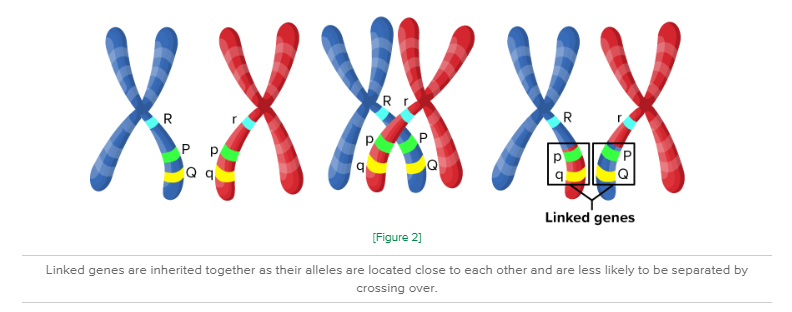
Genes that are located on the same chromosome are called linked genes. Alleles for these genes tend to segregate together during meiosis unless they are separated by crossing over. Crossing over occurs when two homologous chromosomes exchange genetic material during meiosis I. The closer together two genes are on a chromosome, the less likely their alleles will be separated by crossing over as shown in the Figure below.
Linkage explains why certain characteristics are frequently inherited together. For example, genes for hair color and eye color are linked, so certain hair and eye colors tend to be inherited together, such as blonde hair with blue eyes and brown hair with brown eyes. What other human traits seem to occur together? Do you think they might be controlled by linked genes?
Sex-Linked Genes
Genes located on the sex chromosomes are called sex-linked genes. Most sex-linked genes are on the X chromosome because the Y chromosome has relatively few genes. Strictly speaking, genes on the X chromosome are X-linked genes, but the term sex-linked is often used to refer to them.
Mapping Linkage
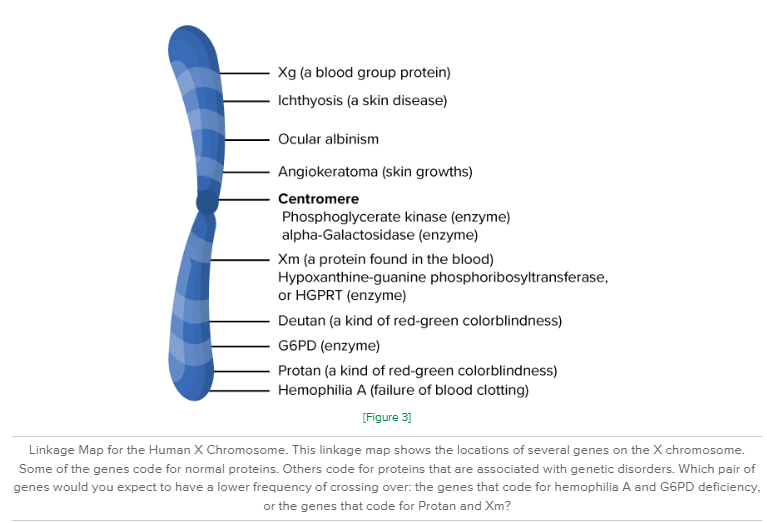
Linkage can be assessed by determining how often crossing over occurs between two genes on the same chromosome. Genes on different (nonhomologous) chromosomes are not linked. They assort independently during meiosis, so they have a 50 percent chance of ending up in different gametes. If genes show up in different gametes less than 50 percent of the time (that is, they tend to be inherited together), they are assumed to be on the same (homologous) chromosome. They may be separated by crossing over, but this is likely to occur less than 50 percent of the time. The lower the frequency of crossing over, the closer together on the same chromosome the genes are presumed to be. Frequencies of crossing over can be used to construct a linkage map like the one in theĀ Figure below. A linkage map shows the locations of genes on a chromosome.
Genes located on the same chromosome are said to be linked.