Copy of Limiting Factors and Carrying Capacity (5/28/2026)
star
star
star
star
star
Last updated about 3 hours ago
20 questions
Limiting Factors
When living conditions in an area are good, a population will generally grow. But eventually some environmental factor will cause the population to stop growing. A limiting factor is an environmental factor that causes a population to decrease. Some limiting factors for populations are resources (food and water), space, and weather conditions.
1
1
3
1
Organisms require food and water (resources) to survive. Since there isn’t always an endless amount of food and water, they are limiting factors. Suppose a bear must eat 10 fish a day to survive. The river nearby provides about 100 fish a day to the bears without harming the fish population. Five bears could easily live in this area because they would only need 50 fish total. But if there were 15 bears they would not all survive because there would not be enough food. No matter how much shelter and water there was, the population would not get larger than 10 bears for any extended period of time.
1
1
2
Space is another limiting factor for populations. Seagulls, for example, come to nest on rocky shores. But the nesting shores get very crowded. If a pair does not find room to nest, they will not be able to add any offspring to the seagull population. So nesting space on the shore is a limiting factor for seagulls. If there were more nesting space, more seagulls would be able to nest, and the population would increase.
Space is also a limiting factor for plants. The amount of space in which a plant grows determines whether the plant can get the sunlight, water, and soil nutrients it needs. For example, many small plants sprout each year in a forest. But as they grow, the roots of those that are too close together run out of space and some of the plants will die. Branches from other trees may block the sunlight the small plants need. Some of the small plants might die, limiting the size of that plant population.
1
1
Weather conditions such as temperature and the amount of rainfall can also limit population growth. A cold front that comes in late spring can kill the offspring of many species of organisms, including plants, birds and mammals. A hurricane or flood can wash away nests and burrows. Such unusual events can have long-lasting effects on population size.
1
Question 10
10.
One weather condition that may limit the growth of a population is _______ .
Carrying Capacity
The largest population an area can support with its resources (food, water, space) is called its carrying capacity (capacity = amount). If we refer back to the limiting factor of food and water, where the bears each need 10 fish a day to survive and the nearby river can only supply 100 fish per day, the carrying capacity of the bear’s habitat would be 10 bears (any more than that would require more fish than the river could provide and the bears would starve). A population usually stays near its carrying capacity because of the limiting factors of a habitat.
As a population first begins to grow, it will typically exhibit exponential growth, and it will continue growing until the population overshoots the carrying capacity.
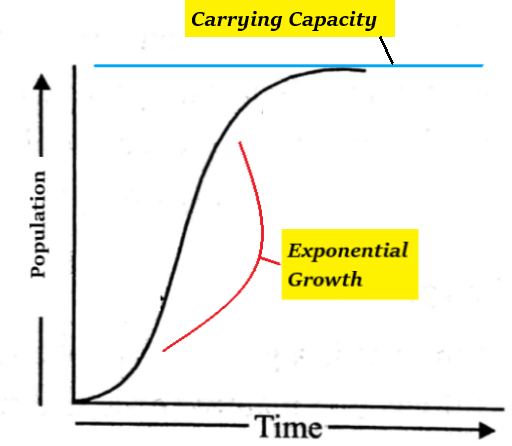
The population will then run out of resources and decline rapidly until it can recover and stabilize around the carrying capacity. Rabbit populations exhibited this behavior when they were first introduced into Australia in the mid1800s. At first, their numbers increased rapidly because they had plenty of vegetation to eat and no predators. The rabbits quickly ate the land bare and their population crashed as they starved to death. However, over time, the vegetation recovered, and the rabbit population increased again. The population continues to increase and decrease, but less dramatically.
1
1
5
Question 13
13.
Situation 1:
A population of trout in a lake has significantly declined over the past year. The main source of food for the fish in this lake are aquatic insects. Due to poor climate conditions, there are significantly fewer insects and thus, not enough food to sustain the population of trout in the lake. Trout is a food supply for larger fish in the lake and without enough trout, other fish are negatively impacted in the lake.
1
1
1
Situation 2:
The population of bullfrogs is growing out of control near a small pond. Its main predator, a snake species, was killed off by disease. Without this natural predator, the bullfrogs can thrive in and around the pond. The growing frog population is having a negative impact on the quality of the environment and other species living in the area.
1
1
1
2
Question 1
1.
Every population has _______ .
Question 2
2.
What is a limiting factor?
Question 3
3.
Types of limiting factors include: _______ ,_______ , and _______ .
Question 4
4.
Are limiting factors biotic or abiotic factors;? Explain.
Question 5
5.
How can resources (food and water) limit population growth?
Question 6
6.
Question 7
7.
Explain your answer to why food is or is not a limiting factor for plants (from #6).
Question 8
8.
Space can be a limiting factor because animals may not be able to _______ to have offspring, and so a population would decrease.
Question 9
9.
Name two reasons that space is a limiting factor for plants.
Question 11
11.
What is carrying capacity?
Question 12
12.
How are limiting factors related to carrying capacity?
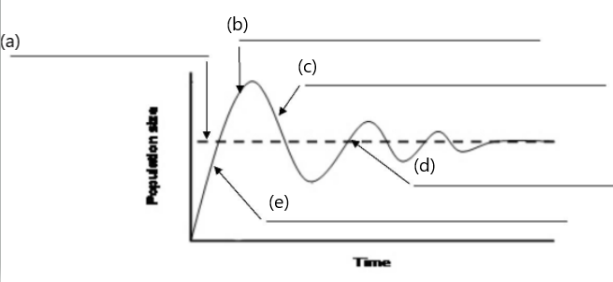
On the graph, identify each of the following:
- exponential growth
- population stabilization
- population decline
- population overshoot
- carrying capacity
(a) _______
(b) _______
(c) _______
(d) _______
(e) _______
Question 14
14.
Question 15
15.
Question 16
16.
Question 17
17.
The problem near the small pond is _______ .
Question 18
18.
_______ caused the problem.
Question 19
19.
Question 20
20.
What should be done to solve the problem?
Food is a limiting factor for plants.
True
False
What is the problem?
Trout population has increased
Insect population has increased
Insect population has decreased
Larger fish population has increased.
What has caused the problem?
Poor climate conditions
Humans overfishing
Pesticides being used on the insects
Decreased water levels
How could humans alter the carrying capacity so that the trout population returns to its normal levels?
Fish for the trout
Fish for the larger fish
Breed the insects
Breed the larger fish
Breed the trout
How could humans alter carrying capacity so the bullfrog population returns to its normal level?