Copy of Solute, Solvent, and Dissolving (5/28/2026)
star
star
star
star
star
Last updated 3 months ago
9 Nsɛmmisa
Untitled Section
1
1
2
1
1
Dissolving
1
1
1
1
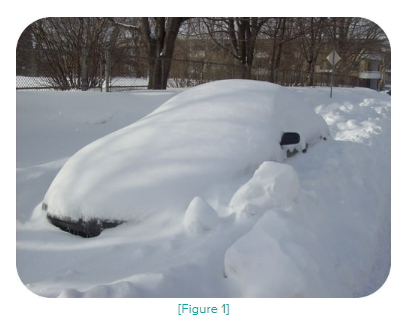
In the winter, the temperature often gets well below the freezing point of water. This condition can create problem in car radiators. If the water freezes, water hoses will break, the engine block can crack, and significant damage can be done to the car.
When one substance dissolves into another, a solution is formed. A solution is a homogenous mixture consisting of a solute dissolved into a solvent. The solute is the substance that is being dissolved, while the solvent is the dissolving medium. Solutions can be formed with many different types and forms of solutes and solvents.
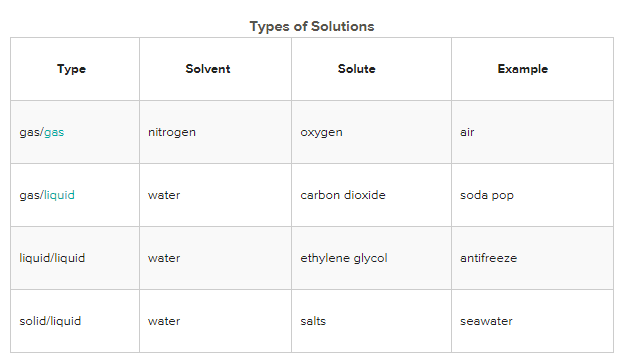
We know of many types of solutions. Check out a few examples in Table below.
We want to focus on solutions where the solvent is water. An aqueous solution is water that contains one or more dissolved substances. The dissolved substances in an aqueous solution may be solids, gases, or other liquids. Some examples are listed in Table above. Other examples include vinegar (acetic acid in water), alcoholic beverages (ethanol in water), and liquid cough medicines (various drugs in water).
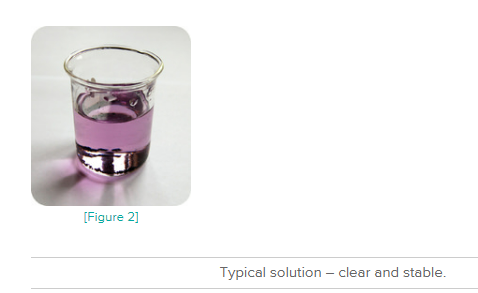
In order to be a true solution, a mixture must be stable. When sugar is fully dissolved into water, it can stand for an indefinite amount of time and the sugar will not settle out of the solution. Further, if the sugar-water solution is passed through a filter it will be unchanged. The dissolved sugar particles will pass through the filter along with the water. This is because the dissolved particles in a solution are very small, usually less than 1 nm in diameter. Solute particles can be atoms, ions, or molecules, depending on the type of substance that has been dissolved.
In a solution, the
A solution is a
A solution has two basic parts, a
A solution in which water is the solvent is known as an
All true solutions must be
Water typically dissolves many ionic compounds and polar molecules. Nonpolar molecules such as those found in grease or oil do not dissolve in water. We will first examine the process that occurs when an ionic compound such as table salt (sodium chloride) dissolves in water.
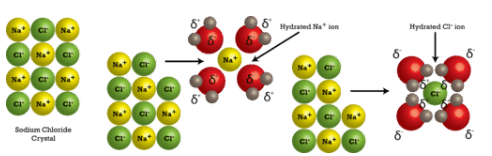
Water molecules move about continuously due to their kinetic energy. When a crystal of sodium chloride is placed into water, the water’s molecules collide with the crystal lattice. Recall that the crystal lattice is composed of alternating positive and negative ions. Water is attracted to the sodium chloride crystal because water is polar and has both a positive and a negative end. The positively charged sodium ions in the crystal attract the oxygen end of the water molecules because they are partially negative. The negatively charged chloride ions in the crystal attract the hydrogen end of the water molecules because they are partially positive. The action of the polar water molecules takes the crystal lattice apart (see image below).
After coming apart from the crystal, the individual ions are then surrounded by solvent particles in a process called solvation. Note that the individual Na+ ions are surrounded by water molecules with the oxygen atom oriented near the positive ion. Likewise, the chloride ions are surrounded by water molecules with the opposite orientation. Hydration is the process of solute particles being surrounded by water molecules arranged in a specific manner. Hydration helps to stabilize aqueous solutions by preventing the positive and negative ions from coming back together and forming a precipitate.
Table sugar is sucrose (C12H22O11) and is an example of a molecular compound. Solid sugar consists of individual sugar molecules held together by intermolecular attractive forces. When water dissolves sugar, it separates the individual sugar molecules by disrupting the attractive forces, but does not break the covalent bonds between the carbon, hydrogen, and oxygen atoms. Dissolved sugar molecules are also hydrated, but without as distinct an orientation to the water molecules as in the case of the ions. The sugar molecule contains many -OH groups that can form hydrogen bonds with the water molecules, helping form the sucrose solution.
Motion of water molecules helps break up interactions between solid ions or molecules.
Solvation involves surrounding ions with solvent particles.
Ionic solute molecules are hydrated (surrounded by solvent molecules in a specific orientation).
What causes water molecules to continuously move?
Sucrose interacts with water by hydrogen bonding their
NaCl easily dissolves in water due to some specific properties of water and NaCl, respectively. For instance, water molecules are attracted to Na+ and Cl- ions because water is