Copy of Periodicity and the Periodic Table 1 (Sep 2022) (5/28/2026)
star
star
star
star
star
Last updated 3 months ago
23 Nsɛmmisa
14
12
11
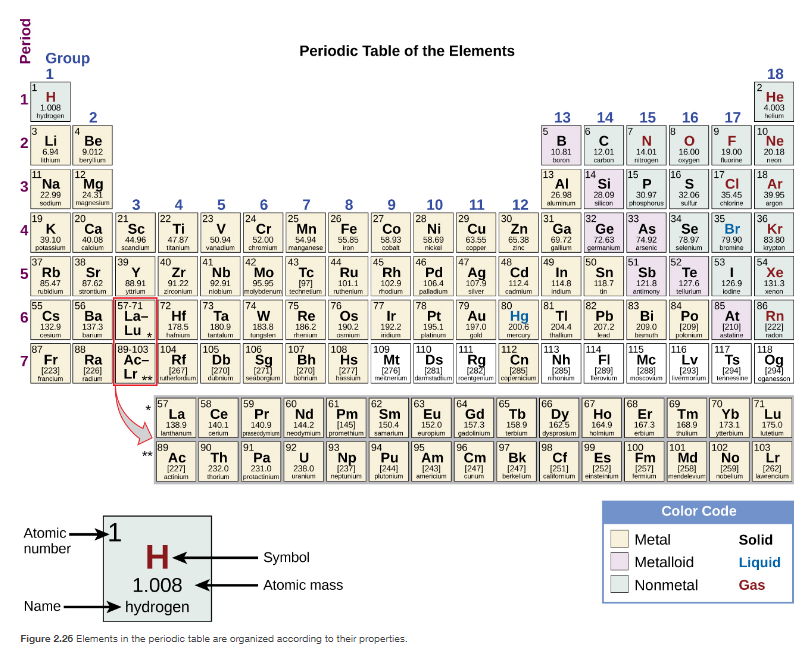
For part of section activity, you will need to know the difference between groups and periods on the periodic table.
Periods are like rows that run left to right, horizontally, on the periodic table.
Groups are like columns that run up and down, vertically, on the periodic table.
On a standard periodic table, the groups and periods are often numbered. Each row is considered a period and they are numbered 1-7; each column is considered a group and they are numbered 1-18. We can use the group and period numbering system to help locate elements on the periodic table.
Use the above information and the attached periodic tables to help answer the following questions.
Identify which elements is located at the intersection of the following groups and periods.
Remember - if you use the element symbol, the first letter must be capitalized.
a. Group 4 Period 5
b. Group 2 Period 2
c. Group 6 Period 6
d. Group 18 Period 1
e. Group 14 Period 5
f. Group 12 Period 4
g. Group 1 Period 7
h. Group 16 Period 6
i. Group 17 Period 3
j. Group 11 Period 5
k. Group 5 Period 4
l. Group 10 Period 6
m. Group 13 Period 3
n. Group 15 Period 6
Read the following paragraphs regarding these three groups of elements, their general properties, and organization on the periodic table. You will use this information, as well as the accompanying periodic table (below), to answer the questions, below.
Many elements differ dramatically in their chemical and physical properties, but some elements are similar in their behaviors. For example, many elements appear shiny, are malleable (able to be deformed without breaking) and ductile (can be drawn into wires), and conduct heat and electricity well. Other elements are not shiny, malleable, or ductile, and are poor conductors of heat and electricity.
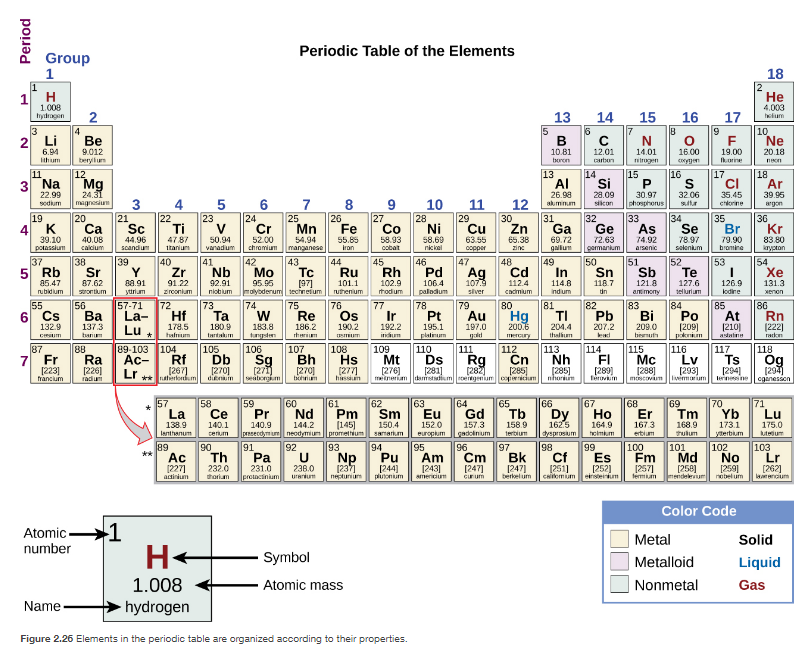
A metal is an element that is a good conductor of heat and electricity. Metals are also malleable, which means that they can be hammered into very thin sheets without breaking. They are ductile, which means that they can be drawn into wires. When a fresh surface of any metal is exposed, it will be very shiny because it reflects light well. This is called luster. All metals are solid at room temperature with the exception of mercury (Hg), which is a liquid. Melting points of metals display a very wide variance. The melting point of mercury is -39°C, while the highest melting metal is tungsten (W), with a melting point of 3422°C. The elements in yellow in the periodic table below are metals. About 80 percent of the elements are metals.
In the chemical world, these “spare parts” would be considered nonmetals, loosely defined as not having the properties of metals. A nonmetal is an element that is generally a poor conductor of heat and electricity. Most properties of nonmetals are the opposite of metals. There is a wider variation in properties among the nonmetals than among the metals. Nonmetals exist in all three states of matter. The majority are gases, such as nitrogen and oxygen. Bromine is a liquid. A few are solids, such as carbon and sulfur. In the solid state, nonmetals are brittle, meaning that they will shatter if struck with a hammer. The solids are not lustrous. Melting points are generally much lower than those of metals. The green elements in the table below are nonmetals.
Some elements are “none of the above.” They don’t fit neatly into the categories of metal or non-metal because of their characteristics. Some elements share properties with metals and nonmetals. A metalloid is an element that has properties that are intermediate between those of metals and nonmetals. Metalloids tend to be "semiconductors," meaning that they conduct heat and electricity better than nonmetals but worse than metals. Metalloids could also be called semimetals. On the periodic table, the elements colored light purple, which generally border the stair-step line, are considered to be metalloids. Notice that aluminum borders the line, but it is considered to be a metal since all of its properties are like those of metals.
Below is a periodic table that has the metals, metalloids, and nonmetals identified.
For each of the below, use the categories (metal, metalloid, nonmetal) from the reading, just above, to identify to which each description belongs; some of these may have more than one answer.
a. Poor conductor of electricity
b. Usually a solid at room temperature
c. Ductile
d. Chlorine (Cl)
e. Semiconductor
f. Silicon (Si)
g. Malleable
h. Typically a gas at room temperature
i. Cobalt (Co)
j. Good conductor of heat
k. Brittle
l. Oxygen (O)
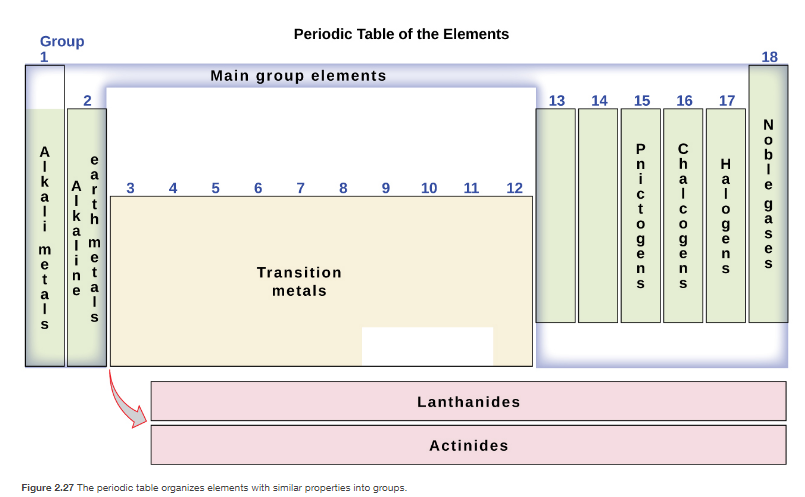
The elements can also be classified into the main-group elements (or representative elements) in the columns labeled 1, 2, and 13–18; the transition metals in the columns labeled 3–123; and inner transition metals in the two rows at the bottom of the table (the top-row elements are called lanthanides and the bottom-row elements are actinides; Figure 2.27).
The elements can be subdivided further by more specific properties, such as the composition of the compounds they form. For example, the elements in group 1 (the first column) form compounds that consist of one atom of the element and one atom of hydrogen. These elements (except hydrogen) are known as alkali metals, and they all have similar chemical properties. The elements in group 2 (the second column) form compounds consisting of one atom of the element and two atoms of hydrogen: These are called alkaline earth metals, with similar properties among members of that group. Other groups with specific names are the pnictogens (group 15), chalcogens (group 16), halogens (group 17), and the noble gases (group 18, also known as inert gases). The groups can also be referred to by the first element of the group: For example, the chalcogens can be called the oxygen group or oxygen family. Hydrogen is a unique, nonmetallic element with properties similar to both group 1 and group 17 elements. For that reason, hydrogen may be shown at the top of both groups, or by itself.
These questions primarily use the immediate reading, just above. However, there may be a few questions that will utilize reading from the first two sections or will serve as a review from assignments from this week.
a. Vertical columns are referred to as
b. Horizontal rows are referred to as
c. The atomic number refers to the number of
d. The number of protons and neutrons determine an atom's
e. The ability of a metal to be drawn into a thin wire is referred to as
f. The ability of a material to be pounded into thin sheets is referred to as
g. The elements in groups 3 -12 are called
h. Group 1 elements are referred to as
i. Group 2 elements are referred to as
j. Group 18 elements are referred to as
k. Group 17 elements are referred to as
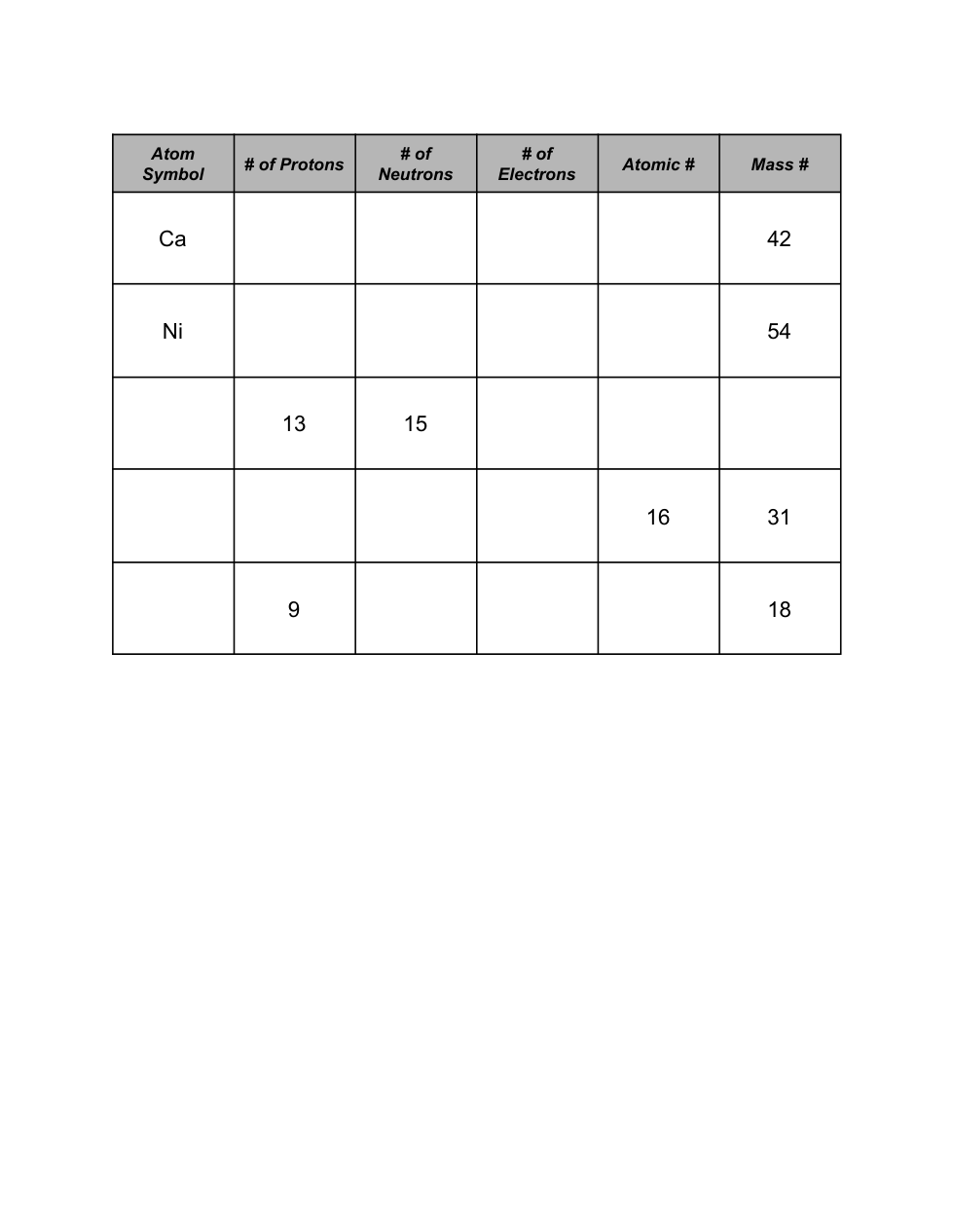
Atomic Number = # of Protons
Atomic Mass = # of Protons + # of Neutrons
In a neutral atom, the # of protons = # of electrons
Protons (1+ charge)
Electrons (1- charge)
Neutrons (0 charge)
Complete the table on the left using the corresponding blanks below.
Use the periodic table to identify the missing elements and identify them by their element symbol.
The circled numbers on the table correspond to the blanks, below.