Copy of Matter and Physical Properties 1- Reading w/Questions (5/28/2026)
star
star
star
star
star
Last updated about 3 hours ago
15 questions
Matter, Mass, and Volume
1
1
1
1
1
Physical Properties and Physical Change
1
1
1
1
1
Change of State
1
1
1
1
1
What is Matter?
Matter is all the “stuff” that exists in the universe. Everything you can see and touch is made of matter, including you! The only things that aren’t matter are forms of energy, such as light and sound. In science, matter is defined as anything that has mass and volume. Mass and volume measure different aspects of matter.
Mass
Mass is a measure of the amount of matter in a substance or an object. The basic SI unit for mass is the kilogram (kg), but smaller masses may be measured in grams (g). To measure mass, you would use a balance. In the lab, mass may be measured with a triple beam balance or an electronic balance, but the old-fashioned balance pictured below may give you a better idea of what mass is. If both sides of this balance were at the same level, it would mean that the fruit in the left pan has the same mass as the iron object in the right pan. In that case, the fruit would have a mass of 1 kg, the same as the iron. As you can see, however, the fruit is at a higher level than the iron. This means that the fruit has less mass than the iron, that is, the fruit's mass is less than 1 kg.
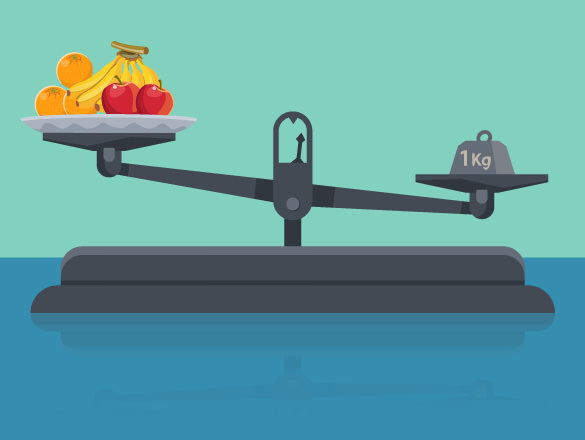
Q: Refer to the picture above. If the fruit were at a lower level than the iron object, what would be the mass of the fruit?
A: The mass of the fruit would be greater than 1 kg.
Mass vs. Weight
Mass is commonly confused with weight. The two are closely related, but they measure different things. Whereas mass measures the amount of matter in an object, weight measures the force of gravity acting on an object. The force of gravity on an object depends on its mass but also on the strength of gravity. If the strength of gravity is held constant (as it is all over Earth), then an object mass is directly proportional to the objects weight, so a greater mass also has a greater weight.
Q: With Earth’s gravity, an object with a mass of 1 kg has a weight of 2.2 lb. How much does a 10 kg object weigh on Earth?
A: A 10 kg object weighs ten times as much as a 1 kg object: 10 × 2.2 lb = 22 lb
Volume
Volume is a measure of the amount of space that a substance or an object takes up. The basic SI unit for volume is the cubic meter (m3), but smaller volumes may be measured in cm3, and liquids may be measured in liters (L) or milliliters (mL). How the volume of matter is measured depends on its state.
The volume of a liquid is measured with a measuring container, such as a measuring cup or graduated cylinder.
The volume of a gas depends on the volume of its container: gases expand to fill whatever space is available to them.
The volume of a regularly shaped solid can be calculated from its dimensions. For example, the volume of a rectangular solid is the product of its length, width, and height.
The volume of an irregularly shaped solid can be measured by the displacement method. You can read below how this method works.
Calculating Volume from Dimensions
Q: How could you find the volume of air in an otherwise empty room?
A: If the room has a regular shape, you could calculate its volume from its dimensions. For example, the volume of a rectangular room can be calculated with the formula:
Volume = length × width × height
If the length of the room is 5.0 meters, the width is 3.0 meters, and the height is 2.5 meters, then the volume of the room is:
Volume = 5.0 m × 3.0 m × 2.5 m = 37.5 m3
Measuring Volume Using the Displacement Method
Q: What is the volume of the dinosaur in the diagram below?
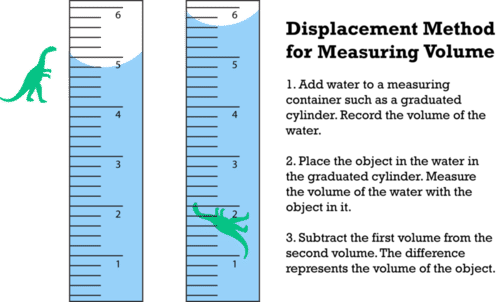
[Figure 3]
A: The volume of the water alone is 4.8 mL. The volume of the water and dinosaur together is 5.6 mL. Therefore, the volume of the dinosaur alone is 5.6 mL – 4.8 mL = 0.8 mL.

Question 1
1.
_______ is defined as anything that has mass and volume.
Question 2
2.
Whereas _______ measures the amount of matter in an object, _______ measures the force of gravity acting on an object.
Question 3
3.
The basic SI unit for_______ is the cubic meter (m3).
Question 4
4.
The volume of a _______ is measured with a measuring container like a graduated cylinder.
Question 5
5.
The volume of an irregularly shaped solid can be measured by the _______ method.
Physical Properties
A physical property is a characteristic of a substance that can be observed or measured without changing the identity of the substance. Silver is a shiny metal that conducts electricity very well. It can be molded into thin sheets, a property called malleability. Salt is dull and brittle and conducts electricity when it has been dissolved into water, which it does quite easily. Physical properties of matter include color, hardness, malleability, solubility, electrical conductivity, density, melting points, and boiling points.
For the elements, color does not vary much from one element to the next. The vast majority of elements are colorless, silver, or gray. Some elements do have distinctive colors: sulfur and chlorine are yellow, copper is (of course) copper-colored, and elemental bromine is red.
Density can be a very useful parameter for identifying an element. Of the materials that exist as solids at room temperature, iodine has a very low density compared to zinc, chromium, and tin. Gold has a very high density, as does platinum.
Hardness helps determine how an element (especially a metal) might be used. Many elements are fairly soft (silver and gold, for example) while others (such as titanium, tungsten, and chromium) are much harder. Carbon is an interesting example of hardness. In graphite (the “lead” found in pencils) the carbon is very soft, while the carbon in a diamond is roughly seven times as hard.
Melting and boiling points are somewhat unique identifiers, especially of compounds. In addition to giving some idea as to the identity of the compound, important information can be obtained about the purity of the material.
Physical Change
As an ice cube melts, its shape changes as it acquires the ability to flow. However, its composition does not change. Melting is an example of a physical change. A physical change is a change to a sample of matter in which some properties of the material change, but the identity of the matter does not. Physical changes can further be classified as reversible or irreversible. The melted ice cube may be refrozen, so melting is a reversible physical change. Physical changes that involve a change of state are all reversible. Other changes of state include vaporization (liquid to gas), freezing (liquid to solid), and condensation (gas to liquid). Dissolving is also a reversible physical change. When salt is dissolved into water, the salt is said to have entered the aqueous state. The salt may be regained by boiling off the water, leaving the salt behind.
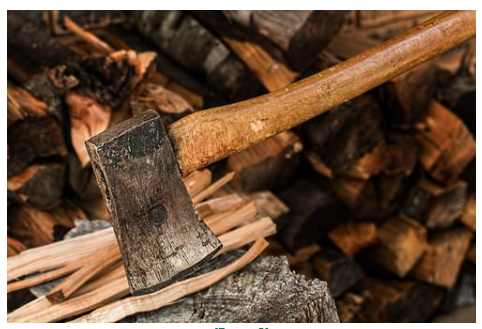
Figure 1 : chopping wood is an irreversible physical change.
When a piece of wood is ground into sawdust, that change is irreversible since the sawdust could not be reconstituted into the same piece of wood that it was before. Cutting the grass or pulverizing a rock would be other irreversible physical changes. Chopping wood for a fire also represents an irreversible physical change since the pieces cannot be put back together to form the tree.
Question 6
6.
A _______ is a characteristic of a substance that can be observed or measured without changing the identity of the substance.
Question 7
7.
Examples of physical properties include _______ , _______ , malleability, and _______ .
Question 8
8.
Melting is an example of a _______ change.
Question 9
9.
Physical changes that involve a change of state, like melting, are _______ changes.
Question 10
10.
When a piece of wood is ground into sawdust, that change is _______ since the sawdust could not be reconstituted into the original wood.
What Are Changes of State?
The water droplets of fog form from water vapor in the air. Fog disappears when the water droplets change back to water vapor. These changes are examples of changes of state. A change of state occurs whenever matter changes from one state to another. Common states of matter on Earth are solid, liquid, and gas. Matter may change back and forth between any two of these states.
Changes of state are physical changes in matter. They are reversible changes that do not change matter’s chemical makeup or chemical properties. For example, when fog changes to water vapor, it is still water and can change back to liquid water again.
Processes that Cause Changes of State
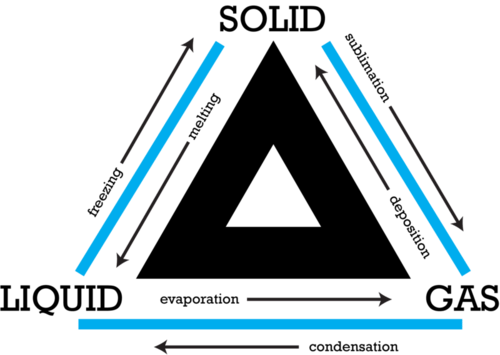
Several processes are involved in common changes of state. They include melting, freezing, sublimation, deposition, condensation, and evaporation. The Figure below shows how matter changes in each of these processes.
Q: Which two processes result in matter changing to the solid state?
A: The processes are deposition, in which matter changes from a gas to a solid, and freezing, in which matter changes from a liquid to a solid.
The Role of Energy in Changes of State
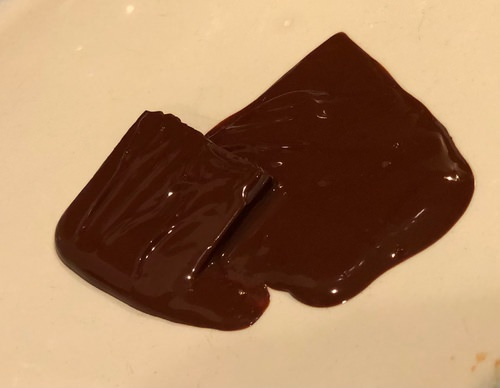
Suppose that you leave some squares of chocolate candy in the hot sun. A couple of hours later, you notice that the chocolate has turned into a puddle like the one pictured in the Figure below.
Q: What happened to the chocolate?
A: The chocolate melted. It changed from a solid to a liquid.
In order for solid chocolate to melt and change to a liquid, the particles of chocolate must gain energy. The chocolate pictured in the Figure above gained energy from sunlight. Energy is the ability to cause changes in matter, and it is always involved in changes of state. When matter changes from one state to another, it either absorbs energy—as when chocolate melts—or loses energy. For example, if you were to place the melted chocolate in a refrigerator, it would lose energy to the cold air inside the refrigerator. As a result, the liquid chocolate would change to a solid again.
Q: Why is energy always involved in changes of state?
A: The energy of particles of matter determines the matter's state. Particles of a gas have more energy than particles of a liquid, and particles of a liquid have more energy than particles of a solid. Therefore, in order for matter to change from a solid to a liquid or from a liquid to a gas, particles of matter must absorb energy. In order for matter to change from a gas to a liquid or from a liquid to a solid, particles of matter must lose energy.
Question 11
11.
Common states of matter on Earth are _______ , liquid, and _______ .
Question 12
12.
Changes of state are _______ changes in matter.
Question 13
13.
When fog changes to water vapor, it is an example of _______ and _______ .
Question 14
14.
In order for solid chocolate to melt, the particles must _______ energy.
Question 15
15.
When matter changes from one state to another, it either _______ energy or _______ energy.