Log in
Sign up for FREE
arrow_back
Library

Copy of States of Matter Virtual Lab (5/28/2026)

star
star
star
star
star
Last updated about 3 hours ago
12 questions
Note from the author:
Virtual Lab - Part 1 and 2 (State of Matter and Phase Change)
Required
2
6
Required
1
1
2
2
2
2
1
1
Exit Ticket - please respond to these two self-reflection questions (they are not hard).
Required
0
Required
0
In this lab, we will explore the impact of increasing or decreasing the energy on certain substances. You will need to read through the instructions for each section of this virtual lab and use the simulations to collect data and observations.
  1. Complete part 1 (States) and part 2 (Phase Changes) using the two simulations below.
  2. Collect all requested data for each part of the lab.
  3. Use the background reading, observations, and data to help answer the post-lab questions.
  4. Complete the exit ticket.
In this lab, we will explore the impact of increasing or decreasing the energy on certain substances. You will need to read through the instructions for each section of this virtual lab and use the simulations to collect data and observations.
  1. Complete part 1 (States) and part 2 (Phase Changes) using the two simulations below.
  2. Collect all requested data for each part of the lab.
  3. Use the background reading, observations, and data to help answer the post-lab questions.
  4. Complete the exit ticket.
Question 1
1.

Prediction — Follow the instructions below to sketch predictions regarding how the atoms of a solid, liquid, and gas may behave; sketch them inside each box. Use dots to represent the atoms, and arrows to represent rapid motion. Use long arrows to represent rapid motion and shorter arrows to exhibit slower motion of the atoms.

  • Click "Show Your Work."
  • Use the tools to the left of the window that opens to make three predictions in the form of a sketch.
  • When all three sketches are complete and labeled, click "Done" in the upper right to submit it.

States of Matter Instructions

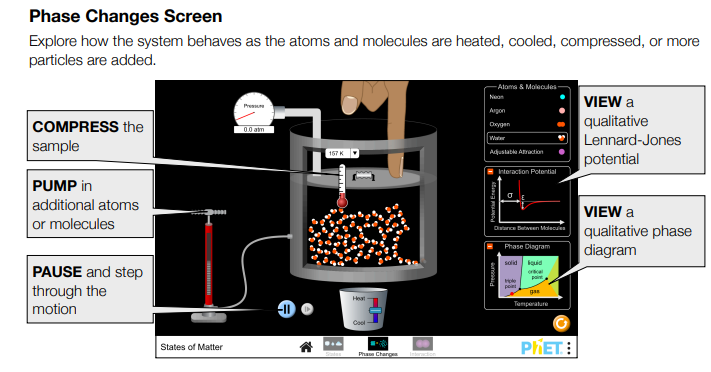
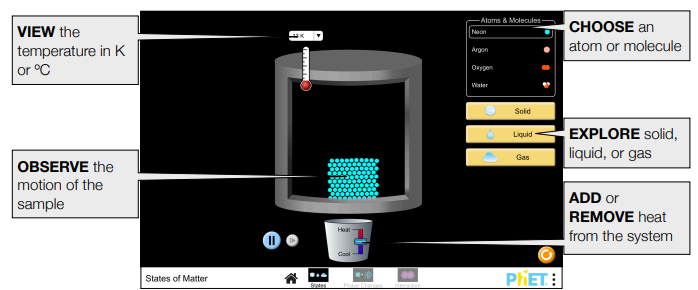
  1. Examine the image below and read the labels to know what the essential controls do.
  2. This virtual lab will consist of two parts - part 1 is State and part 2 is Phase Change.
  3. The goal of part 1 is to explore how changing the energy (increasing or decreasing temperature) of each substance affects how the atoms behave.
  4. The goal of part 2 is to explore the concept of triple point temperature and to find the triple point of each substance.

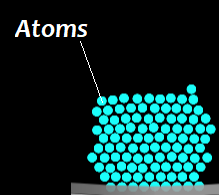
Part 1 Screen:


Part 2 Screen:

Part 1 - States

  • Click "States" in the simulation, below.
  • Use the States simulation to identify and record the temperature in Kelvin (K) of all four substances in each state of matter (solid, liquid, gas).
  • Record the temperatures in the spaces provided below the simulation.
  • You will also use the "Show Your Work" tool to sketch observations of the atoms of each substance in each state of matter.
Directions:
  1. Begin with Neon on the solid state of matter (you should see a vibrating block).
  2. The simulation begins with the solid state of matter; find the temperature in Kelvin (K) in the upper-left of the screen. Record this temperature below the simulation.
  3. Below the simulation, you will see a "heat" and "cold" control; add energy to the sample by sliding the control up.
  4. Observe the state of matter for the presence of a change of state from solid to liquid. Record this temperature below the simulation.
  5. Continue adding energy until the presence of a second change of matter from liquid to gas occurs. Record this temperature below the simulation.
  6. Repeat steps 2-5 using Argon, Oxygen, and Water.
Question 2
2.
Part 1 Observations (States)

Neon (Ne):
  • solid _______ K
  • liquid _______ K
  • gas _______ K
Argon (Ar):
  • solid _______ K
  • liquid _______ K
  • gas _______ K
Oxygen (O):
  • solid _______ K
  • liquid _______ K
  • gas _______ K
Water (H2O):
  • solid _______ K
  • liquid _______ K
  • gas _______ K
Question 3
3.

Click "Show Your Work" and use the table to provide sketches of what the particles of each substance were doing in each state of matter.

Try to match the particle distances and placements of each substance and each state of matter that was observed in the simulation. Repeat the simulation if you need to see them again.

Part 2 - Phase Changes

  • Click "Phase Changes" in the simulation, below.
  • Use the Phase Changes simulation to identify and record all four substances' triple point temperatures in Kelvin (K).
  • Recall that triple point temperature is the temperature at which all three states of matter are simultaneously present for a single substance.
  • Record the temperatures in the spaces provided below the simulation.
  • You will also use the "Show Your Work" tool to sketch observations of the atoms of each substance in each state of matter.
Directions:
  1. Begin with Neon. Identify the temperature (K) at the top of the simulation.
  2. Adjust the energy available to the particles (atoms) in each sample by increasing or decreasing the temperature (same control as in Part 1).
  3. Observe the Phase Diagram at the bottom-right for the red dot lining up with the triple point.
  4. Record the triple point temperature for each sample in the area below the simulation.
  5. Perform this simulation for Neon, Argon, Oxygen, and Water.
Question 4
4.
Part 2 Observations (Phase Changes)

Neon:
  • Triple Point Temp _______ K
Argon:
  • Triple Point Temp _______ K

Oxygen:
  • Triple Point Temp _______ K

Water:
  • Triple Point Temp _______ K
Post-Lab Questions
Use the observations and the data that you recorded from this lab to assist you.
Question 5
5.
Review Part 1 - Which substance in which state of matter had the lowest temperature?
List the substance and the temperature.

Substance _______
State of Matter _______
Temperature _______
Question 6
6.
Review Part 1 - Which substance in which state of matter had the highest temperature?
List the substance and the temperature.

Substance _______
State of Matter _______
Temperature _______
Question 7
7.
Review part 2 - Which substance in has the lowest triple point temperature?
List both the substance and the temperature.
Substance _______
Temperature _______
Question 8
8.
Review Part 2 - Which substance has the highest triple point temperature?
List both the substance and the temperature.
Substance _______
Temperature _______
Question 9
9.

Explain how a change of temperature affects the pressure inside of a container.

Question 10
10.

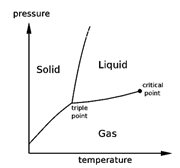
Briefly explain what this diagram is describing.

Question 11
11.

Briefly describe or name an area of this activity in which you feel that you don't fully understand.

Question 12
12.

States of Matter Background

  • There are four states of matter: three standard and one uncommon (plasma).
  • The standard states of matter include — solid, liquid, and gas.
  • All substances can exhibit all three of these states of matter.
  • The state of matter is determined by the amount of energy a substance possesses.
  • As a substance gains energy, the atoms that make up the substance begin to vibrate; as the energy continues to increase, the motion of those atoms will also increase.
  • If the energy and motion of the atoms increase, eventually, the amount of space between the particles will increase, as well as the speed at which the atoms move.
  • The energy of a substance can be increased or decreased by changing its temperature.
  • A solid is a state of matter in which all of the atoms in that substance are stacked up in an organized fashion; the particles, while not changing position, will vibrate in place.
  • A liquid is a state of matter in which the atoms exhibit more motion than those of a solid and are sliding by one another.
  • A gas is a state of matter in which the atoms exhibit more motion than those of a liquid and are now moving in very rapid, straight lines.
  • Triple Point Temperature - the temperature and pressure at which a single substance's three states of matter (gas, liquid, and solid) are simultaneously present.
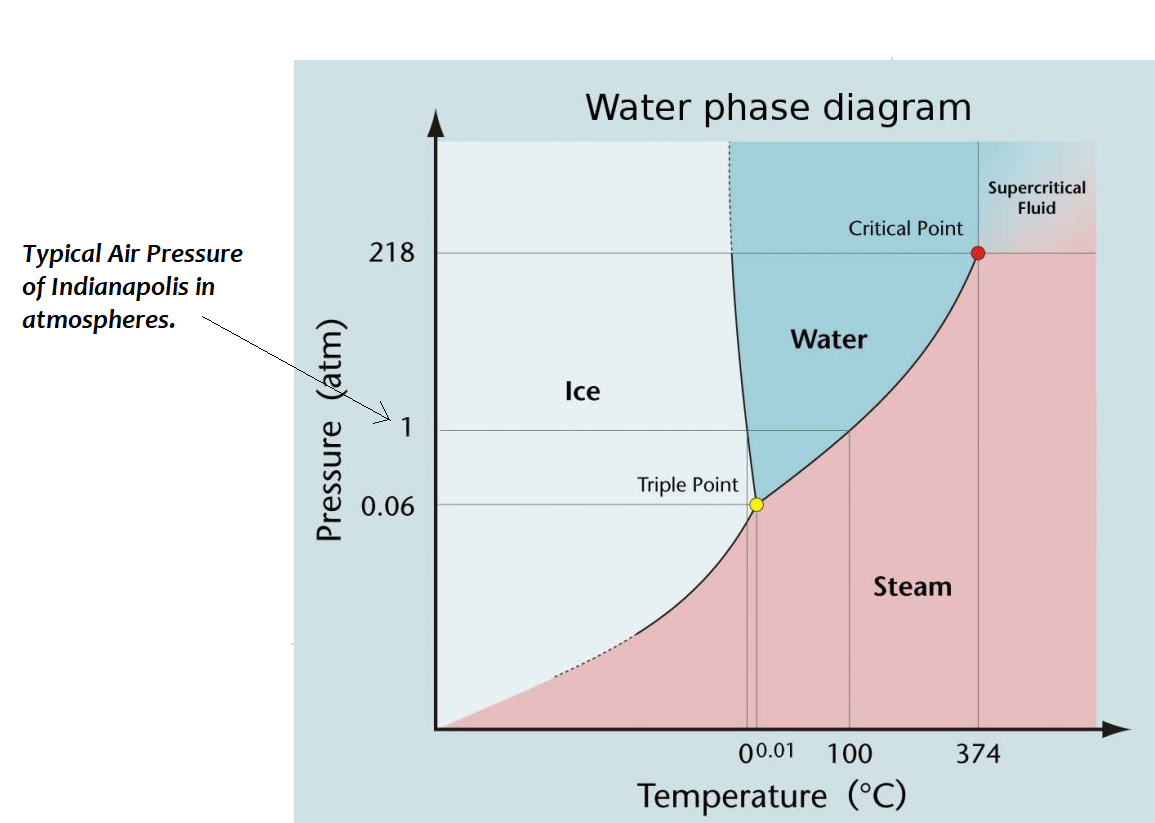
  • Below is a phase diagram for water that displays the relationship between pressure and temperature with each state of matter of water; notice that at 0.06 atm and 0.01 oC, all three states of water are present, even in small amounts - this is the triple point for water.

In this lab, we will explore the impact of increasing or decreasing the energy on certain substances. You will need to read through the instructions for each section of this virtual lab and use the simulations to collect data and observations.
My confidence regarding the concepts covered in this activity has...
Significantly increased
Moderately increased
Slightly increased
Not changed
Slightly decreased
Moderately decreased
Significantly decreased