Copy of Single and Double Replacement Reactions (5/28/2026)
star
star
star
star
star
Last updated about 3 hours ago
12 questions
1
1
1
1
Single and Double-Displacement Questions with a Review of Synthesis and Decomposition Reactions
1
1
1
3
2
1
1
1
Review of Synthesis and Decomposition Reactions
Synthesis and decomposition reactions are related reactions. Synthesis reactions work to combine two simple compounds into one more complex compound. Decomposition reactions move in the opposite direction. Instead of combining two compounds into a single one, decomposition reactions, with the input of some form of energy, work to breakdown a more complex compound into two simpler ones.
Question 1
1.
Question 2
2.
Question 3
3.
Question 4
4.
Question 5
5.
Question 6
6.
Question 7
7.
Question 8
8.
Question 9
9.
Question 10
10.
Reactions in which two or more substances combine to form a new substance are referred to as _______ reactions.
Question 11
11.
When one element replaces another element the reaction is known as a _______ reaction.
Question 12
12.
Single-Replacement Reactions
A single-replacement reaction is a reaction in which one element replaces a similar element in a compound. The general form of a single-replacement (also called single-displacement) reaction is:

Y is a nonmetal and replaces the nonmetal Z in the compound with X.
Metal Replacement
Magnesium is a more reactive metal than copper. When a strip of magnesium metal is placed in an aqueous solution of copper(II) nitrate, it replaces the copper. The products of the reaction are aqueous magnesium nitrate and solid copper metal.

*(s) - solid; (aq) - dissolved in water, aqueous solution.
This subcategory of single-replacement reactions is called a metal replacement reaction because it is a metal that is being replaced (zinc).
Hydrogen Replacement
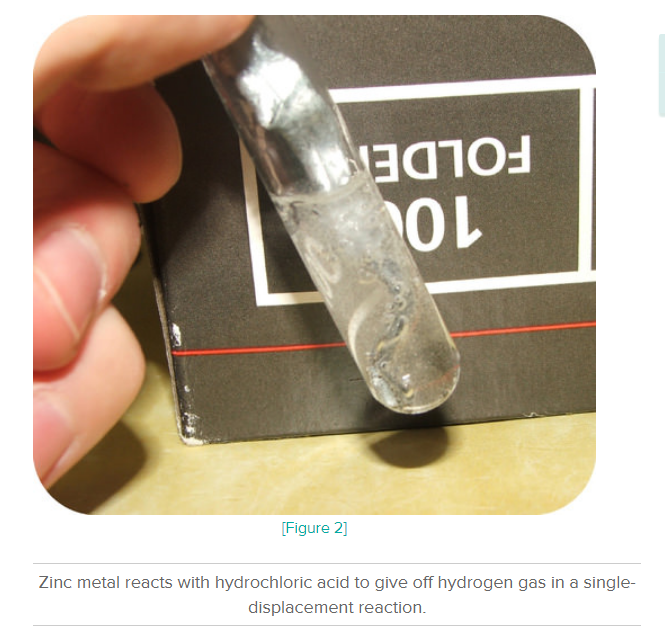
Many metals react easily with acids and when they do so, one of the products of the reaction is hydrogen gas. Zinc reacts with hydrochloric acid to produce aqueous zinc chloride and hydrogen (Figure below).

In a hydrogen replacement reaction, the hydrogen in the acid is replaced by an active metal.
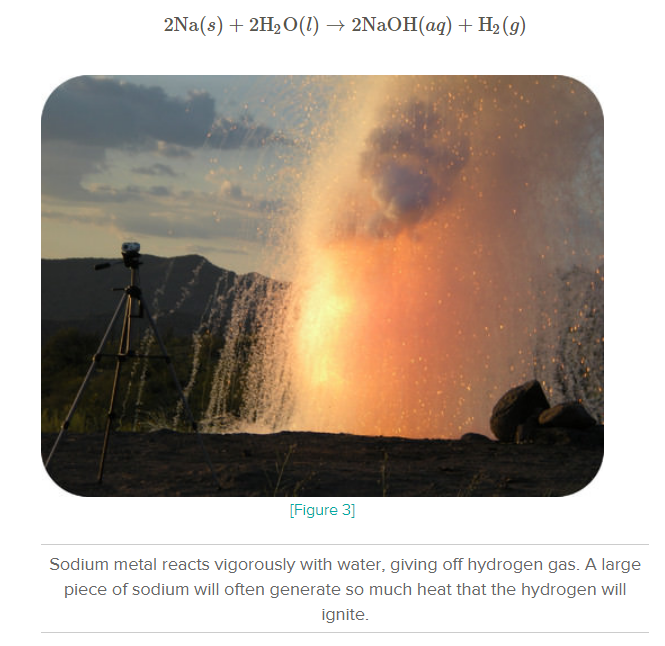
Some metals are so reactive that they are capable of replacing the hydrogen in water. The products of such a reaction are the metal hydroxide and hydrogen gas. All group 1 metals undergo this type of reaction. Sodium reacts vigorously with water to produce aqueous sodium hydroxide and hydrogen (see Figure below).
Halogen Replacement
The element chlorine reacts with an aqueous solution of sodium bromide to produce aqueous sodium chloride and elemental bromine.

The reactivity of the halogen group (group 17) decreases from top to bottom within the group. Fluorine is the most reactive halogen, while iodine is the least. Since chlorine is above bromine, it is more reactive than bromine and can replace it in a halogen replacement reaction.

In a single replacement reaction, one compound reacts with another compound to form a single product.
True
False
“Carbon dioxide gas is added to water.” The described chemical reaction should be classified as a single displacement reaction.
True
False
A non-metal will replace a metal.
True
False
Double-Replacement Reactions
A double-replacement reaction is a reaction in which the positive and negative ions of two ionic compounds exchange places to form two new compounds. The general form of a double-replacement (also called double-displacement) reaction is:
AB + CD → AD + CB
In this reaction, A and C are positively charged cations, while B and D are negatively charged anions. Double-replacement reactions generally occur between substances in aqueous solution. For a reaction to occur, one of the products is usually a solid precipitate, a gas, or a molecular compound such as water.
Formation of a Precipitate
A precipitate forms in a double-replacement reaction when the cations from one of the reactants combine with the anions from the other reactant to form an insoluble ionic compound. When aqueous potassium iodide and lead (II) nitrate solutions are mixed, the following reaction occurs.
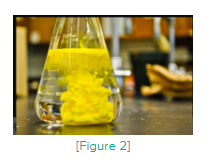
There are very strong attractive forces that occur between Pb2+ and I− ions and the result is a brilliant yellow precipitate (see Figure below). The other product of the reaction, potassium nitrate, remains soluble.
Formation of lead iodide precipitate (Fig. 2)
Formation of a Gas
Some double-replacement reactions produce a gaseous product which then bubbles out of the solution and escapes into the air. When solutions of sodium sulfide and hydrochloric acid are mixed, the products of the reaction are aqueous sodium chloride and hydrogen sulfide gas.
Formation of a Molecular Compound
Another kind of double-replacement reaction is one that produces a molecular compound as one of its products. Many examples in this category are reactions that produce water. When aqueous hydrochloric acid is reacted with aqueous sodium hydroxide, the products are aqueous sodium chloride and water.
Sample Problem: Double-Replacement Reactions
Write a complete and balanced chemical equation for the following double-replacement reactions. One product is indicated as a guide.
Step 1: Plan the problem.
In A, the production of a gas drives the reaction. In B, the production of a precipitate drives the reaction. In both cases, use the ionic charges of both reactants to construct the correct formulas of the products.
Step 2: Solve.
A. The cations of both reactants are +1 charged ions, while the anions are -1 charged ions. After exchanging partners, the balanced equation is:
B. Ammonium and nitrate ions are 1+ and 1−, respectively, while barium and sulfate are 2+ and 2−. This must be considered when exchanging partners and writing new formulas. Then, the equation is balanced.
Step 3: Think about your result.
Both are double-replacement reactions. All formulas are correct, and the equations are balanced. Occasionally, a reaction will produce both a gas and a molecular compound. The reaction of a sodium carbonate solution with hydrochloric acid produces aqueous sodium chloride, carbon dioxide gas, and water.
A double replacement reaction has two compounds as reactants.
True
False
What type of chemical reaction is this:
Combination
Double Displacement
Single displacement
Decomposition
What type of chemical reaction is this:
Single Displacement
Decomposition
Synthesis
Double Discplacement
What type of reaction is the reverse of a combination reaction?
decomposition
combustion
double displacement
single displacement
Identify each reaction by their type
Single Displacement
Double Displacement
Synthesis
Decomposition
Which of the following is not a double-replacement reaction (select all that apply)?