The following is a synthesis reaction.

The following is a synthesis reaction.
Review - Synthesis and Decomposition Reactions
A synthesis (combination) reaction involves two or more substances to form a single new substance. The following formula can represent them:
A + B → AB
Some synthesis reactions that easily occur in nature are between metals and oxygen, as well as between nonmetals and oxygen. Both of these will form an oxide. For example, iron, a metal, reacts with oxygen to form iron oxide (which we commonly identify as rust). Sulfur, a nonmetal, can also react with oxygen to form sulfur oxide.
Decomposition reactions are similar to synthesis reactions but also are quite different in that they move backward compared to synthesis reactions. Decomposition reactions begin with a more complex compound and will breakdown (or decompose) to form two or more simpler substances. The following formula can represent them:
AB → A + B
The following is a synthesis reaction.
The following is a decomposition reaction.
The following is a synthesis reaction.
This is a decomposition reaction.
Review - Single and Double-Replacement Reactions
A single-replacement reaction is one in which a single element replaces a similar element in a compound. They can be represented by the following formula:
A + BC → B + AC
A double-replacement reaction is one in which positive and negative ions of two ionic compounds trade places to form two new compounds. They can be represented by the following formula:
AB + CD → AD + CB
These reactions usually take place within an aqueous solution. As a result of these reactions, a solid precipitate, a gas, or a molecular compound is formed as a product.
The following reaction is a double-displacement reaction:
The following reaction is a single-displacement reaction:
The following reaction is a single-displacment reaction:
A gas, a solid precipitate, and a molecular compound, such as water, can form as a result of a double-replacement reaction.
Combustion Reactions
Roasting marshmallows over an open fire is a favorite pastime for campers, outdoor cookouts, and gathering around a fire in the backyard. The trick is to get the marshmallow a nice golden brown without catching it on fire. Too often, we are unsuccessful, and we see the marshmallow burning on the stick – a combustion reaction taking place right before us.
A combustion reaction is a reaction in which a substance reacts with oxygen gas, releasing energy in the form of light and heat. Combustion reactions must involve O2 as one reactant. The combustion of hydrogen gas produces water vapor.
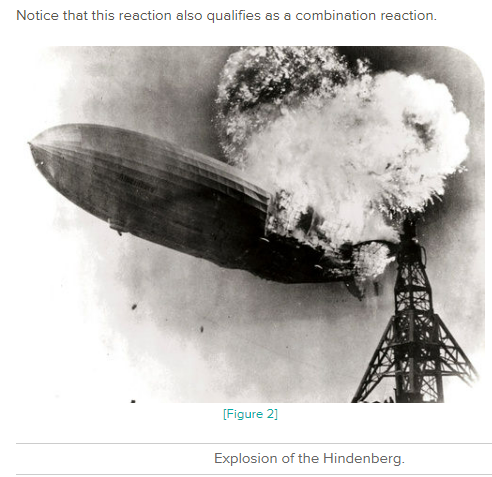
The Hindenburg was a hydrogen-filled airship that suffered an accident upon its attempted landing in New Jersey in 1937. The hydrogen immediately combusted in a huge fireball, destroying the airship and killing 36 people. The chemical reaction was a simple one: hydrogen combining with oxygen to produce water.
Many combustion reactions occur with a hydrocarbon, a compound made up solely of carbon and hydrogen. The products of the combustion of hydrocarbons are carbon dioxide and water. Many hydrocarbons are used as fuel because their combustion releases very large amounts of heat energy. Propane (C3H8) is a gaseous hydrocarbon that is commonly used as the fuel source in gas grills.
Combustion reactions must have oxygen as a reactant. Note that the water produced is in the gas rather than the liquid state because of the high temperatures accompanying a combustion reaction.
What is or are the product(s) of a combustion reaction?
The following reaction would be classified as what type of reaction?
What are the products of any combustion reaction involving a hydrocarbon as a reactant?
Which of the following is not a combustion reaction?
Which of the following is the correct chemical equation for the combution of methane (CH4)?
What must be a reactant for a chemical reaction to qualify as cumbustion?
What happens when a fuel, such as coal, is heated to a high temperture in the presence of oxygen gas?
What are the primary products of the combustion of a hydrocarbon?
Combustion reactions release large amounts of energy as heat and/or light.