Copy of Exothermic and Endothermic Reactions (5/28/2026)
star
star
star
star
star
Last updated 3 months ago
17 Nsɛmmisa
Exothermic Reactions
1
1
1
2
1
1
Endothermic Reactions
2
1
1
2
1
1
1
1
1
1
1
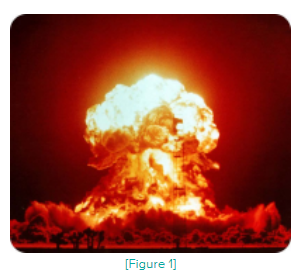
This mushroom cloud was produced in a 1953 nuclear bomb test in Nevada. There’s no doubt that the explosion gave off a huge amount of energy. Although not as impressive as nuclear reactions, many chemical reactions also give off energy. These reactions are called exothermic reactions.
All chemical reactions involve energy. Energy is used to break bonds in reactants, and energy is released when new bonds form in products. In some chemical reactions, called endothermic reactions, less energy is released when new bonds form in the products than is needed to break bonds in the reactants. The opposite is true of exothermic reactions. In an exothermic reaction, it takes less energy to break bonds in the reactants than is released when new bonds form in the products.
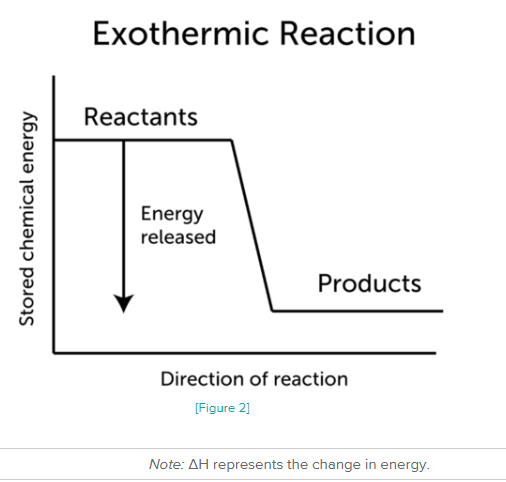
The word exothermic means “releasing heat.” Energy, often in the form of heat, is released as an exothermic reaction proceeds. This is illustrated in the Figure below.
The general equation for an exothermic reaction is:
Reactants → Products + Energy
If the energy produced in an exothermic reaction is released as heat, it results in a rise in temperature. As a result, the products are likely to be warmer than the reactants.
Q: You turn on the hot water faucet, and hot water pours out. How does the water get hot? Do you think that an exothermic reaction might be involved?
A: A hot water heater increases the temperature of water in most homes. Many hot water heaters burn a fuel such as natural gas. The burning fuel causes the water to get hot because combustion is an exothermic reaction.
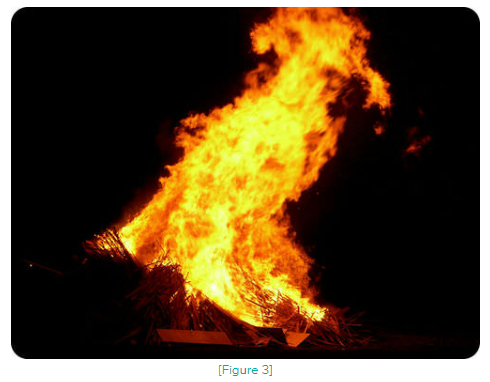
All combustion reactions are exothermic reactions. During a combustion reaction, a substance burns as it combines with oxygen. When substances burn, they usually give off energy as heat and light. Look at the big bonfire in the Figure below. The combustion of wood is an exothermic reaction that releases a lot of energy as heat and light. You can see the light energy the fire is giving off. If you were standing near the fire, you would also feel its heat.
According to the video, an exothermic reaction
According to the video, a dilute aqueous solution has more
According to the video, exothermic reactions often release excess energy in the form of
An exothermic reaction is a chemical reaction in which less energy is needed to break bonds in the reactants than is released when new bonds form in the products.
During an exothermic reaction, energy is constantly given off, often in the form of heat.
All combustion reactions are exothermic reactions. During combustion, a substance burns as it combines with oxygen, releasing energy in the form of heat and light.
According to the reading, exothermic reactions
According to figure 2, there is
According to the reading,
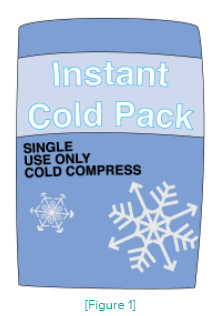
Did you ever use an instant ice pack like this one? You don’t have to pre-cool it in the freezer. All you need to do is squeeze the pack and it starts to get cold. How does this happen? The answer is an endothermic chemical reaction.
All chemical reactions involve energy. Energy is used to break bonds in reactants, and energy is released when new bonds form in products. In some chemical reactions, called exothermic reactions, more energy is released when new bonds form in the products than is needed to break bonds in the reactants. The opposite is true of endothermic reactions. In an endothermic reaction, it takes more energy to break bonds in the reactants than is released when new bonds form in the products.
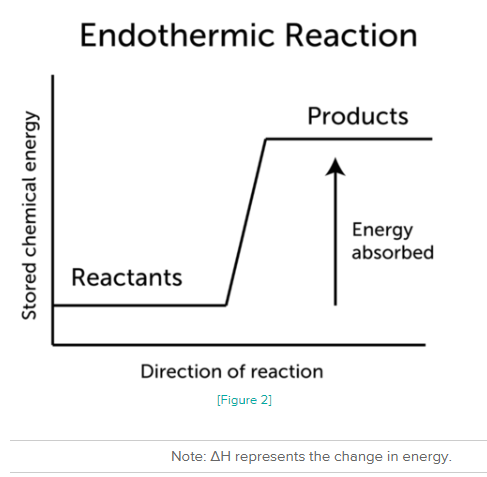
The word endothermic literally means “taking in heat.” A constant input of energy, often in the form of heat, is needed to keep an endothermic reaction going. This is illustrated in the Figure below. Energy must be constantly added because not enough energy is released when the products form to break more bonds in the reactants.
The general equation for an endothermic reaction is:
Reactants + Energy → Products
In endothermic reactions, the temperature of the products is typically lower than the temperature of the reactants. The drop in temperature may be great enough to cause liquids to freeze.
Q: Now can you guess how an instant cold pack works?
A: Squeezing the cold pack breaks an inner bag of water, and the water mixes with a chemical inside the pack. The chemical and water combine in an endothermic reaction. The energy needed for the reaction to take place comes from the water, which gets colder as the reaction proceeds.
One of the most important series of endothermic reactions is photosynthesis. In photosynthesis, plants make the simple sugar glucose (C6H12O6) from carbon dioxide (CO2) and water (H2O). They also release oxygen (O2) in the process.
The reactions of photosynthesis are summed up by this chemical equation:
6 CO2 + 6 H2O → C6H12O6 + 6 O2
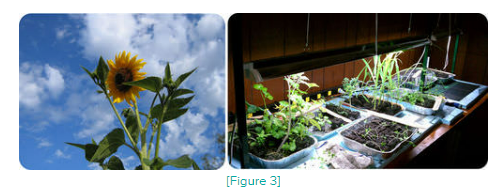
The energy for photosynthesis comes from light. Without light energy, photosynthesis cannot occur. As you can see in the Figure below, plants can get the energy they need for photosynthesis from either sunlight or artificial light.
According to the video, exothermic reactions
According to the video, you can identify if an exothermic or endothermic reaction has taken place if there is a
According to the video, a
According to the video, in an endothermic reaction, the reactants will have
An endothermic reaction is a chemical reaction in which more energy is needed to break bonds in the reactants than is released when new bonds form in the products.
A constant input of energy, often in the form of heat, is needed to keep an endothermic reaction going.
One of the most important series of endothermic reactions is photosynthesis. The energy needed for photosynthesis comes from light.
According to the reading, it takes
According to the reading, to keep an endothermic reaction moving, a
In an exothermic reaction, does the temperature go up or down?
In an endothermic reaction, does the temperature go up or down?
Under the "Reaction" column, select which reactions would be considered endothermic.
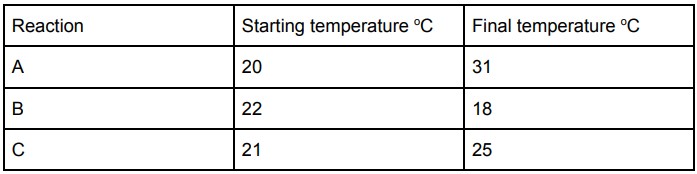
Briefly explain why you chose the above reaction(s).
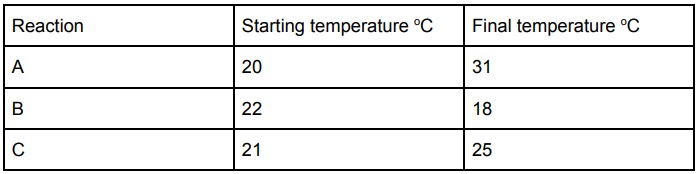
Briefly explain why you chose the above reaction(s).