Copy of Ideal Gas Law Reading w/ Questions (5/28/2026)
star
star
star
star
star
Last updated 3 months ago
1 Asɛmmisa
Ɛhia
5
I have "read" this.
I have "read" this.
I have "read" this.
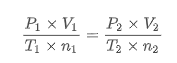
As with the other gas laws, we can also say that
is equal to a constant. The constant can be evaluated provided that the gas being described is considered to be ideal.
The ideal gas law is a single equation which relates the pressure, volume, temperature, and number of moles of an ideal gas. If we substitute in the variable R for the constant, the equation becomes:
The ideal gas law is conventionally rearranged to look this way, with the multiplication signs omitted:
The variable 𝑅 in the equation is called the ideal gas constant.
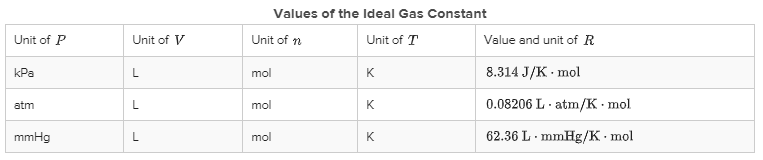
The value of 𝑅, the ideal gas constant, depends on the units chosen for pressure, temperature, and volume in the ideal gas equation. It is necessary to use Kelvin for the temperature and it is conventional to use the SI unit of liters for the volume. However, pressure is commonly measured in one of three units: kPa, atm, or mmHg. Therefore, 𝑅 can have three different values.
We will demonstrate how 𝑅 is calculated when the pressure is measured in kPa. Recall that the volume of 1.00 mol of any gas at STP is measured to be 22.414 L. We can substitute 101.325 kPa for pressure, 22.414 L for volume, and 273.15 K for temperature into the ideal gas equation and solve for 𝑅.
This is the value of 𝑅 that is to be used in the ideal gas equation when the pressure is given in kPa. Table below shows a summary of this and the other possible values of 𝑅. It is important to choose the correct value of 𝑅 to use for a given problem.
Notice that the unit for 𝑅 when the pressure is in kPa has been changed to J/K • mol. A kilopascal multiplied by a liter is equal to the SI unit for energy, a joule (J).