Log in
Sign up for FREE
arrow_back
Library

Copy of Energy of Reactions POGIL (5/28/2026)

star
star
star
star
star
Last updated about 3 hours ago
23 questions
Note from the author:
Untitled Section
3
3
3
2
2
1
1
1
1
1.5
Untitled Section
2
1
1
1
1
1
2
1
1
1
1.5
1
1
All short answer questions must be re-graded by Mr. Poe.
Model 1: Enthalpy of endothermic and exothermic processes

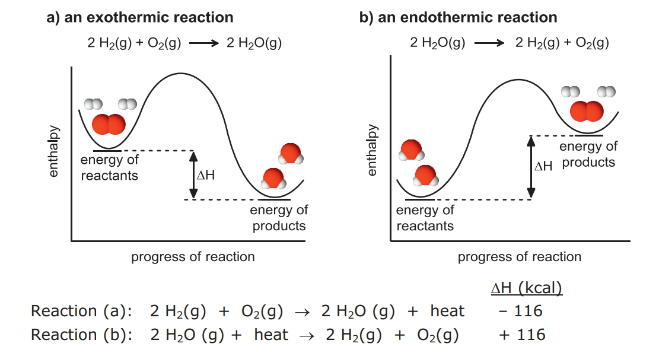
The chemicals in a reaction system (what we are focusing on in an observation) can either absorb heat energy from the surroundings (everything outside of the system) or release heat energy to the surroundings. A reaction in which heat energy moves from the system to the surroundings (and feels warm) is said to be exothermic. A reaction in which heat energy moves from the surroundings to the system (and feels cool) is said to be endothermic.

The breaking of bonds requires energy from molecular collisions to separate bonded atoms (called activation energy, or Eact), and the formation of bonds releases energy to the surroundings. Activation energy is the input of energy required to initiate any chemical reaction.

Because in most chemical reactions bonds are both broken and formed, the difference in energy between the reactants and products determines whether heat is released or absorbed. This difference is called the change in enthalpy, or ΔH. In general, exothermic reactions favor the formation of products, and we say that they are “favorable”. Because they are more favorable, they are generally the most common type of reaction.

While not all, many exothermic and endothermic reactions are reversible reactions of one another—meaning that the reactants of one reaction are the products of the other.
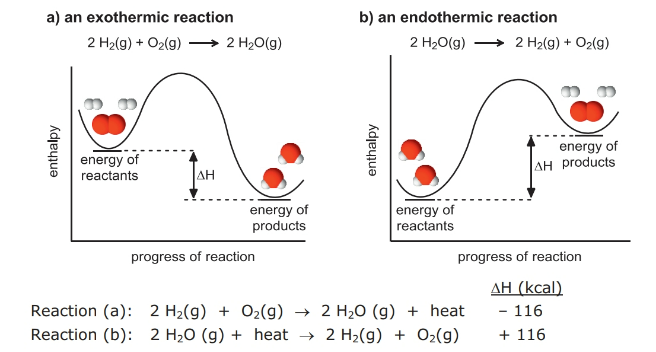
*Note - Rxn is often used as an abbreviation for the word "reaction".
Question 1
1.
a. Compare the equations for Reactions (a) and (b) in Model 1. How is Reaction (b) related to Reaction (a)? _______

Think about how the difference in Reactions (a) and (b) affect the sign of ΔH.
b. Rxn (a) has a negative ΔH value, what does that mean? _______
c. Rxn (b) has a positive ΔH value, what does that mean? _______
Question 2
2.
Other Answer Choices:
equal to
neutral
unchanged
absorbed
lower than
higher than
positive
released
negative
Question 3
3.
Other Answer Choices:
absorbed
released
equal to
higher than
positive
lower than
neutral
unchanged
negative
Question 4
4.
a. Since reactions are favorable when they release energy and form lower energy products, which reaction — Rxn (a) or Rxn (b) — is favorable? _______
b. What is the sign (+ or –) for the energy (enthalpy) value of a favorable reaction? _______
Question 5
5.
When the temperature is increased:
a. Atoms and molecules move ___________.
b. Atoms and molecules have _________ kinetic energy.
Other Answer Choices:
sideways
slower
more
equal amounts of
less
faster
Question 6
6.

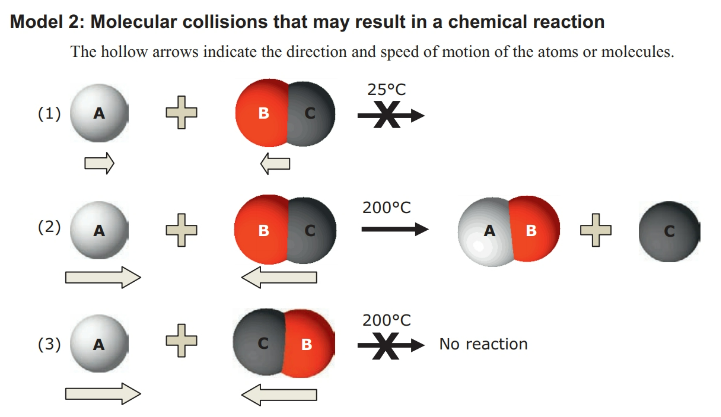
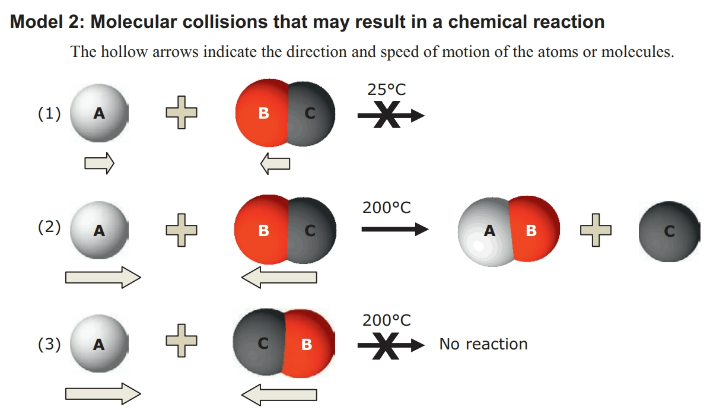
In what way(s) are collisions between molecules at 200°C different from the collisions at room temperature (25°C)?

Question 7
7.

Compare Rxn (1) and Rxn (2) in Model 2. In what way(s) are they different?

Question 8
8.

Compare Rxn (2) and Rxn (3) in Model 2. In what way(s) are they different?

Question 9
9.

Propose two conditions that must be satisfied for a molecular collision to result in a chemical reaction.

Question 10
10.
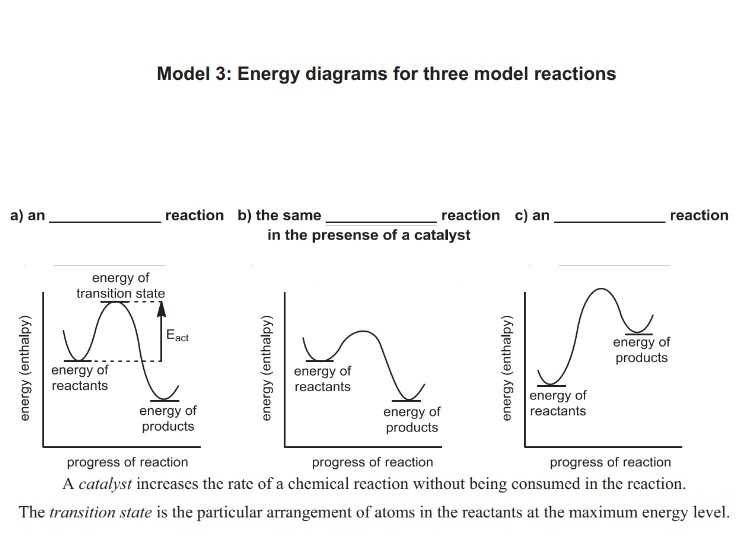
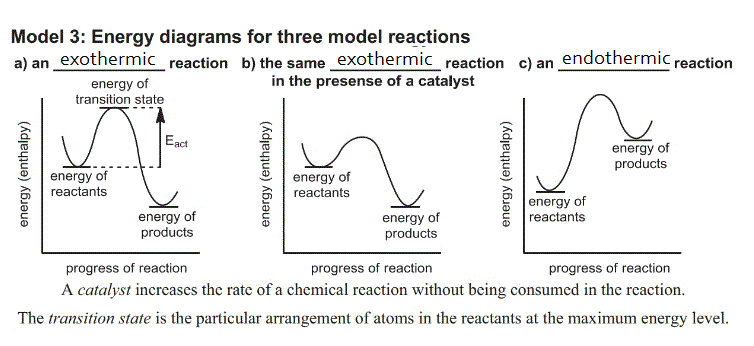
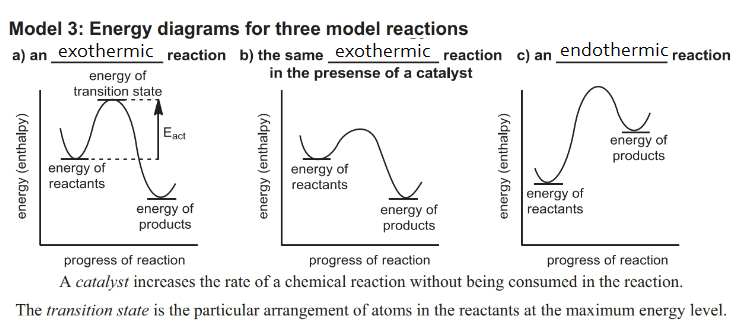
Without looking at Model 1, if possible, identify what type of reaction a, b, and c are, below.
Other Answer Choices:
endothermic
exothermic
exothermic
endothermic
Question 11
11.

Identify the transition state energy in Rxn b and c, below.

Question 12
12.

Use the Line Tool to draw vertical arrows onto Model 3 for Rxn b and c that represents that activation energy (Eact) for each.


Question 13
13.

What do you think happens to reactant molecules that collide with less energy than the energy of the transition state?

Question 14
14.
Which reaction in Model 2 illustrates reactant molecules that collide with less energy than the energy of the transition state? _______
Question 15
15.

In light of Models 2 and 3, why do reactions proceed faster at higher temperatures? The best answers will include the terms molecules and activation energy.

Question 16
16.

Examine Rxn b in Model 3. Then propose an answer to complete the following sentence:

A catalyst increases the rate of a chemical reaction by...

Question 17
17.
Considering Model 3, does a catalyst affect the energies of the reactants? _______ Does a catalyst affect the energies of the products? _______
Question 18
18.

From the previous question, indicate how you can tell this from the model.

Information:
The lower the energy of a chemical species, the more favorable it is to be formed. In exothermic reactions, the products have less energy than the reactants, and so these reactions favor conversion of most of the reactants to products. The exact equilibrium amounts of reactants and products are determined by their relative energies.

Catalysts will increase the rate of the reaction by placing each reactant in a favorable orientation to each other, thus lowering the Eact needed for the reaction to occur and proceed forward. In reversible reactions, if the rate of forward and reverse reactions are both increased, the chemical equilibria are unchanged, even though they may be reached faster.
Question 19
19.

Does a catalyst affect the equilibrium amounts of reactants or products? Why or why not?

Question 20
20.

Consider Rxn (2) in Model 2. What do you think would happen to the reaction rate if more A atoms were added to the mixture, causing the concentration of A to increase?

Question 21
21.
From this activity, provide a list of three ways to speed up the rate of a chemical reaction.
_______; _______; _______
Question 22
22.

The burning of a piece of paper in air to produce CO2 and H2O vapor is a spontaneous exothermic reaction. What would be necessary to start this reaction?

Question 23
23.

The burning of a piece of paper in air to produce CO2 and H2O vapor is a spontaneous exothermic reaction. After the reaction starts, what provides the activation energy for the reaction to continue?

For an exothermic reaction:
a. The energy of the products is _______________ the reactants.
b. Heat is _____________.
c. The sign for ΔH is _____________.
For an endothermic reaction:
a. The energy of the products is ________________ the reactants.
b. Heat is _____________.
c. The sign for ΔH is _____________.