Identify which of the following reactions are exothermic and which are endothermic:
a. 2 Mg(s) + O2(g) → 2 MgO(s) ΔH = –1204 kJ
b. CaCl2 · 6 H2O(s) →(H2O)→ CaCl2(aq) ΔH = 18.0 kJ
c. 4 NH3(g) + 3 O2(g) → N2(g) + 6 H2O(g) ΔH = –1250 kJ
d. CH4(g) → C(s) + 2 H2(g) ΔH = 412.0 kJ
Define internal energy. In your definition describe its relationship to work and heat.
For a certain process, the values for both q and w are negative. What do these values mean in terms of heat transfer and work done? In your answer, be sure to explain what happens to internal energy.
In a process, the internal energy of a system decreased to 10.4 kJ. The system absorbs 62.5 kJ of energy from its surroundings. Calculate how much work (w) the system did. Do not forget to include the units in your reported answer.
w =
Potassium bromide, KBr, has an enthalpy of formation of -393.8 kJ. Explain what this statement means.
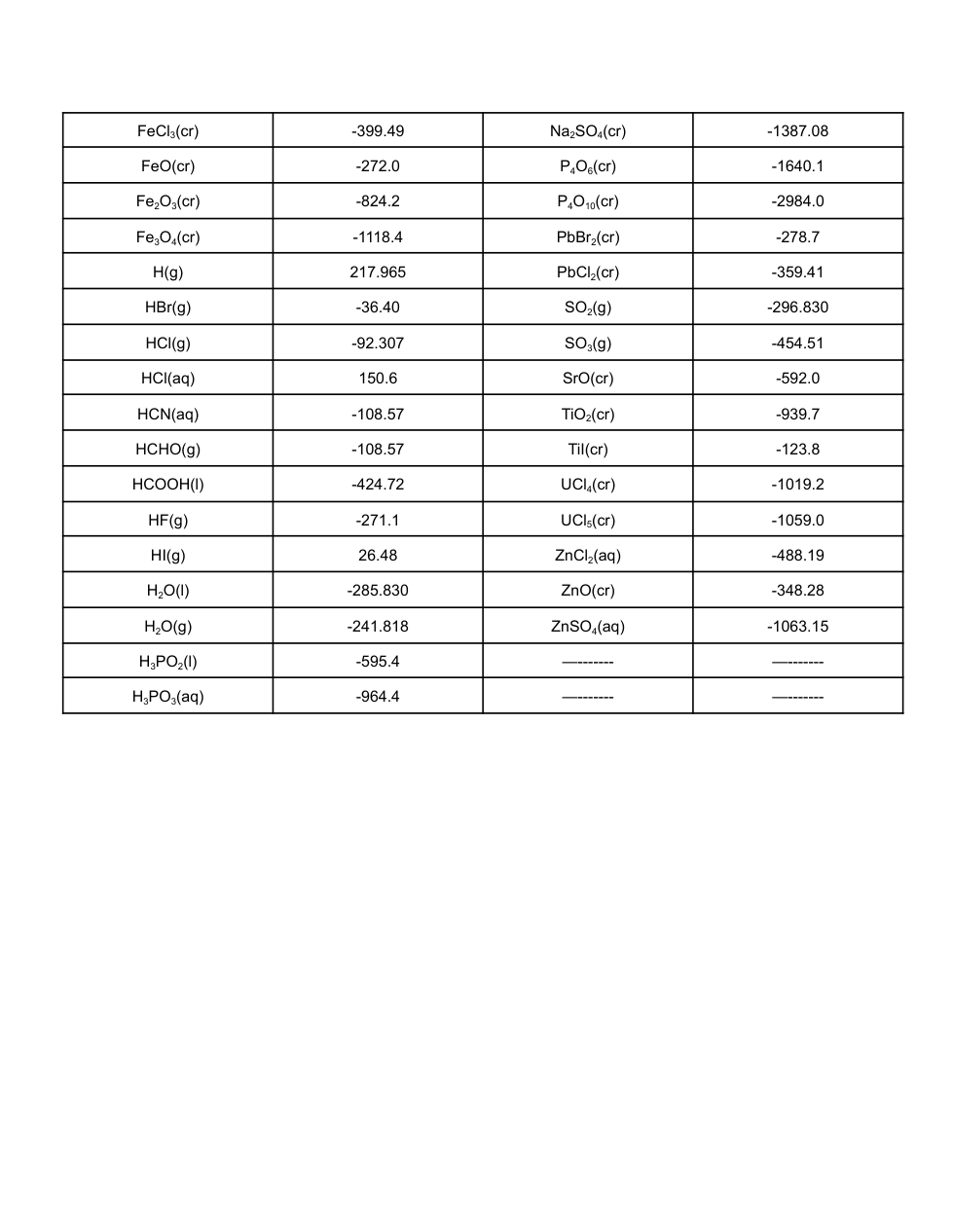
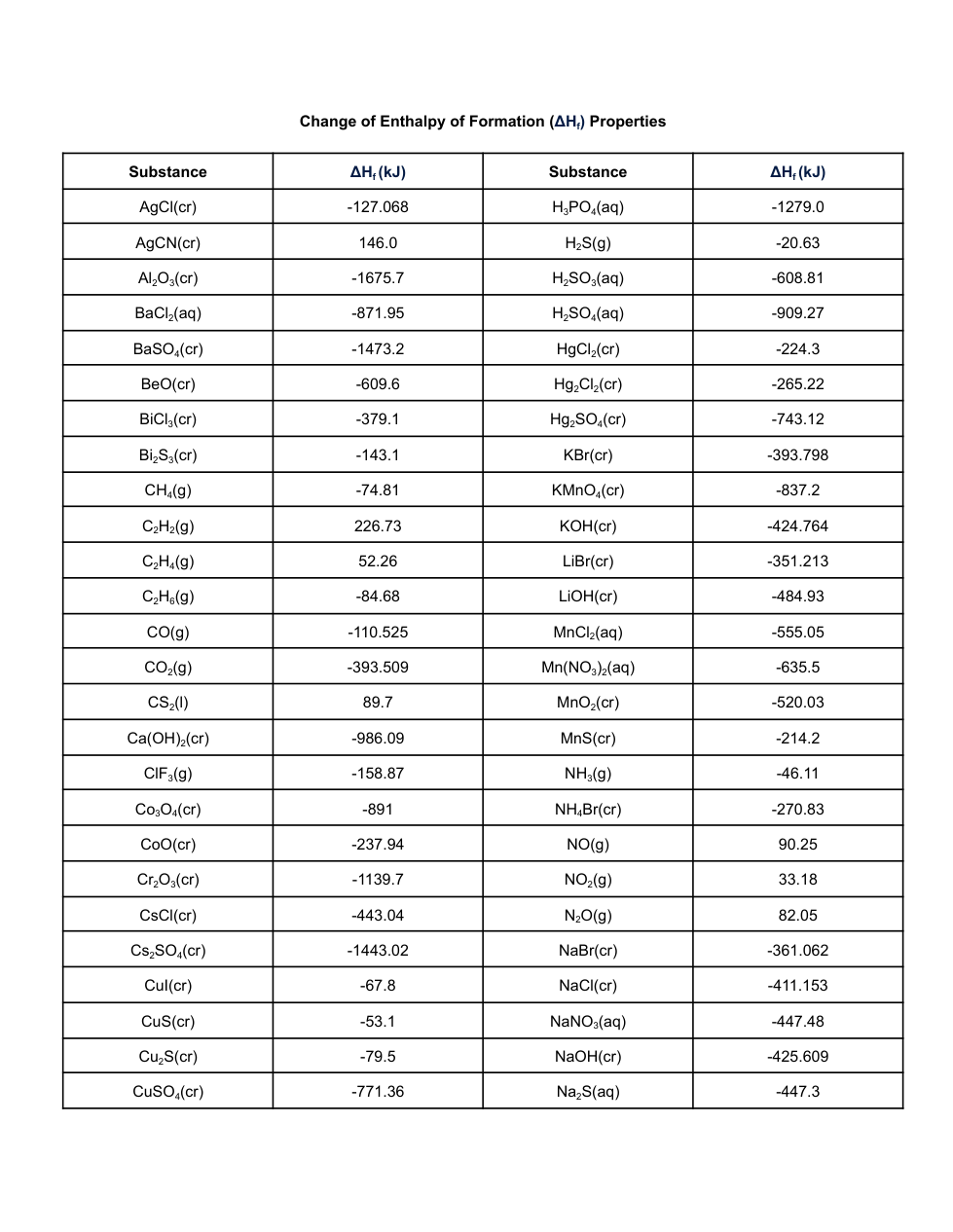
Table - Enthalpies of Formation (link to the table, above)- https://docs.google.com/document/d/1eMtEzoL4hy-TEIY3um630ByOmg0HuXvanCew26Tp39Y/edit?usp=sharing
Calculate the change of enthalpy (ΔHr) for each of the following reactions. You will need to use the table provided to you in your notes to find the ΔHf for each compound. Do not forget to include the units in your answers.
a. Zn(cr) + H2SO4(aq) → H2(g) + ZnSO4(aq)
ΣΔHf(reactants) =
ΣΔHf(products) =
ΔHr =
b. Fe2O(cr) + 3 CO(g) → 3 CO2(g) + 2 Fe(cr)
ΣΔHf(reactants) =
ΣΔHf(products) =
ΔHr =
c. CH4(g) + 2 O2(g) → CO2(g) + 2 H2O(l)
ΣΔHf(reactants) =
ΣΔHf(products) =
ΔHr =
d. 2 ClF3(g) + 2 NH3(g) → N2(g) + 6 HF(g) + Cl2(g)
ΣΔHf(reactants) =
ΣΔHf(products) =
ΔHr =