How is Bone Made?
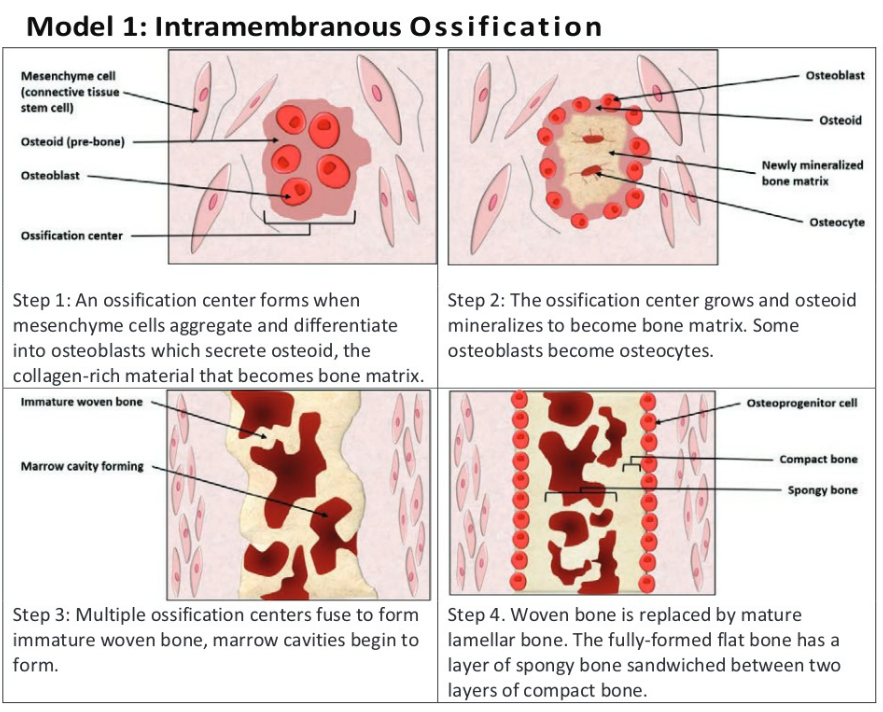
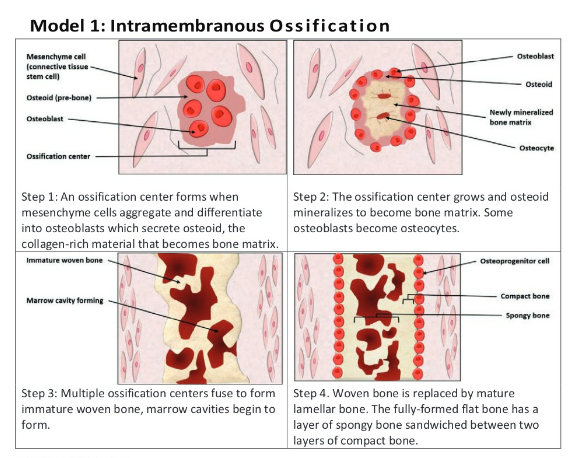
Examine each step of the model, reading the information below each diagram as well as the labels for each structure.
Examine each step of the model, reading the information below each diagram as well as the labels for each structure.
a.) According to the model, what cells form the stem cells for connective tissues?
b.) According to the model, what action do the cells of this tissue take immediately before they differentiate into osteoblasts?
a.) What substance do osteoblasts secrete?
b.) What is that substance made of?
c.) What has to happen to that substance before it becomes mature bone matrix?
a.) What is the term for these clusters of osteoblasts that create "islands" of bone?
b.) Does it appear that the entire bone grows from a single one of these clusters?
c.) What forms the mature flat bone?
Osteoprogenitor cells are stem cells found in the bone that play a crucial role in bone repair and growth. They are also known as osteogenic cells or bone-forming cells. These cells are precursors to more specialized bone cells, such as osteoblasts and osteocytes, and reside in the bone marrow.
Characteristics of Osteoprogenitor Cells:
Originate from mesenchymal stem cells (MSCs) and differentiate into osteoblasts
Have the potential to differentiate into other cell types, including fibroblasts, adipocytes, chondrocytes, and muscle cells under appropriate circumstances
Located on the endosteal and periosteal surface of the bone and inner surface of Haversian canals
Activate during bone remodeling or regeneration of injury
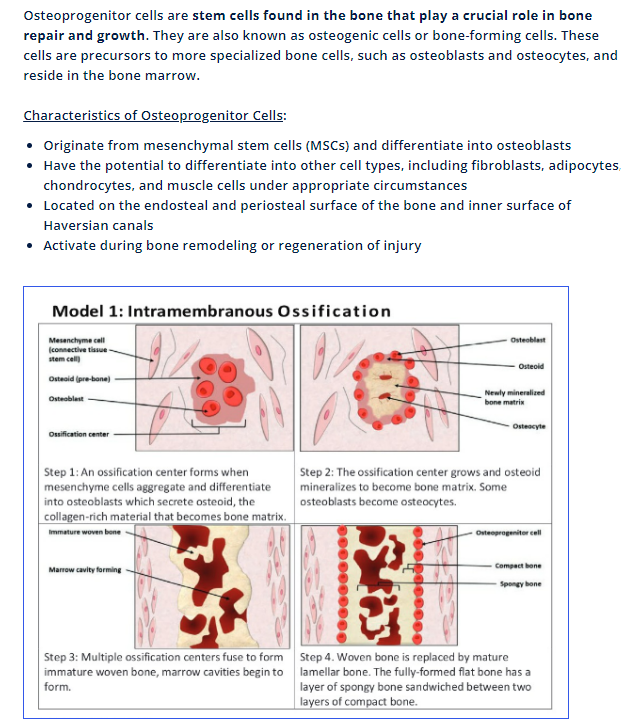
a.) Looking at the picture of mature bone in part 4 of the model, where is the only place you see osteoprogenitor cells?
Based on the information in question 4, including your answer to Q4, attempt to explain how bone might continue to grow once it's shape has been established.
Click on the image, below, to view the reading and model from question 4.
I must regrade this.
Cleidocranial dysplasia is a disorder in which some mesenchyme cells are prevented from transforming directly into osteoblasts, resulting in a decrease in osteoblastic activity in developing flat bones.
Gaten Matarazzo, star of the Netflix series “Stranger Things” is probably the most well-known person with cleidocranial dysplasia. Based on the word “cleidocranial” and what you can look up about Gaten Matarazzo, as well as the name of the disease, determine some bones that might be affected by this disorder.
I must regrade this.
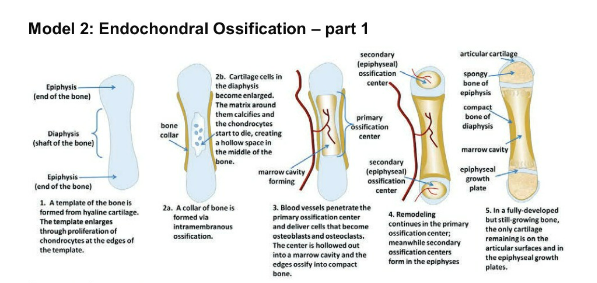
a.) According to Model 2, what forms the template or model for a developing long bone?
b.) What tissue is laid down as a collar around this template?
c.) Referring back to Model 1, what do you think is going to happen to the cartilage in the primary ossification center (this one is tough)?
d.) In what portion of the long bone in Model 2 is the secondary ossification center?
e.) What is the name of the cartilaginous structure that separates the answer to 'd' and the diaphysis?
f.) Refer back to model 1, does it appear that flat bones begin with a cartilage template?
Compose a sentence that best describes the difference between the intramembranous system and endochondral ossification.
I must regrade this.
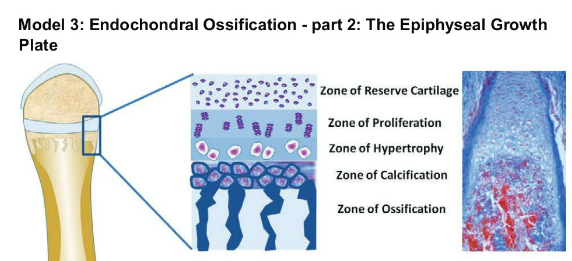
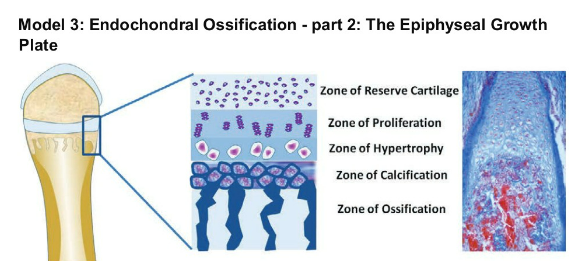
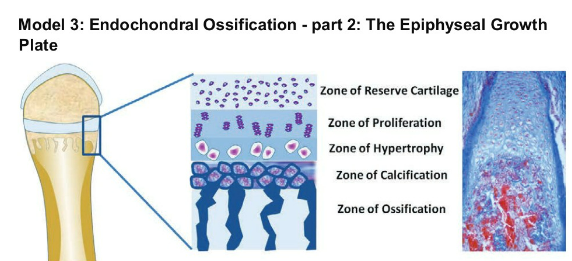
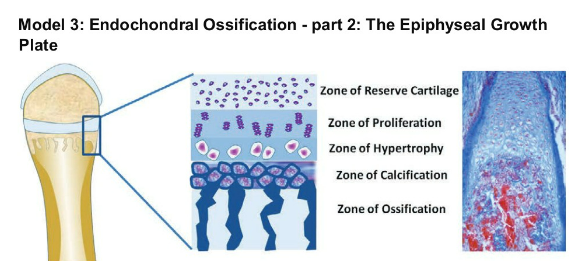
Chondrocytes are cartilage cells. If these cells are proliferating, what does that mean they are doing?
Based on the order of the various zones in the growth plate, what does it appear happens to the cartilage cells (chondrocytes) after they proliferate?
I must regrade this.
Answer both of the following questions in the space provided below.
Hyper- means more than normal, and trophy- means to eat.
a.) What happens to a person if they eat more than necessary for an extended period of time?
b.) Based on your previous answer and the appearance of the chondrocytes in the zone of hypertrophy, what does hypertrophy mean
I must regrade this.
a.) What happens to the cartilage after it hypertrophies?
b.) What does the calcified cartilage become in the ossification zone?
Draw an arrow next to the growth plate in model 3 to indicate the direction in which the bone is growing.