Log in
Sign up for FREE
arrow_back
Library

Copy of Cardiac Cycle Reading Guide (5/28/2026)

star
star
star
star
star
Last updated about 3 hours ago
6 questions
1
1
1
1
1
10
Cardiac Cycle Reading - https://drive.google.com/file/d/187YjXJH9qrCx_u3aD4aRhszM6zrkpAMs/view?usp=sharing

Cardiac Cycle Reading Guide - https://docs.google.com/document/d/1CQMc-ac6q8NGuLgbTDdDkDy7aFVeAwE_ONoOfpuF4u4/copy

Use the reading to complete the reading guide. This reading guide will be evaluated based solely upon what the provided reading states. Do not use any other source (this would exclude the use of internet sources, so please don't do it). Submit the reading guide at the bottom of this.

Use the cardiac cycle reading to help you with 1 - 5.
Question 1
1.

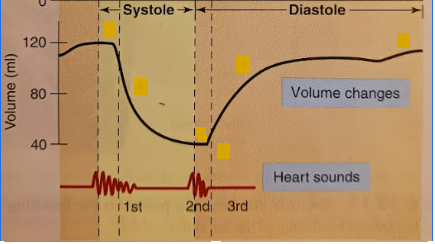
Identify which part of the diagram matches the following description related to pressure and volume changes in the left ventricle during the cardiac cycle:

When the pressure in the left ventricle exceeds that in the aorta, the semilunar valves open, initiating the ejection phase. Both the left ventricle and aorta reach a pressure of about 120 mmHg, while the volume in the ventricle decreases.
Question 2
2.

Identify which part of the diagram matches the following description related to pressure and volume changes in the left ventricle during the cardiac cycle:

Atrial contraction (atrial systole) delivers the last bit of blood into the ventricles just before the ventricles enter the isovolumetric contraction phase.

Question 3
3.

Identify which part of the diagram matches the following description related to pressure and volume changes in the left ventricle during the cardiac cycle:

During the initial contraction of the ventricles, intraventricular pressure increases, causing the AV valves to close. At this point, the ventricles are not filling with blood or ejecting it, marking the isovolumetric contraction phase.

Question 4
4.

Identify which part of the diagram matches the following description related to pressure and volume changes in the left ventricle during the cardiac cycle:

In the isovolumetric relaxation phase, both the AV and semilunar valves are closed, lasting until the pressure in the ventricles drops below that in the atria.

Question 5
5.

Identify which part of the diagram matches the following description related to pressure and volume changes in the left ventricle during the cardiac cycle:

When the pressure in the left ventricle drops below that in the aorta, back pressure causes the semilunar valves to close. The aortic pressure decreases to 80 mmHg, while the left ventricular pressure falls to 0 mmHg.

Question 6
6.

Submit your completed copy of the Cardiac Cycle Reading Guide, here.

After you submit your copy, add it to your Heart Anatomy Notes, including the link to the reading.