Mr. Poe will read each section of the reading. At the end of the section, I will pause, giving you time to discuss and answer the short answer question the follows each section.
All questions are answered from the information in the reading. Do not use any other source. If it is obvious to me that you have not used the reading to answer questions, you will not receive credit for this.
Mr. Poe will read each section of the reading. At the end of the section, I will pause, giving you time to discuss and answer the short answer question the follows each section.
All questions are answered from the information in the reading. Do not use any other source. If it is obvious to me that you have not used the reading to answer questions, you will not receive credit for this.
What could this hilly blue surface possibly be?
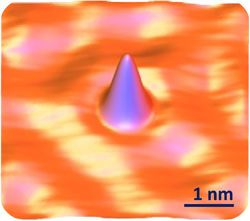
Do you have any idea? The answer is a single atom of the element cobalt. The picture was created using a scanning tunneling microscope. No other microscope can make images of things as tiny as atoms. How small are atoms? You will find out in this lesson.
Atoms are very tiny, so tiny that they could not be seen before scanning tunneling microscopes were invented in 1981. However, the atom and its parts were discovered long before the tunneling microscope was invented. How did scientists discover the atom if they couldn’t see it? They made models. A scientific model is a tool constructed by the scientist based on all the known experimental evidence about a particular thing, such as an atom. The first model of the atom goes back to ancient Greece. As time went by and more experiments are performed, models evolve and change to account for new understanding.
How did scientists develop models of the atom before the invention of the scanning tunneling microscope in 1981?
Atoms are the building blocks of matter. They are the smallest particles of an element that still have the element's properties. Elements, in turn, are pure substances—such as nickel, hydrogen, and helium—that make up all kinds of matter. All the atoms of a given element are identical in that they have the same number of protons, one of the building blocks of atoms (see below). They are also different from the atoms of all other elements, as atoms of different elements have different numbers of protons.
What are atoms, and how do they relate to elements?
Unlike bricks, atoms are extremely small. The radius of an atom is well under 1 nanometer, which is one billionth of a meter. If a size that small is hard to imagine, consider this: trillions of atoms would fit inside the period at the end of this sentence. Although all atoms are very small, elements vary in the size of their atoms. The Figure below compares the sizes of atoms of more than 40 different elements, showing their atomic radii in picometers (pm), which is the most common unit used to measure atomic radius. The elements in the figure are represented by chemical symbols, such as H for hydrogen and He for helium. Of course, real atoms are much smaller than the circles representing them in the Figure below.
Atomic size chart - Atomic Radii are measured in picometers (pm).
What is the typical radius of an atom, and how does this size compare to everyday objects like bricks?
Although atoms are very tiny, they consist of even smaller particles. Three main types of particles that make up all atoms are protons, neutrons, and electrons. The interactive below shows how these particles are arranged in an atom. Click on the subatomic particle to learn more about each type.
The atom shown above represented by the model is carbon, but the particles of all atoms are arranged in the same way. At the center of the atom is a dense area called the nucleus, where all the protons and neutrons are clustered closely together. The electrons constantly move around the nucleus. Helium has two protons and two neutrons in its nucleus and two electrons moving around the nucleus. Atoms of other elements have different numbers of subatomic particles, but the number of protons always equals the number of electrons. This makes atoms neutral in charge because the positive and negative charges "cancel out."
The model above shows an atom of helium that has two protons, two neutrons, and two electrons.
What are the three main types of subatomic particles that make up all atoms, and how are they arranged within an atom?
The nucleus (plural, nuclei) is a positively charged region at the center of the atom. It consists of two types of subatomic particles packed tightly together. The particles are protons, which have a positive electric charge, and neutrons, which are neutral in electric charge.
A proton is one of three main particles that make up the atom. The other two particles are the neutron and electron. Protons are found in the nucleus of the atom. This is a tiny, dense region at the center of the atom. Protons have a positive electrical charge of one (+1) and a mass of 1 atomic mass unit (amu), which is about 1.67 × 10⁻²⁷ kilograms. Together with neutrons, they make up virtually all of the mass of an atom.
A neutron is one of three main particles that make up the atom. The other two particles are the proton and electron. Atoms of all elements—except for most atoms of hydrogen—have neutrons in their nucleus. The nucleus is the small, dense region at the center of an atom where protons are also found. Atoms generally have about the same number of neutrons as protons. For example, all carbon atoms have six protons and most also have six neutrons.
Outside of the nucleus, an atom is mostly empty space, with orbiting negative particles called electrons whizzing through it. The Figure below shows these parts of the atom.
What is the nucleus of an atom, and what types of subatomic particles does it contain?
The nucleus of the atom is extremely small. Its radius is only about 1/100,000 of the total radius of the atom. If an atom were the size of a football stadium, the nucleus would be about the size of a pea!
Electrons have virtually no mass, but protons and neutrons have a lot of mass for their size. As a result, the nucleus has virtually all the mass of an atom. Given its great mass and tiny size, the nucleus is very dense. If an object the size of a penny had the same density as the nucleus of an atom, its mass would be greater than 872.5 billion kilograms!
Particles with opposite electric charges attract each other. This explains why negative electrons orbit the positive nucleus. Particles with the same electric charge repel each other. This means that the positive protons in the nucleus push apart from one another. So why doesn’t the nucleus fly apart? An even stronger force—called the strong nuclear force—holds protons and neutrons together in the nucleus.
How does the size and mass of the nucleus compare to the overall size of an atom, and what force keeps the nucleus from flying apart?
Electrons are one of three main types of particles that make up atoms. The other two types are protons and neutrons. Unlike protons and neutrons, which consist of smaller, simpler particles, electrons are fundamental particles that do not consist of smaller particles.
Electrons are extremely small. The mass of an electron is only about 1/2000 the mass of a proton or neutron, so electrons contribute virtually nothing to the total mass of an atom. Electrons have an electric charge of -1, which is equal but opposite to the charge of proton, which is +1. All atoms have the same number of electrons as protons, so the positive and negative charges “cancel out,” making atoms electrically neutral.
Unlike protons and neutrons, which are located inside the nucleus at the center of the atom, electrons are found outside the nucleus. Because opposite electric charges attract each other, negative electrons are attracted to the positive nucleus. This force of attraction keeps electrons constantly moving through the otherwise empty space around the nucleus. The Figure shown below is a common way to represent the structure of an atom. It shows the electron as a particle orbiting the nucleus, similar to the way that planets orbit the sun.
What distinguishes electrons from protons and neutrons in terms of their composition and mass?
Where are electrons located in an atom, and what keeps them moving around the nucleus?
These questions use all of the reading in this activity. You may need to re-read/skim the above passages prior to or while you are attempting these.
a.) The three main types of subatomic particles that make up all atoms are
b.) The
c.) The nucleus of an atom is about
d.) Protons have a positive electric charge of
e.) Electrons are found
f.) The strong nuclear force is responsible for holding
g.) An atom is electrically neutral because it has the same number of
Open the above link (if it does not immediately provide you a copy, click "file", then "make a copy".
Use the above reading, and only the reading (do not use any other source) to help you define each vocab word. If it is obvious that you have used another source, you will not receive credit for this.
Use the submission portal below, to submit your completed vocab form.
Chap 3 Vocab Submission - Submit your complete vocab sheet here.