Přejít k hlavnímu obsahu
Přihlásit se
Sign up for FREE
arrow_back
Knihovna

Copy of 8.) Velocity (5/28/2026)

star
star
star
star
star
Poslední aktualizace about 1 month ago
9 Dotazy
1
1
1
1
1
3
1
5

Velocity

Ramey and her mom were driving down this highway at 45 miles per hour, which is the speed limit on this road. As they approached this sign, Ramey’s mom put on the brakes and started to slow down so she could safely maneuver the upcoming curves in the road. This speed limit sign actually represents two components of motion: speed and direction.

Speed and Direction

Speed tells you only how fast or slow an object is moving. It doesn’t tell you the direction the object is moving. The measure of both speed and direction is called velocity. Velocity is a vector. A vector is measurement that includes both size and direction. Vectors are often represented by arrows. When using an arrow to represent velocity, the length of the arrow stands for speed, and the way the arrow points indicates the direction. 

Otázka 1
1.

What are the two components of motion represented by the speed limit sign that Ramey and her mom encountered?

Otázka 2
2.

What is the term used to describe the measure that includes both speed and direction, and how is it represented (what object can be used)?

Using Vector Arrows to Represent Velocity

The arrows in the Figure below represent the velocity of three different objects. Arrows A and B are the same length but point in different directions. They represent objects moving at the same speed but in different directions. Arrow C is shorter than arrow A or B but points in the same direction as arrow A. It represents an object moving at a slower speed than A or B but in the same direction as A.
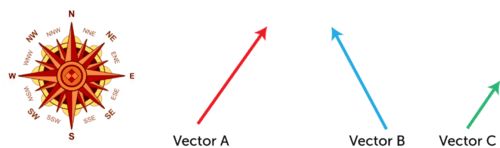
Three arrows depicting object velocities: A and B are equal, C is shorter and slower.

Differences in Velocity

Objects have the same velocity only if they are moving at the same speed and in the same direction. Objects moving at different speeds, in different directions, or both have different velocities. Look again at arrows A and B from the Figure above. They represent objects that have different velocities only because they are moving in different directions. A and C represent objects that have different velocities only because they are moving at different speeds. Objects represented by B and C have different velocities because they are moving in different directions and at different speeds.

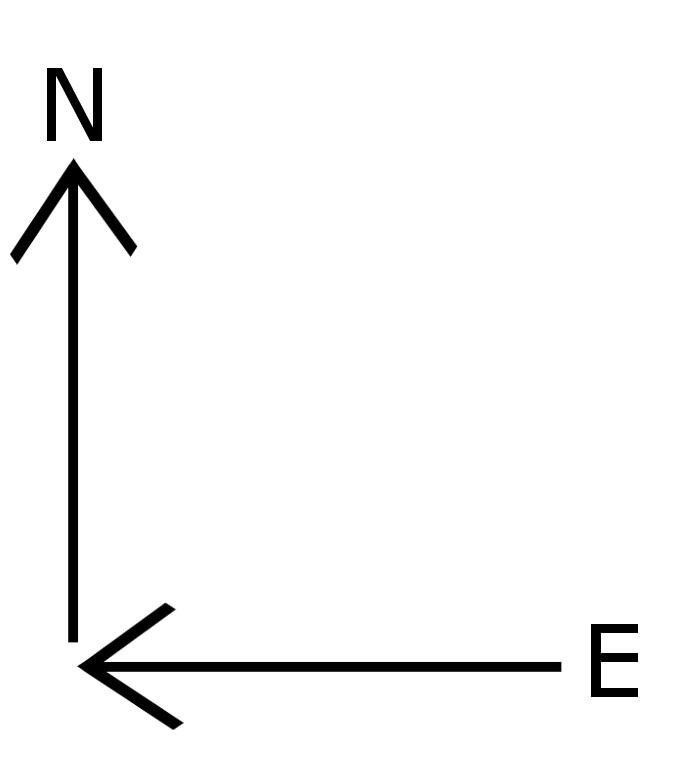
  • Q: Jerod is riding his bike at a constant speed. As he rides down his street he is moving from east to west. At the end of the block, he turns right and starts moving from south to north, but he’s still traveling at the same speed. Has his velocity changed?

  • A: Although Jerod’s speed hasn’t changed, his velocity has changed because he is moving in a different direction.

  • Q: How could you use vector arrows to represent Jerod’s velocity and how it changes?

  • A: The arrows might look like this:

Vector arrows indicating cardinal directions: North and East.

[Figure 3]

Otázka 3
3.

Arrows A and B:

  • How are they similar in terms of velocity?

  • How are they different in terms of velocity?

  • What do they indicate about the objects they represent?

Otázka 4
4.

Under what conditions would two objects have the same velocity?

How do arrows A and C differ in terms of velocity?

Calculating Average Velocity

You can calculate the average velocity of a moving object that is not changing direction by dividing the distance the object travels by the time it takes to travel that distance. You would use this formula:

This is the same formula that is used for calculating average speed. It represents velocity only if the answer also includes the direction that the object is traveling.

Let’s work through a sample problem. Toni’s dog is racing down the sidewalk toward the east. The dog travels 36 meters in 18 seconds before it stops running. The velocity of the dog is:

Note that the answer is given in the metric unit for velocity, which is m/sec, and it includes the direction that the dog is traveling.

Q: What would the dog’s velocity be if it ran the same distance in the opposite direction but covered the distance in 24 seconds?

A: In this case, the velocity would be:

Summary

  • Velocity is a measure of both speed and direction of motion. Velocity is a vector, which is a measurement that includes both size and direction.

  • Velocity can be represented by an arrow, with the length of the arrow representing speed and the way the arrow points representing direction.

  • Objects have the same velocity only if they are moving at the same speed and in the same direction. Objects moving at different speeds, in different directions, or both have different velocities.

  • The average velocity of an object moving in a constant direction is calculated with the formula:

  • The units for velocity is m/sec, plus the direction the object is traveling (the vector).

Otázka 5
5.

_____________ describes how fast something is going, whereas, __________ describes how fast something is going and in a certain direction.

Otázka 6
6.

a. How fast an object is moving is its .

b. Any measurement that includes both magnitude and direction is called a(n)

c. Velocity has both speed and direction, so it is a

Otázka 7
7.

Jerod is riding his bike at a constant speed. He rides down his street, from east to west. Then, he turns rights and is traveling north. He is still traveling at the same speed. Has his velocity changed?

Otázka 8
8.

a.) Find the velocity of a plane that traveled 3000 miles west in 5 hours.

b.) A car travels northwest for 120 seconds and covers a distance of 2500 meters. What is the velocity of the car?

c.) A velocity-time graph shows how velocity changes over .

d.) is a measure of both speed and direction of motion.

e.) A dog runs across the street to greet the mail man. The mail man is standing 10 meters west and it take the dog 2 seconds. What is the velocity of the dog?

Question 9
00:00
keyboard_arrow_down
5
Otázka 9
9.

a. Two ways to measure motion are and .

b. Speed is considered a measurement, which means it measures magnitude but not .

c. Velocity is the of an object in a certain .

d. Unlike speed, velocity is a quantity that measures both and .