Log in
Sign up for FREE
arrow_back
Library

Copy of 4. Biological Molecules - Models (5/28/2026)

star
star
star
star
star
Last updated about 3 hours ago
17 questions
Note from the author:
Model 1
1
1.5
Model 2
2
1
Spicy Questions - Optional
0
0
0
0
Biological Molecules

  • Building Blocks of Life
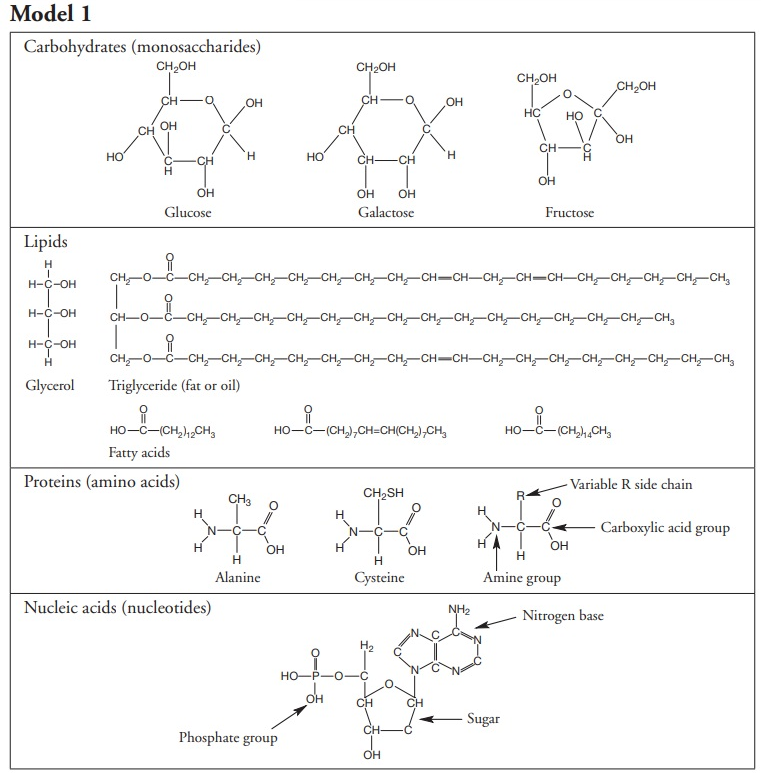
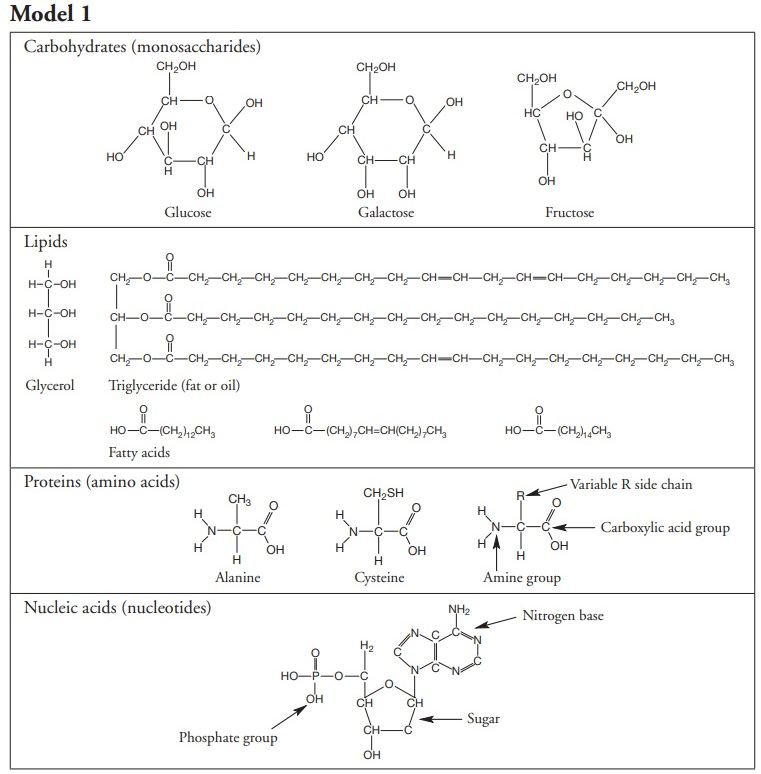
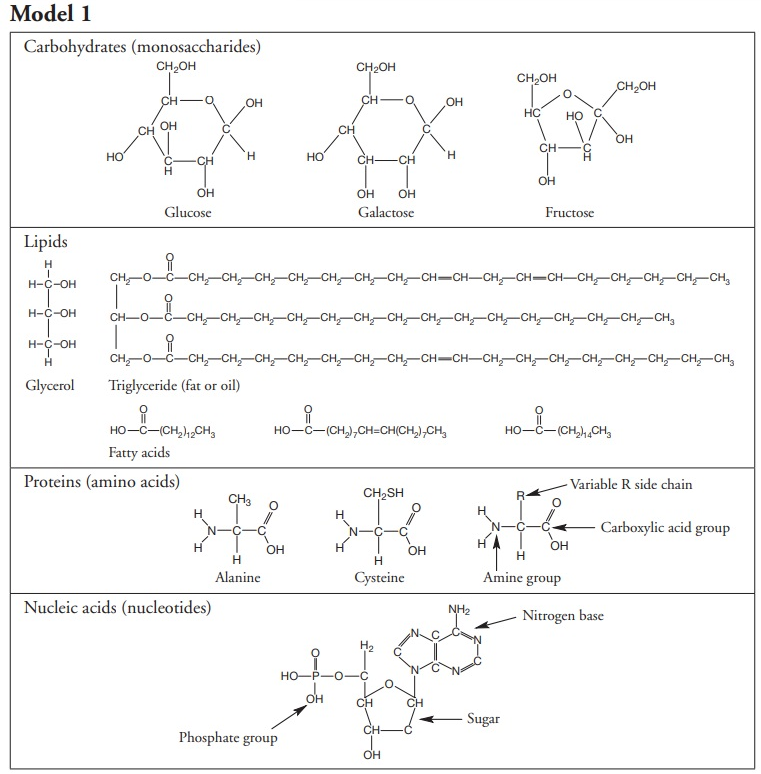
From the smallest single-celled organism to the tallest tree, all life depends on the properties and reactions of four classes of organic (carbon-based) compounds — carbohydrates, lipids, proteins, and nucleic acids. These organic molecules are the building blocks of all living things, and are responsible for most of the structure and functions of the body, including energy storage, insulation, growth, repair, communication, and transfer of hereditary information. Simple organic molecules can be joined together to form all the essential biological molecules needed for life.
1.5
Question 1
1.
1
Question 3
3.


The fatty acid chain of the lipids is often referred to as a hydrocarbon chain. As a class, discuss why this chain is given this name and provide a one-sentence explanation.

1
Question 4
4.
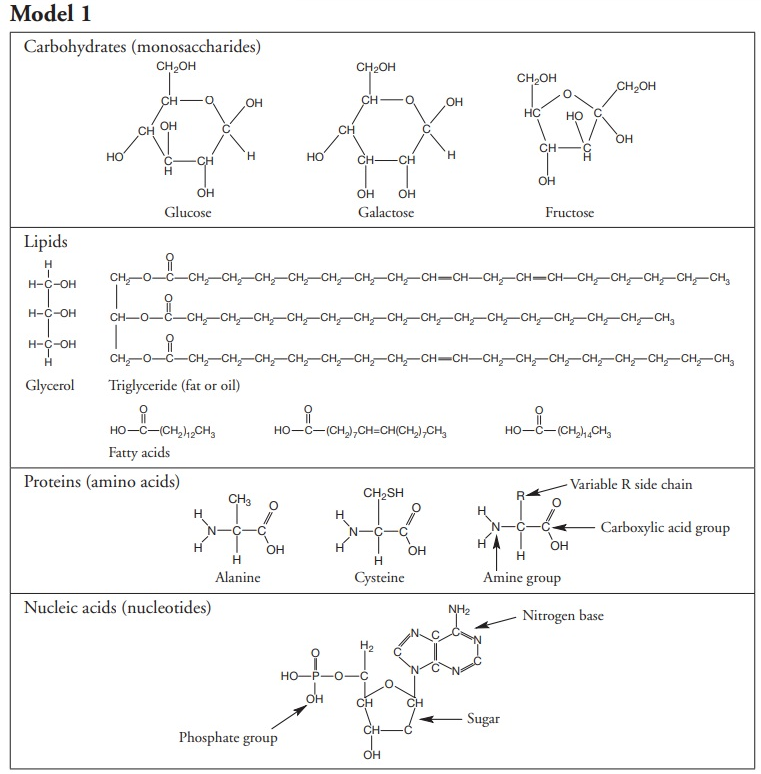
a.) Which biomolecule has a central carbon atom with four different components around it? _______
b.) Which biomolecule has a sugar, nitrogenous base, and a phosphate group? _______
Question 5
5.


Do this independently - Provide a list of some similarities among all four types of molecules. List as many as you can.

1
Question 6
6.
Look at the first carbohydrate in model 1; provide its molecular formula (be sure to capitalize the letters in the formula). _______
2.5
Question 7
7.

Read:

During chemical reactions, the bonds in molecules are continually broken and reformed. To break a bond, energy must be absorbed. When bonds are formed, energy is released. If more energy is released than absorbed during a chemical change, the process can be used as a source of energy. A general rule is the more carbon atoms there are in a molecule, the more energy that molecule can provide to the organism when it is used as food.

Consider this, lipids will contain hundreds of carbons in the fatty acid tails of the triglyceride; however, polysaccharides could be constructed of thousands of monosaccharides. Each monosaccharide contains six carbons, each - meaning the overall carbon content of many polysaccharides reaches into the ten-thousands.
1
Question 8
8.
1.5
Question 9
9.
2
Question 10
10.

Read:

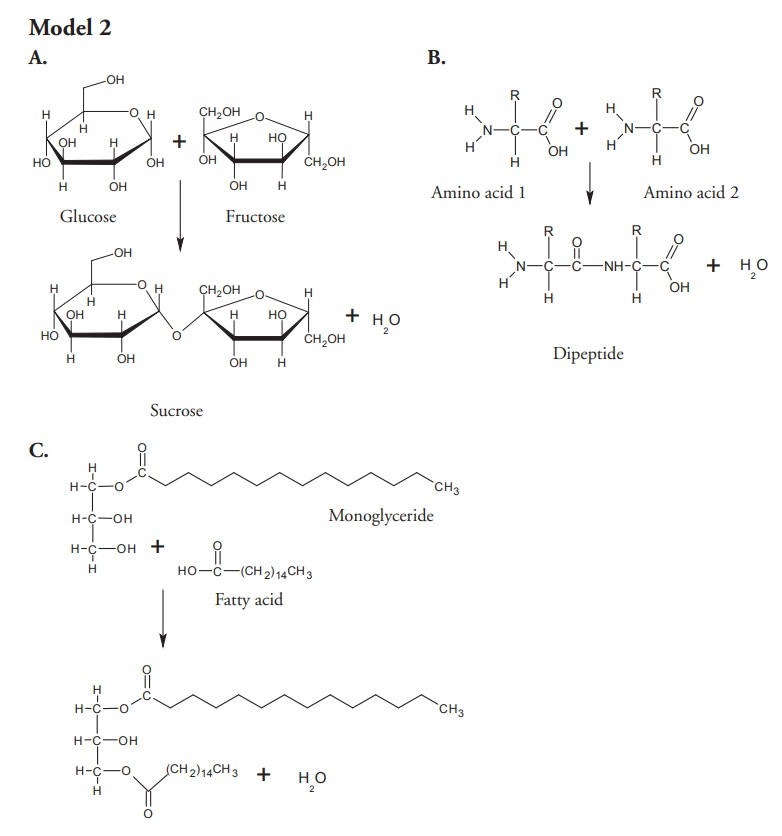
When sugars are joined together the new bond that forms is a glycosidic bond. When amino acids are joined the new bond that forms is a peptide bond. When fatty acids are joined to a glycerol the bond that holds them is an ester bond.
Question 11
11.

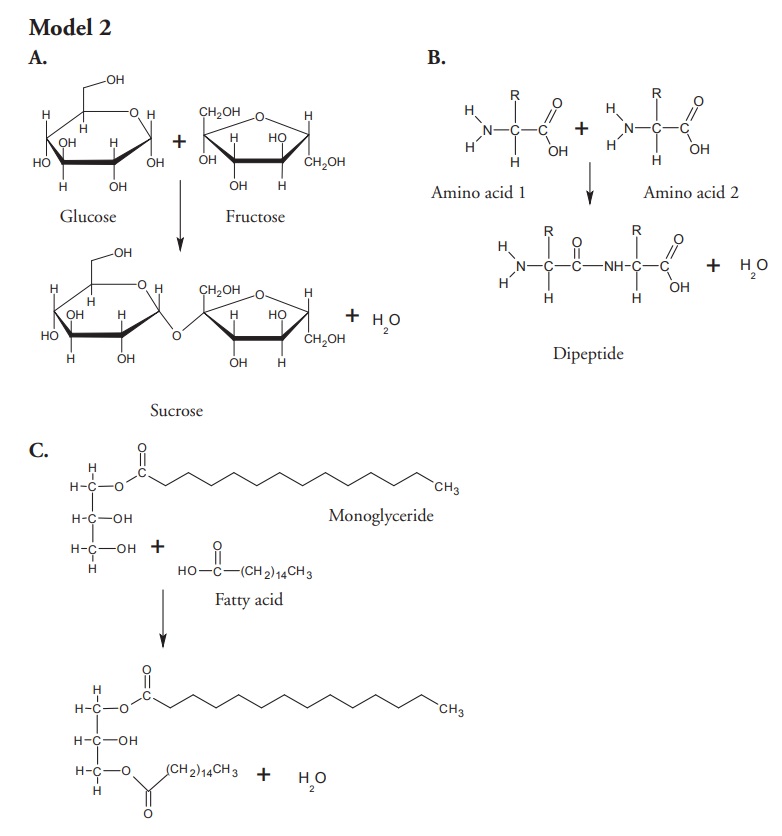
On model 2, circle and label the glycosidic, peptide, and ester bonds in reaction A, B, and C.
You will label these bonds in the primary products - the dipeptide, the sucrose, and the monoglyceride.

Click, "Show Your Work," and use the tools to the left to complete this question.

Recommended Tools:
  • Scribble - draw lines.
  • Text - label items
  • Eraser - correct mistakes
  • Hand - pan the image around.
  • Zoom in/Zoom out - make the image bigger or smaller.

Question 12
12.


The reactions of model 2 are all referred to as dehydration synthesis or condensation reactions.

With the class, develop a simple explanation for why these terms are used to describe these reactions.

1.5
Question 13
13.
Question 14
14.

"Metabolism" is the term used to describe all the chemical reactions taking place inside organisms. Why is water so important for metabolic reactions?

Question 15
15.

We store excess food in our body either in the form of carbohydrates (in muscles and the liver) or as fat (adipose tissue). When our body needs additional energy it uses the carbohydrate source first as a source of “quick” energy, then it uses fat. Why do you think carbohydrates are used as a source of quick energy rather than fat? Use complete sentences in your response.

Question 16
16.

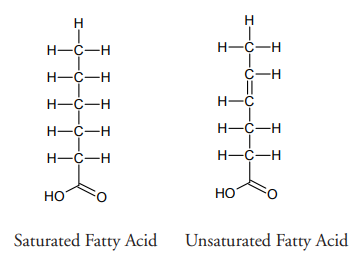
Examine the two fatty acids below - one is a saturated fat and the other is unsaturated. What is the primary difference between the two?

Question 17
17.

Saturated fats are solid fats, like the animal fats lard and butter, whereas unsaturated fats are more fluid and form oils, such as vegetable oil. Trans fats are plant oils that are artificially solidified to make them suitable for baking purposes. In recent years trans fats have been associated with negative health issues and are not as widely used. Explain in simple molecular terms what would have to be done to a plant oil to transform it to a trans fat.

Refer to Model 1 to determine which atoms are present in each type of biomolecule listed (use the symbol for each atom - must be capitalized).

a.) Carbohydrate - C, H, O
b.) Protein (Amino Acid) - _______
c.) Nucleic Acid - _______
d.) Lipid - _______
Question 2
2.
Which type of biomolecule contains a lot of carbon in a long-chain structure? _______
a.) In this type of biomolecule, what is the primary element that is attached to the carbons? _______
a.) What three structural groups shown do all amino acids have in common? _______, _______, and _______

b.) There are twenty naturally-occurring amino acids; each one only differs by their R-side chain. There are two types of amino acids in model 1; what are their R-side chains (capitalize any atomic abbreviation used)? _______ and _______
Using the reading to the left, is a carbohydrate or lipid likely to be a good source of energy for organisms? _______
a.) What are the reactants of reaction A? _______
b.) What are the products of reaction A? _______
c.) Each of the reactants in reaction A is a single simple sugar molecule (monosaccharide). What prefix before 'saccharide' would you use to describe the product of reaction A? _______
a.) What are the reactants of reaction B? _______
b.) What are the products of reaction B? _______ and _______
c.) What product do all three reactions (A, B, and C) have in common? _______
The reactions shown in model 2 can also be reversed, breaking the larger molecules (polymers) into the smaller components (monomers).

a.) What substance would be needed to be be added to reverse this reaction? _______

b.) 'Lysis' means to split, separate, or breakdown. If water is used to break larger molecules down into smaller molecules, what prefix would be added in front of lysis that would indicate water being used to break something down? _______

c.) Using your answers to a and b, what word would be used to describe the reaction that uses water to breakdown a large molecule into smaller ones? _______