Přejít k hlavnímu obsahu
Přihlásit se
Sign up for FREE
arrow_back
Knihovna

Copy of 8.) Active Transport Reading w/Questions (5/28/2026)

star
star
star
star
star
Poslední aktualizace about 1 month ago
20 Dotazy
Poznámka od autora:

Each section has three things:

  1. Reading

  2. Section Questions - answered from the reading.

  3. Audio Track - Use this as needed, but follow along with the reading.

All questions are answered from the reading in each section. Some questions are to the right of the reading, others occur at the end of a section.

Do not use any other source to answer questions, you will not receive points if you do.

Learning Goals:

  • Define Active Transport: Students will be able to explain what active transport is and how it differs from passive transport.

  • Identify Mechanisms: Students will identify the various mechanisms involved in active transport, including protein pumps and endocytosis.

  • Understand Energy Requirements: Students will understand the role of ATP and energy in facilitating active transport processes.

  • Examples of Active Transport: Students will provide examples of substances that move via active transport and explain their significance in cellular functions.

Reading
3
Exit Ticket
Požadovaný
0
Požadovaný
0

Each section has three things:

  1. Reading

  2. Section Questions - answered from the reading.

  3. Audio Track - Use this as needed, but follow along with the reading.

All questions are answered from the reading in each section. Some questions are to the right of the reading, others occur at the end of a section.

Do not use any other source to answer questions, you will not receive points if you do.

Learning Goals:

  • Define Active Transport: Students will be able to explain what active transport is and how it differs from passive transport.

  • Identify Mechanisms: Students will identify the various mechanisms involved in active transport, including protein pumps and endocytosis.

  • Understand Energy Requirements: Students will understand the role of ATP and energy in facilitating active transport processes.

  • Examples of Active Transport: Students will provide examples of substances that move via active transport and explain their significance in cellular functions.

Active Transport

Learning Goals:

  • Types of active transport

  • Role of ATP in active transport

  • Difference between active and passive transport

Active Transport

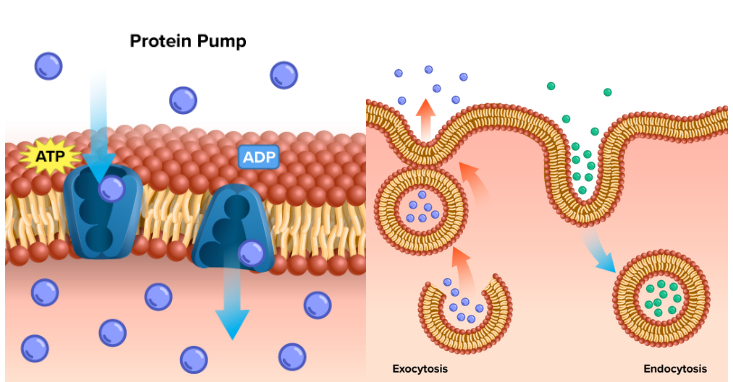
In contrast to passive transport, which does not require energy and carries molecules or ions down a concentration gradient, active transport pumps molecules and ions against a concentration gradient (from low to high concentration). Sometimes an organism needs to transport something against a concentration gradient. The only way this can be done is through active transport, which uses energy in the form of ATP (adenosine triphosphate) that is produced by cellular respiration. In active transport, the particles move across a cell membrane from a lower concentration to a higher concentration (see the Figure below). Active transport is the energy-requiring process of pumping molecules and ions across membranes "uphill" - against a concentration gradient.

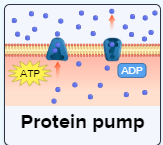
  • The active transport of small molecules or ions across a cell membrane is generally carried out by transport proteins that are found in the membrane, also known as a protein pumps.

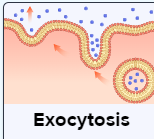
  • Larger molecules such as starch can also be actively transported across the cell membrane with a vesicle, that is formed from a piece of a cell membrane, via two active transport processes called endocytosis (substances enter the cell) and exocytosis (substances exit the cell).

Types of Active Transport: Protein Pump, Exocytosis, Endocytosis

1
Otázka 1
1.

Active transport pumps substances the concentration gradient.

1
Otázka 2
2.

For an energy source, active transport uses .

1
Otázka 3
3.

In active transport, particles move from areas of concentration to areas of concentration, this can be described as moving particles against the concentration gradient.

2
Otázka 4
4.

The active transport of small particles and ions is performed by transport proteins referred to as . When large molecules are transported via active transport they are moved using a .

1
Otázka 5
5.

The general process that requires energy to move particles against the concentration gradient is known as .

1
Otázka 6
6.

The carrier proteins that are used in active transport are known as .

1
Otázka 7
7.

ATP powers active transport by transferring a to a carrier protein. This causes the protein to which moves the particle from one side of the cell membrane to the other.

1
1
2
1
1

Endocytosis and Exocytosis

What you will learn

  • How vesicles in the cytoplasm move large particles across the cell membrane

  • What happens in endocytosis and exocytosis

What does a cell "eat"?

Is it possible for objects larger than a small molecule to be engulfed by a cell? Of course, it is. For example, cells of the immune system consistently destroy pathogens by essentially "eating" them.

Vesicle Transport

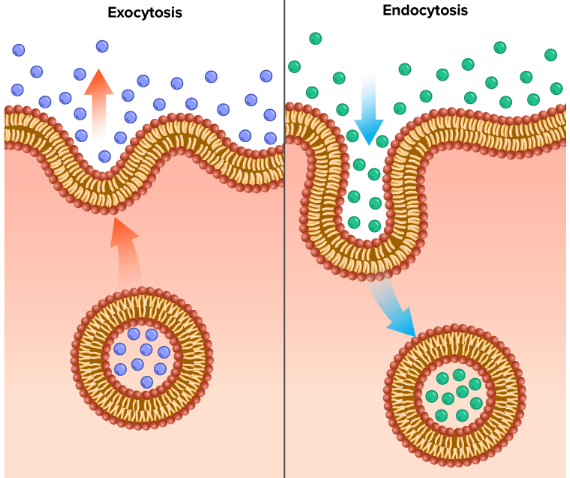
Some molecules or particles are just too large to pass through the plasma membrane or to move through a transport protein. So cells use two other active transport processes to move these macromolecules (large molecules) into or out of the cell. Vesicles or other bodies in the cytoplasm move macromolecules or large particles across the plasma membrane. There are two types of vesicle transport, endocytosis and exocytosis (illustrated in the Figure below). Both processes are active transport processes, requiring energy.

Illustration of the two types of vesicle transport, exocytosis and endocytosis.

Endocytosis and Exocytosis

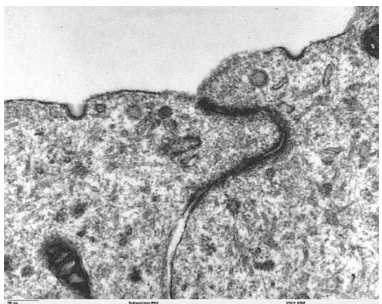
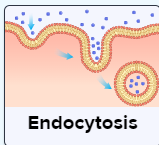
Endocytosis is the process of capturing a substance or particle from outside the cell by engulfing it with the cell membrane. The membrane folds over the substance and it becomes completely enclosed by the membrane. At this point a membrane-bound sac, or vesicle, pinches off and moves the substance into the cytosol. There are two main kinds of endocytosis:

  • Phagocytosis, or cellular eating, occurs when dissolved materials enter the cell. The plasma membrane engulfs these materials, forming a phagocytic vesicle.

  • Pinocytosis, or cellular drinking, occurs when the plasma membrane folds inward to form a channel allowing certain types of fluids to enter the cell, as shown in the Figure below. When the channel is closed, the liquid is encircled within a pinocytic vesicle.

Transmission electron microscope image of brain tissue that shows pinocytotic vesicles. Pinocytosis is a type of endocytosis.

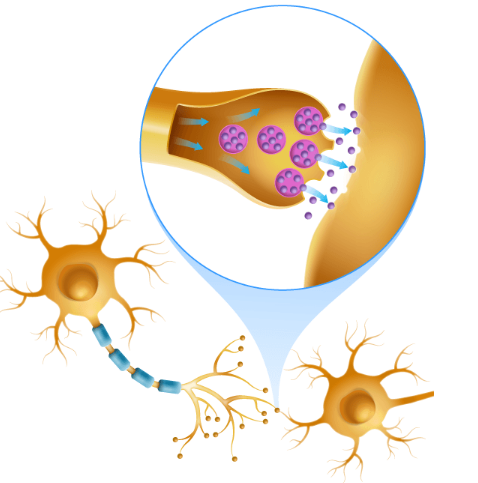
Exocytosis describes the process of vesicles fusing with the plasma membrane and releasing their contents to the outside of the cell, as shown in the Figure below. Exocytosis occurs when a cell produces substances for export, such as a protein, or when the cell is getting rid of a waste product or a toxin. Newly made membrane proteins and membrane lipids are moved on top of the plasma membrane by exocytosis.

Illustration of an axon releasing a neurotransmitter by exocytosis.

Summary

  • Active transport is the energy-requiring process of pumping molecules and ions across membranes against a concentration gradient.

  • Endocytosis is the process of capturing a substance or particle from outside the cell by engulfing it with the cell membrane and bringing it into the cell.

  • Exocytosis describes the process of vesicles fusing with the plasma membrane and releasing their contents to the outside of the cell.

  • Both endocytosis and exocytosis are active transport processes.

1
Otázka 13
13.

move large particles, such as macromolecules, in and out of the cell.

The two processes that utilize the above structure are referred to as endocytosis and .

1
1
1
1
Otázka 18
18.

Match each type of active transport with its correct description.

Přetahovatelná položkaarrow_right_altOdpovídající položka

arrow_right_alt

Taking in of substances, such as: protein, microorganisms, and fluid.

arrow_right_alt

Large molecules (toxins and metabolic wastes) are moved outside of the cell.

arrow_right_alt

Na+ and K+ ions move against the concentration gradient and across the cell membrane using transport proteins.

Otázka 19
19.

Provide one concept in this activity that you don't feel like you understand well.

Otázka 20
20.

After completing this and other related activities, my confidence regarding this concept has/is:

Sodium-Potassium Pump

Learning Goals:
  • How the sodium-potassium pump works in active transport

  • The role of the electrochemical gradient in the movement of ions across the cell membrane

What is this incredible object?

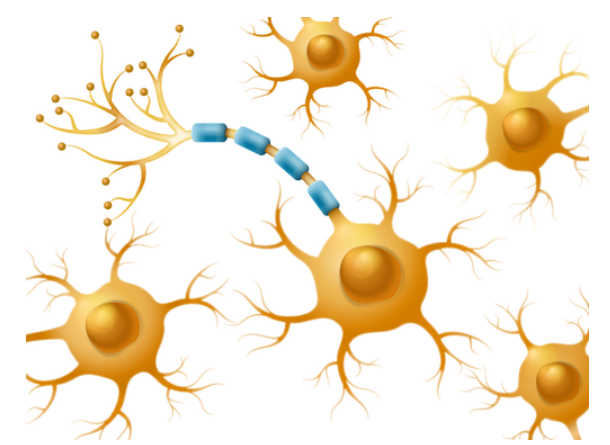
Would it surprise you to learn that it is a human cell? The image represents an active human nerve cell (neuron). Active transport processes play a significant role in the function of these cells. Specifically, it is the sodium-potassium pump that is active in the axons of these nerve cells.

The Sodium-Potassium Pump

Active transport is the energy-requiring process of pumping molecules and ions across membranes "uphill" - against a concentration gradient. To move these molecules against their concentration gradient, a carrier protein is needed. Carrier proteins can work with a concentration gradient (during passive transport), but some carrier proteins can move solutes against the concentration gradient (from low concentration to high concentration), with an input of energy.

In active transport, as carrier proteins are used to move materials against their concentration gradient, these proteins are known as protein pumps. As in other types of cellular activities, ATP supplies the energy for most active transport. One way ATP powers active transport is by transferring a phosphate group directly to a carrier protein. This may cause the carrier protein to change its shape, which moves the molecule or ion to the other side of the membrane. An example of this type of active transport system, as shown in the Figure below, is the sodium-potassium pump, which exchanges sodium ions for potassium ions across the cell membrane of animal cells.
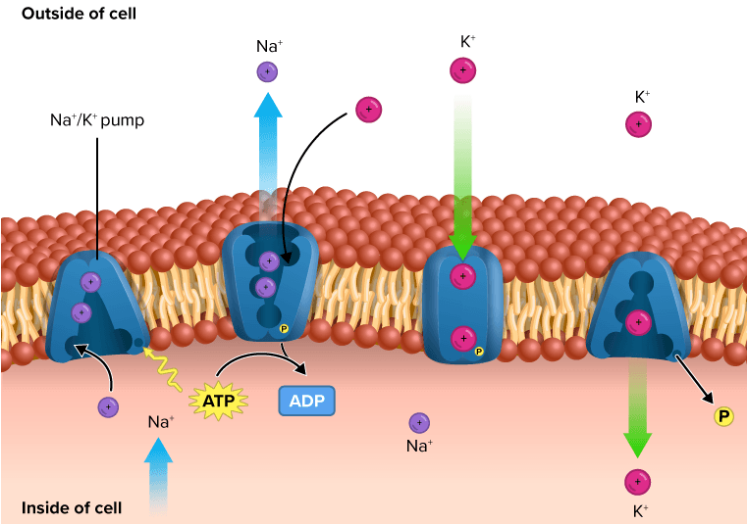
The sodium-potassium pump system moves sodium and potassium ions against large concentration gradients. It moves two potassium ions into the cell where potassium levels are high, and pumps three sodium ions out of the cell and into the extracellular fluid.

As is shown in the Figure above, three sodium ions bind with the protein pump inside the cell. The carrier protein then gets energy from ATP and changes shape. In doing so, it pumps the three sodium ions out of the cell. At that point, two potassium ions from outside the cell bind to the protein pump. The potassium ions are then transported into the cell, and the process repeats. The sodium-potassium pump is found in the cell membrane of almost every human cell and is common to all cellular life. It helps maintain cell electrical potential and regulates cellular volume.

The Electrochemical Gradient

The active transport of ions across the membrane causes an electrical gradient to build up across the cell membrane. The number of positively charged ions outside the cell is greater than the number of positively charged ions in the cytosol. This results in a relatively negative charge on the inside of the membrane, and a positive charge on the outside. This difference in charges causes a voltage across the membrane. Voltage is electrical potential energy that is caused by a separation of opposite charges, in this case across the membrane. The voltage across a membrane is called membrane potential. Membrane potential is very important for the conduction of electrical impulses along nerve cells.

Because the inside of the cell is negative compared to outside the cell, the membrane potential favors the movement of positively charged ions (cations) into the cell, and the movement of negative ions (anions) out of the cell. So, there are two forces that drive the diffusion of ions across the cell membrane—a chemical force (the ions' concentration gradient), and an electrical force (the effect of the membrane potential on the ions’ movement). These two forces working together are called an electrochemical gradient.

Summary

  • Active transport is the energy-requiring process of pumping molecules and ions across membranes against a concentration gradient.

  • The sodium-potassium pump is an active transport pump that exchanges sodium ions for potassium ions.
Otázka 8
8.

An example of a carrier protein in active transport is the .

Otázka 9
9.

The sodium-potassium pump is able to carry sodium ions outside of the cell and potassium ions inside of the cell at the same time.

Otázka 10
10.

The transport of Na+ and K+ ions across the cell membrane leads to an to build up across the cell membrane.

When this forms, the number of positively-charged ions outside of the cell is to that found inside of the cell. This leads to a relative inside of the cell and a relative outside of the cell.

Otázka 11
11.

The voltage that exists across a cell membrane is referred to as , which is important for conducting electrical signals along nerve cells.

Otázka 12
12.

The membrane potential and the movement (diffusion) of positive and negative ions into and out of the cell lead to an gradient.

Otázka 14
14.

Endocytosis can be further divided into two specific forms - ("cell eating") and ("cell drinking").

Otázka 15
15.

Pinocytosis is the movement of fluids into the cell, while phagocytosis is the movement of into the cell.

Otázka 16
16.

Exocytosis occurs when a vesicle fuses with the releasing its contents of the cell.

Otázka 17
17.

Newly made and are often moved into the plasma membrane via exocytosis