Log in
Sign up for FREE
arrow_back
Library

Copy of Mutations Reading w/Questions (5/28/2026)

star
star
star
star
star
Last updated about 3 hours ago
12 questions
Untitled Section
Exit Ticket
Required
0
Required
0
B.4.3 Construct a model to explain that the unique shape and function of each protein is determined by the sequence of its amino acids, and thus is determined by the sequence of the DNA that codes for this protein.

Learning Goals:
  • What are mutations and how are they caused.
  • Two major categories of mutations.
  • What are chromosomal alterations and its types.
  • Point mutations and their effects.
Directions:
  1. Read each section of the reading to the left of this formative. I have included an audio recording of each section (click the play button to the right of each section). If you use the audio recordings, you should still follow the text as the audio plays.
  2. To the right of each section is a set of questions. They are all answered from the reading in each section.
  3. Exit Ticket - complete this after you have completed the reading and the questions.
  4. Submit - click this at the bottom of the "Exit Ticket" section when you are complete.
  5. Warning - if you attempt to use any other source, other than the reading, to answer the questions, I will know it; you will not receive credit for these questions.

What causes albinism?
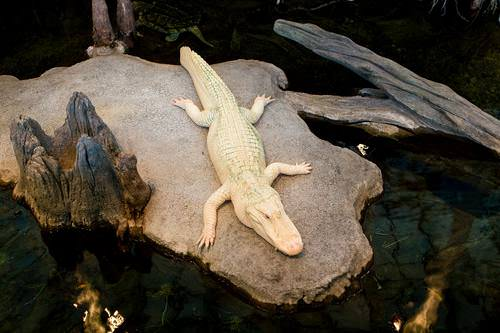

This rare albino alligator must have the specific "instructions," or DNA, to have this quality. The cause of albinism is a mutation in a gene for melanin, a protein found in skin and eyes. Such a mutation may result in no melanin production at all or a significant decline in the amount of melanin.

Mutations

A change in the sequence of bases in DNA is called a mutation. Does the word mutation make you think of science fiction and bug-eyed monsters? Think again. Everyone has mutations. In fact, most people have dozens or even hundreds of mutations in their DNA. However, most mutations have no effect on the organisms in which they occur. Even potentially harmful mutations rarely cause drastic changes in organisms.
1
1

Types of Mutations

There are a variety of types of mutations. Two major categories of mutations are germline mutations and somatic mutations.
  • Germline mutations occur in gametes (sperm and ovum). These mutations are especially significant because they can be transmitted to offspring and every cell in the offspring will have the mutation.
  • Somatic mutations occur in other cells of the body (other than sperm and ovum). These mutations may have little effect on the organism because they are confined to just one cell and its daughter cells. Somatic mutations cannot be passed on to offspring.
Mutations also differ in the way that the genetic material is changed. Mutations may change the structure of a chromosome or just change a single nucleotide.
2
2
2
Question 5
5.
6

Point Mutations

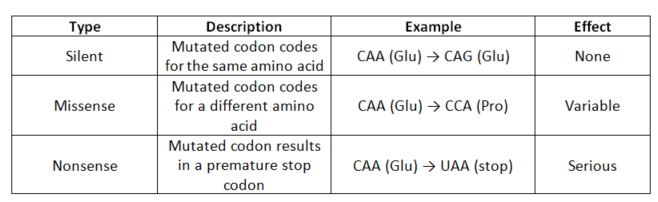
A point mutation is a change in a single nucleotide in DNA. This type of mutation is usually less serious than a chromosomal alteration. An example of a point mutation is a mutation that changes the codon UUU to the codon UCU.

Point mutations can be silent, missense, or nonsense mutations, as shown in the table below. These types of point mutations are also known as substitutions. Their effects depend on how they change the genetic code.

4

Frameshift Mutations

A frameshift mutation (also a type of point mutation) includes a deletion or insertion of one or more nucleotides that changes the reading frame of the base sequence. Deletions remove nucleotides, and insertions add nucleotides.

Consider the following sequence of bases in RNA:

AUG-AAU-ACG-GCU = Met-Asp-Thr-Ala

Now, assume an insertion occurs in this sequence. Let’s say an A nucleotide is inserted after the start codon AUG:

AUG-AAA-UAC-GGC-U = Met-Lys-Tyr-Gly

Even though the rest of the sequence is unchanged, this insertion changes the reading frame and thus all of the codons that follow it. As this example shows, a frameshift mutation often leads to profound changes as they can dramatically change how the codons in mRNA are read. This can have drastic effects on the protein produced during translation of mRNA.
3

Albinism

Albinism is not commonly seen in nature because the change in pigmentation is often a disadvantage to organisms in their natural environment. The lack of pigmentation can make the albino organism more vulnerable and an easier target to predators since organisms with albinism, for instance, cannot easily camouflage themselves into their environment. As a result, an albino alligator like the one depicted above may not live long enough to survive and reproduce due to being more vulnerable and easier prey to predators, especially when they are young and small.
1

Summary

  • Germline mutations occur in gametes. Somatic mutations occur in other body cells.
  • Chromosomal alterations are mutations that change chromosome structure.
  • Point mutations change a single nucleotide.
  • Frameshift mutations are additions or deletions of nucleotides that cause a shift in the reading frame.
Watch the video and answer the questions based upon the information in the video.
Question 10
00:00
keyboard_arrow_down
6
Question 10
10.
All questions are answered in the video.

a.) Albinism is a non-contagious, congenital condition characterized by a drastic reduction or complete lack of _______ in the hair, skin, and eyes.

b.) The outermost layer of skin is called the _______ .

c.) _______ are cells that secrete the pigment melanin, which is responsible for skin color.

d.) Albinism is caused by a recessive gene mutation that affects enzymes needed to produce _______ .

e.) Diagnosis of albinism can be confirmed through genetic testing and _______ or _______ .
Question 11
11.

Provide a list of one or two things that you learned from this activity.

Question 12
12.

Question 1
1.
A mutation is a change in the _______ in DNA.
Question 2
2.
Most mutations have _______ on the organism.
Question 3
3.
Mutations that affect the gametes are known as _______.

Mutations that affect every other cell, other than the gametes, are known as _______
Question 4
4.
_______ are not passed on to offspring.
_______ are passed on to offspring.

Chromosomal Alterations

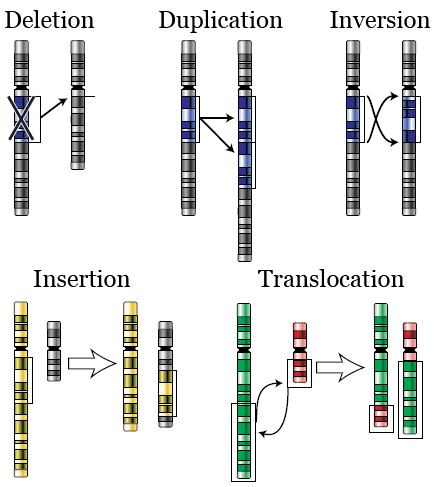
Chromosomal alterations are mutations that change chromosome structure. They occur when a section of a chromosome breaks off and rejoins incorrectly or does not rejoin at all.

Possible types of mutations in chromosomes include:
  1. Deletion: When a segment of DNA is lost, so there is a missing segment in the chromosome. These usually result in many genes missing from the chromosome.
  2. Duplication: When a segment of DNA is repeated, creating a longer chromosome. These usually result in multiple copies of genes in the chromosome.
  3. Inversion: When a segment of DNA is flipped and then reattached to the same chromosome.
  4. Insertion: When a segment of DNA from one chromosome is added to another, unrelated chromosome.
  5. Translocation: When two segments from different chromosomes change positions.


Chromosomal alterations are very serious. They often result in the death of the organism in which they occur. If the organism survives, it may be affected in multiple ways.
Mutations that alter the structure of a chromosome are known as _______.
How many types of these mutations are there? _______
Question 6
6.
Types of Chromosomal Mutations (Alterations):

  • If a segment of DNA detaches, flips around, and reattaches a _______ has occurred.
  • When segments of DNA from differing chromosomes trade places, a _______ has occurred.
  • If a segment of DNA has been lost, a _______ has occurred.
  • If a segment of DNA is added a chromosome, a _______ has occurred.
  • If a segment of DNA is copied so that it repeats, a _______ has occurred.
A typical result of chromosomal alterations is the _______ of the organism.
Question 7
7.
If there has been a change in a _______, a point mutation has occurred.

There a three types of point mutations.
  • _______ results in a different amino acid.
  • _______ results in an early stop codon.
  • _______ results in no change to the amino acid.
Question 8
8.
There two types of frameshift mutations.

  • A _______ results in a single nucleotide being removed.
  • A _______ results in a single nucleotide being added.
Frameshift mutations result in the entire frame of codons in the mRNA being shifted. This will eventually impact the type of _______ produced during translation.
Question 9
9.

Explain why albinism is not a common condition that is seen in wild animals.

I have to grade this question myself - it will automatically count it incorrect, I will make corrections to the grade, as needed.

My confidence regarding this activity has:
Significantly increased
Moderately increased
Somewhat increased
Not changed
Somewhat decreased
Moderately decreased
Significantly decreased