Copy of DNA as Genetic Material Article with Questions (5/28/2026)
star
star
star
star
star
Last updated 3 months ago
6 Nsɛmmisa
1
1
3
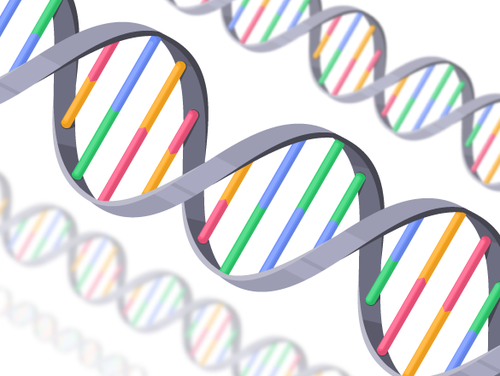
What type of organic molecule is this?
Here’s a hint: molecules like this one determine who you are. They contain genetic information that controls your characteristics. They determine your eye color, facial features, and other physical attributes. What molecule is it?
You probably answered "DNA." Today, it is commonly known that DNA is the genetic material. For a long time, scientists knew such molecules existed. They were aware that genetic information was contained within organic molecules. However, they didn’t know which type of molecules play this role. In fact, for many decades, scientists thought that proteins were the molecules that carry genetic information.
DNA, deoxyribonucleic acid, is the genetic material in your cells. It was passed on to you from your parents and determines your characteristics. The discovery that DNA is the genetic material was another important milestone in molecular biology.
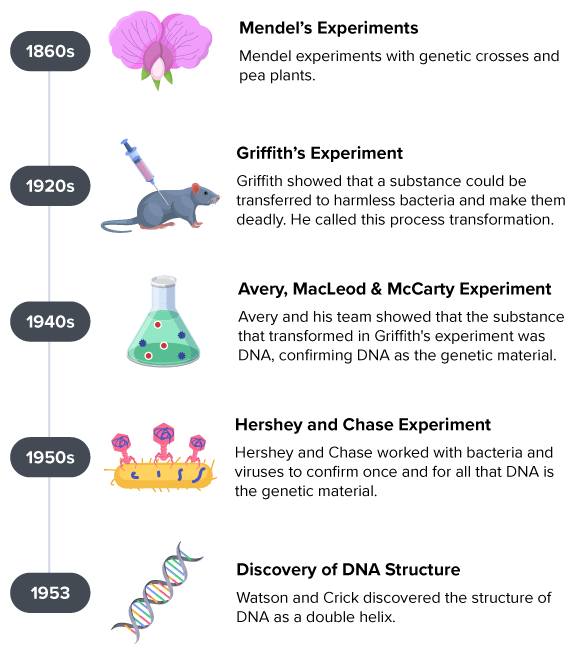
Many scientists contributed to the identification of DNA as the genetic material. In the 1920s, Frederick Griffith made an important discovery. He was studying two different strains of a bacterium, called R (rough) strain and S (smooth) strain. He injected the two strains into mice. The S strain killed (virulent) the mice, but the R strain did not (non-virulent). Griffith also injected mice with S-strain bacteria that had been killed by heat. As expected, the killed bacteria did not harm the mice. However, when the dead S-strain bacteria were mixed with live R-strain bacteria and injected, the mice died.
a.) DNA is the
b.) Griffith was studying two different strains of a bacterium called R (rough) strain and S (
c.) The S strain killed the mice, but the R strain did not. The R strain was
d.) When Griffith injected mice with S-strain bacteria that had been killed by heat, as expected, the killed bacteria did not
e.) When the dead S-strain bacteria were mixed with live R-strain bacteria and injected, the mice
Based on his observations, Griffith deduced that something in the killed S strain was transferred to the previously harmless R strain, making the R strain deadly. He called this process transformation, as something was "transforming" the bacteria from one strain into another strain. What was that something? What type of substance could change the characteristics of the organism that received it?
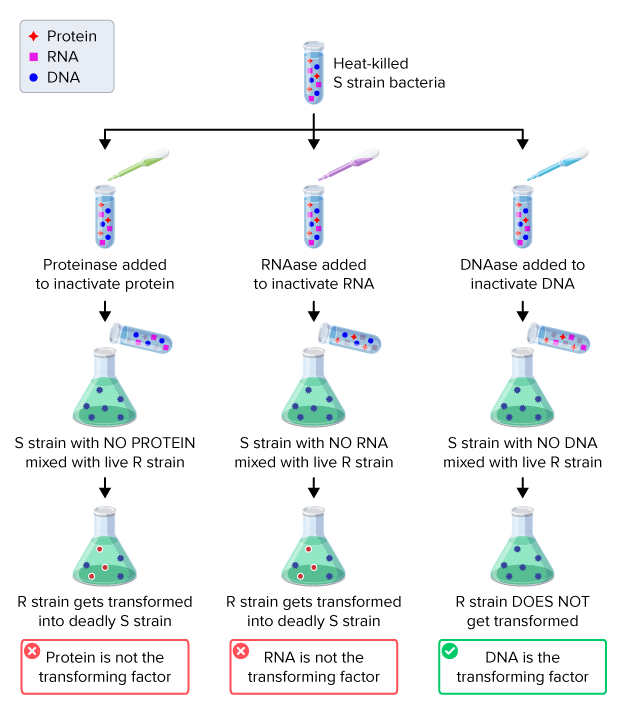
In the early 1940s, a team of scientists led by Oswald Avery tried to answer the question raised by Griffith’s results. Avery, together with his colleagues Colin MacLeod and Maclyn McCarty, inactivated various substances in the heat-killed S-strain bacteria. They then mixed the heat-killed S-strain bacteria with the harmless R-strain bacteria. When proteins and RNA were inactivated, the R-strain still transformed into the deadly S-strain. This ruled out proteins and RNA as the genetic material. Why? Even without the S-strain proteins or RNA, the R-strain was changed or transformed, into the deadly S-strain. However, when the researchers inactivated DNA in the S-strain, the R-strain did not transform. This led to the conclusion that DNA is the substance that controls the characteristics of organisms. In other words, DNA is the genetic material.
a.) Griffith deduced that something in the killed S strain was
b.) He called this process
c.) Avery's team tried to answer the question raised by Griffith's results: what type of
d.) Even without the S-strain
e.) When the researchers
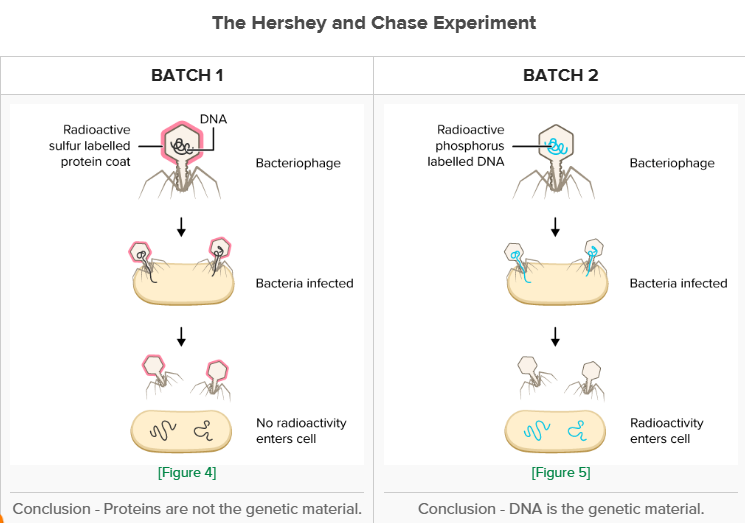
The conclusion that DNA is the genetic material was not widely accepted at first. It had to be confirmed by other research. In the 1950s, Alfred Hershey and Martha Chase did experiments with viruses known as bacteriophages, a virus that infects bacteria. Viruses are not made of cells. Bacteriophages are basically DNA inside a protein coat. To reproduce, a virus must insert its own genetic material into a cell (such as a bacterium). Then it uses the cell’s machinery to make more viruses. The researchers used different radioactive elements to label the DNA and proteins in viruses. This allowed them to identify which molecule the viruses inserted into bacteria. DNA was the molecule they identified. This confirmed that DNA is the genetic material.
a.) The researchers used different
b.) Alfred Hershey and Martha Chase conducted experiments with
c.) To reproduce, a virus must insert its own
d.) Bacteriophages are basically DNA inside a
Which part of Griffith’s experiment helped him discover bacterial transformation?
Before DNA was identified, scientists thought
Mendel used to conduct experiments in the 1860's.
The main conclusion of very, MacLeod, and McCarty's experiment in the 1940s was .
discovered the structure of DNA as a double helix.