Log in
Sign up for FREE
arrow_back
Library

Copy of 8.) Translation Models (5/28/2026)

star
star
star
star
star
Last updated about 3 hours ago
15 questions
Model 1
Model 2
2
Question 1
1.
1
1
Question 3
3.

1
Question 4
4.
1
6
Question 6
6.
3
Question 7
7.
1
Question 8
8.

2
Question 9
9.

3
Question 10
10.
1
Question 11
11.
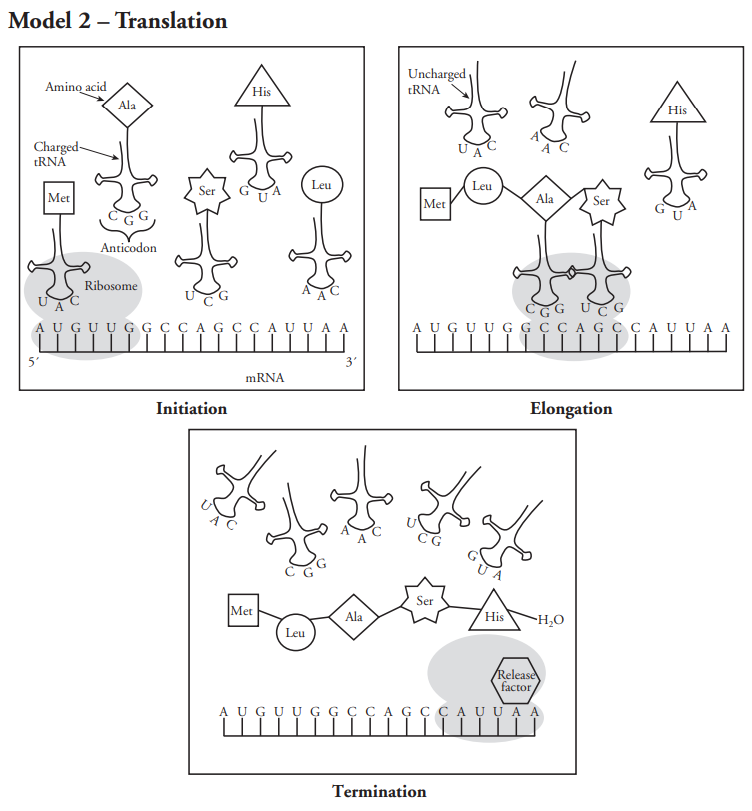
According to the model, what organelle will the mRNA attach to once it leaves the nucleus? _______
1
Question 12
12.

Describe the movement of the ribosome as translation occurs.


4
Question 13
13.
2
Question 14
14.

The “t” in tRNA is short for transfer. Using your own words (in other words, do not look this up), explain why this molecule is called transfer RNA.

1
Question 15
15.

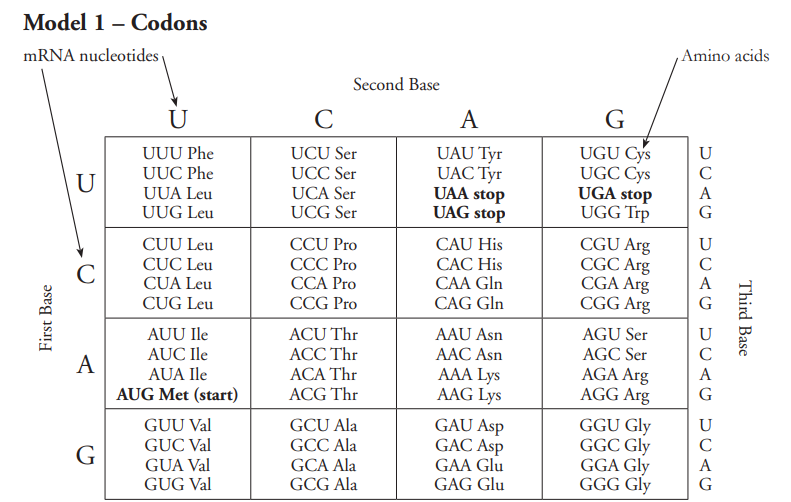
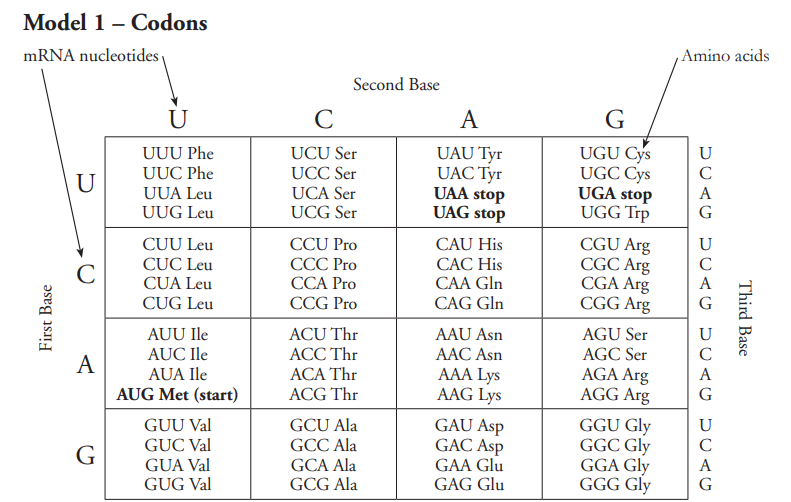
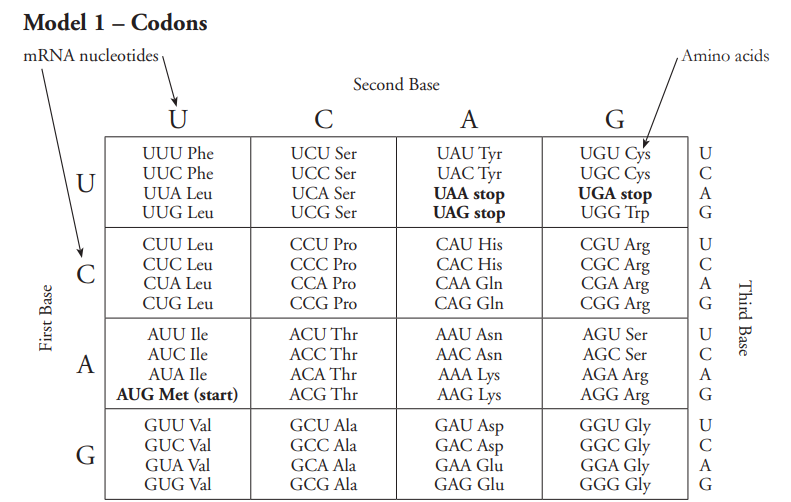
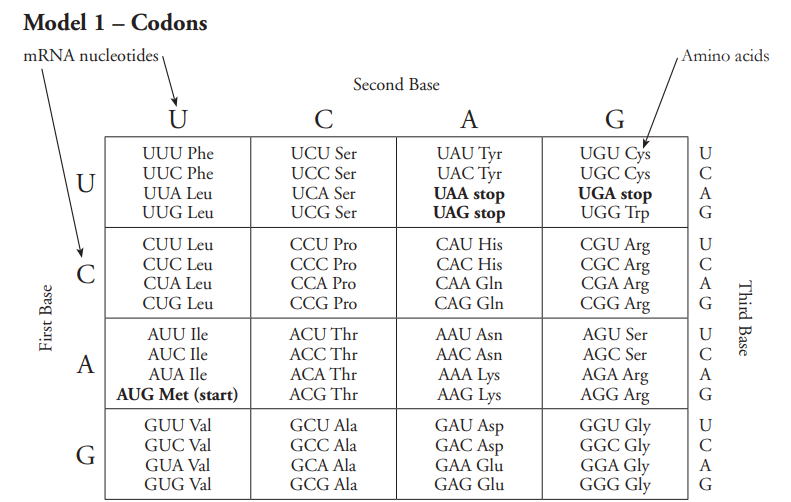
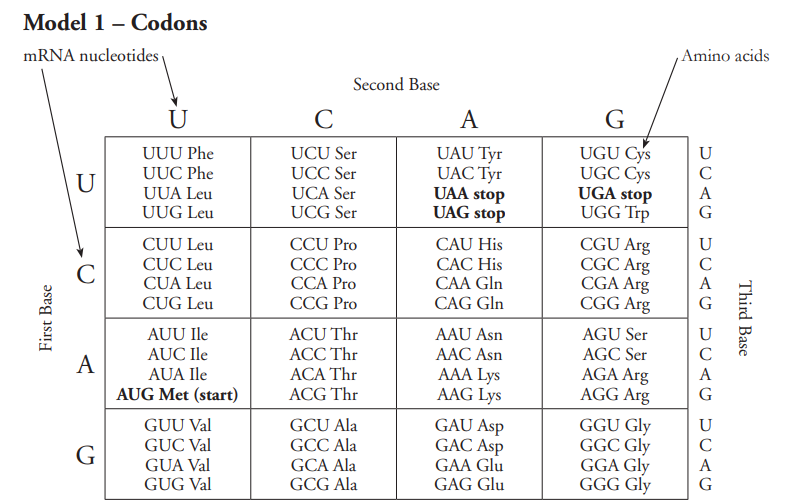
Model 1 is referred to a "codon key" and it is used to determine which amino acids related to specific sequences of RNA nucleotides on an mRNA.

a.) What do the letters U, C, A, and G (around the outside) represent on this model? _______

b.) What do the abbreviations within the blocks of this model (ex. Phe, Ile, Ala, and Glu) represent? _______
Question 2
2.

The "language" of mRNA is in a triplet code. Explain the significance of this?
If an mRNA had 300 nucleotides, how many amino acids would be in the polypeptide synthesized from this mRNA strand?

Show a simple math equation to support your answer.
a.) How many different codons (triplets) code for proline (Pro)? _______
Question 5
5.

Compare and contrast all codons for proline. What are the similarities and differences?

In this question, we will simulate both transcription (DNA to mRNA) and translation (mRNA to polypeptide).

Perform this using groups of three nucleotides at a time. Be sure to use the correct case (nucleotide abbreviations: always in all capitals - AUU; amino acids: the first letter is capitalized and the next two are lower case - Pro).

DNA: mRNA: Polypeptide:
TAC _______ _______
GTT _______ _______
CGC _______ _______
AGG _______ _______
CTG _______ _______
ATT _______ _______
a.) According to the model, what amino acid will always be at the front of every polypeptide (remember the case rule from question 6)? _______

b.) According to the model, which nucleotide codon is read first to begin translation(remember the case rule from question 6)? _______

c.) According to the model, which codons would signal the end of translation? _______, _______, and _______
Provide the correct polypeptide chain from the provided mRNA chain, linking each amino acid with a hyphen between each (do not forget which codon is read first and when it stops).

CUU AUG GAC UUA CUG AUC UGA UUU
The tRNA's used during translation will bring the appropriate amino acid to the rRNA (ribosome) according to each codon (set of three mRNA nucleotides). According to the model, do we always need all three nucleotides to know which amino acid will attached to the polypeptide? Provide an example to support your answer.
According to the model, what are three stages of translation (place them in the correct order)?

First: _______
Second: _______
Third: _______
tRNA's are short sequences of nucleotides that contain an anticodon, which pairs with a codon on the mRNA according to the base-pairing rules. Additionally, each tRNA carries a specific amino acid.

a.) Find the tRNA that is carrying His (histidine); what sequence of nucleotides is on the anticodon? _______

b.) What is the sequence of nucleotides on the mRNA codon that would match the anticodon of 'a'? _______

c.) What anticodon would carry Gly (glycine)? _______

d.) During elongation, how many tRNA's are in the ribosome at one time? _______
Using your own words, describe one thing that happens during termination (there are multiple - choose one). As always, do not use answers found on the internet.