Ignore the letters in parenthesis, as they correspond to the diagram at the end of the formative.
In the 1860's, the principles of genetics were established by
Mendel's ideas help us to describe how
Mendel used the common
The primary reason that Mendel used this plant was that it is fairly
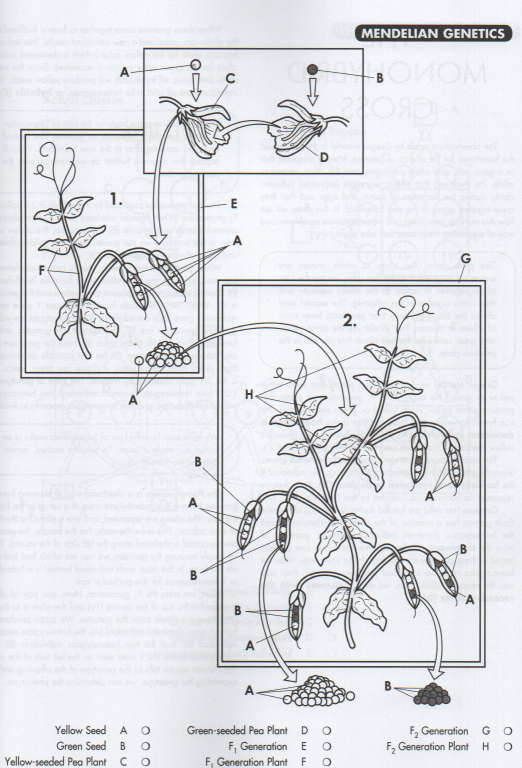
Mendel used two types of pea seeds:
Next, Mendel crossed these P1 generation plants by breeding (cross-pollinating) a yellow-seeded plant with a
The previous cross is known as a
The seeds (offspring) of this cross between the plants of the P1 generation are known as the
All of this generation's seeds were
The conclusion that Mendel derived from observing this F1 generation was that the trait that was not hidden (in this case, yellow seed color) must be the
Mendel's next step involved allowing the F1 plants to
The offspring of this F1 cross was known as the
Mendel's observations of the F2 plants were that most of the seeds were yellow, however some of them were
After performing these experiments numerous times, Mendel analyzed his data of the count of each seed color. He calculated that the ratio of yellow-to-green seed color in the F2 generation was
Some of the conclusions that have been derived from Mendel's experiments are:
1. Inherited traits are determined by
2. Each parent contributed
3. Alternative forms of the same gene are known as
If an individual has two differing copies of the same gene (two different alleles) then they are said to be
If an individual has two exact copies of the same gene then they are said to be
Finally, Mendel determined that the alleles segregate during the formation of gametes (sperm/ovum) during meiosis
Mendel planted both of these seed types and observed that they both grew plants with the same color seed as that which was planted. These plants were considered the first generation or the