Copy of 4.) Meiosis Models (5/28/2026)
star
star
star
star
star
Last updated 3 months ago
9 Nsɛmmisa
Hyɛ no nsow a efi ɔkyerɛwfo no hɔ:
Part 1
Part 2
Part 3
Use the models, the short paragraphs, and your background knowledge to answer the questions.
B.4.5 Make and defend a claim based on evidence that inheritable genetic variations may result from: (1) new genetic combinations through meiosis, (2) viable errors occurring during replication, and (3) mutations caused by environmental factors.
Learning Goals
I can use evidence to describe how meiotic events can produce inheritable genetic variations.
I can explain the purpose of meiosis.
I can explain the relationship between meiosis and fertilization.
All short answer questions must be re-graded by Mr. Poe.
Use the models, the short paragraphs, and your background knowledge to answer the questions.
B.4.5 Make and defend a claim based on evidence that inheritable genetic variations may result from: (1) new genetic combinations through meiosis, (2) viable errors occurring during replication, and (3) mutations caused by environmental factors.
Learning Goals
I can use evidence to describe how meiotic events can produce inheritable genetic variations.
I can explain the purpose of meiosis.
I can explain the relationship between meiosis and fertilization.
All short answer questions must be re-graded by Mr. Poe.
Why?
Cells reproduce through mitosis to make exact copies of the original cell. This is done for growth and repair. Sexually reproducing organisms have a second form of cell division that produces reproductive cells with half the number of chromosomes. This process is called meiosis, and without it, humans, oak trees, beetles, and all other sexually reproducing organisms would be vastly different than they are today.
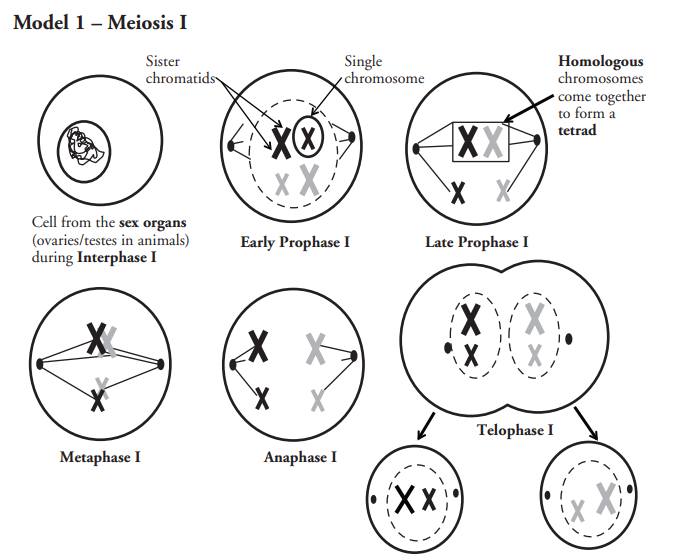
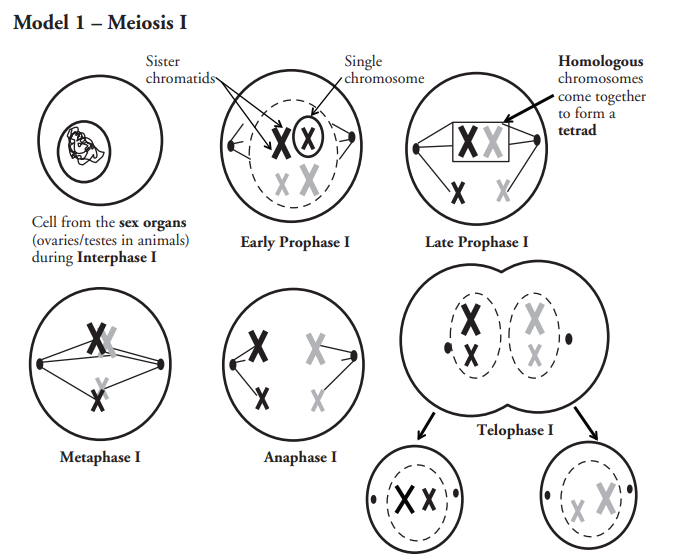
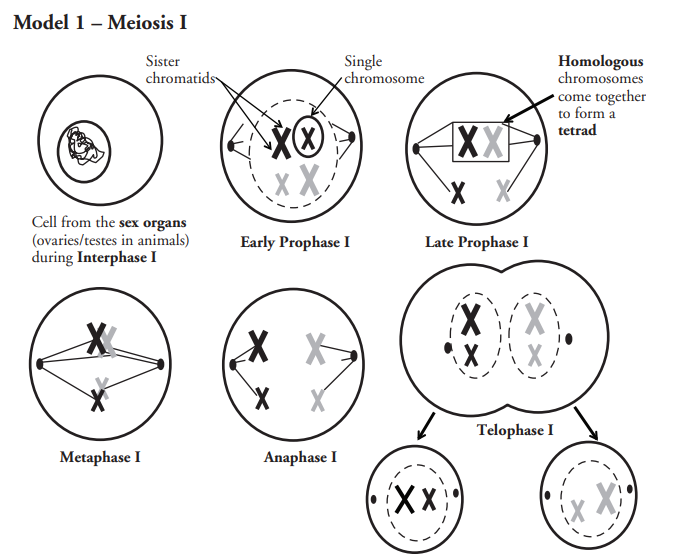
a. According to model 1, in what type of organs are the cells that enter meiosis I found?
b. Considering what you already know in cells, what event must take place during S-phase of interphase before a cell proceeds to division?
c. What two structures make up a single replicated chromosome?
d. In model 1, how many replicated chromosomes does the cell contain during prophase I?
Read This!
Alleles are alternative forms of the same gene. For example, gene A may contain the information for fur color. One allele “A” may result in white fur, while the alternative allele “a” may result in black fur. Homologous chromosomes are chromosomes that contain the same genes, although each chromosome in the homologous pair may have different alleles.
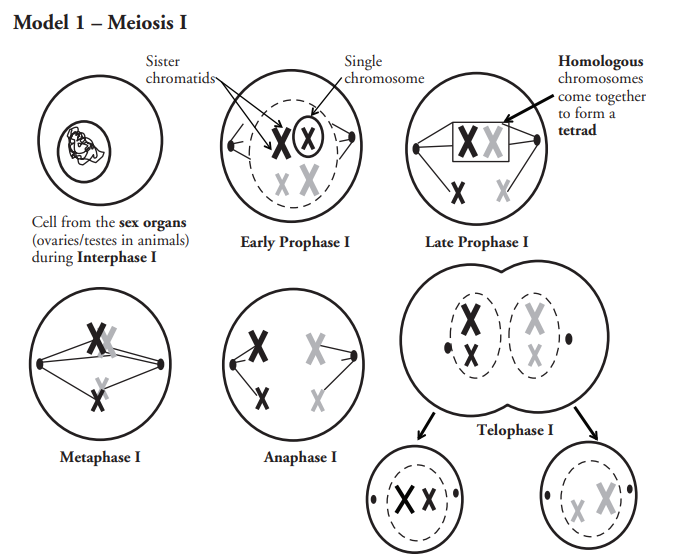
a. At which stage in meiosis I do the pairs of homologous chromosomes come together?
b. Once the chromosomes have formed pairs, what do they form?
c. At the end of meiosis I, two cells have been produced. How many replicated chromosomes are in each of these cells?
d. Cells with a full set of chromosomes are referred to as diploid or 2n, whereas cells with half the typical number of chromosomes are haploid or n. List the stage(s) of meiosis I that the cells are diploid
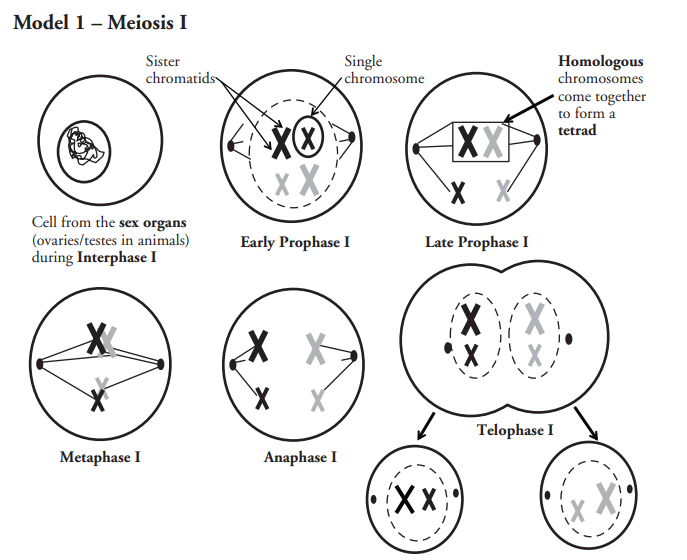
Which of the statements below correctly describes the relationship between the cells at the end of telophase I and the original cell (select all that apply)?
Considering the genetic makeup of the homologous pairs, will the cells at the end of telophase I be genetically identical to each other?
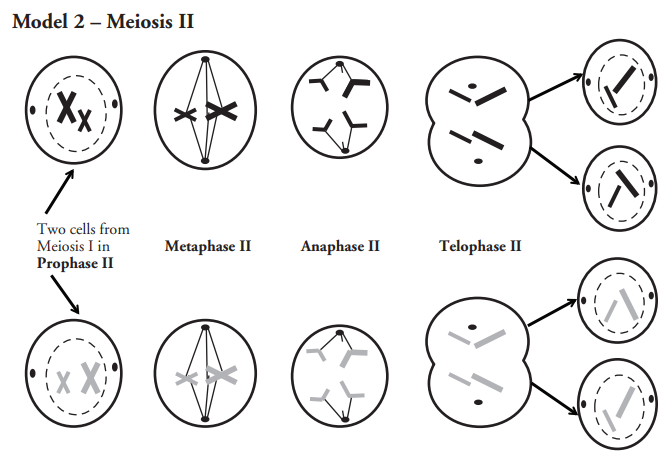
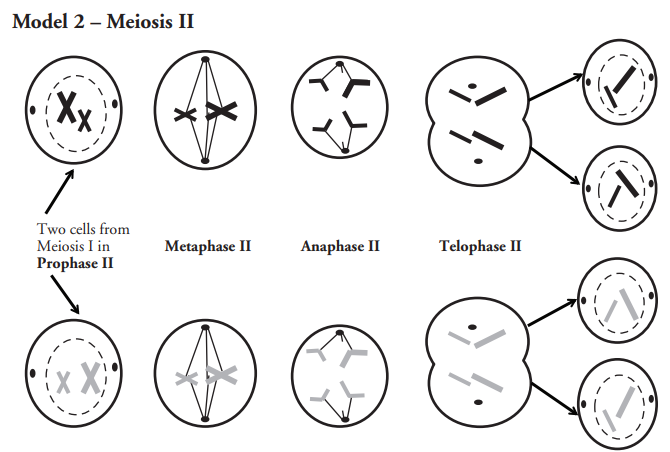
a. According to Model 2, where did each of the cells come from that started meiosis II?
b. In meiosis I, during anaphase I, which structures separated—homologous chromosomes or sister chromatids?
c. In meiosis II, during anaphase II, which structures separated—homologous chromosomes or sister chromatids?
d. At the end of the meiosis II there are four daughter cells. Are they haploid or diploid?
Explain your answer to 5d in a complete sentence.
Which of the statements below correctly describes the relationship between the cells at the end of meiosis II and the original cell?
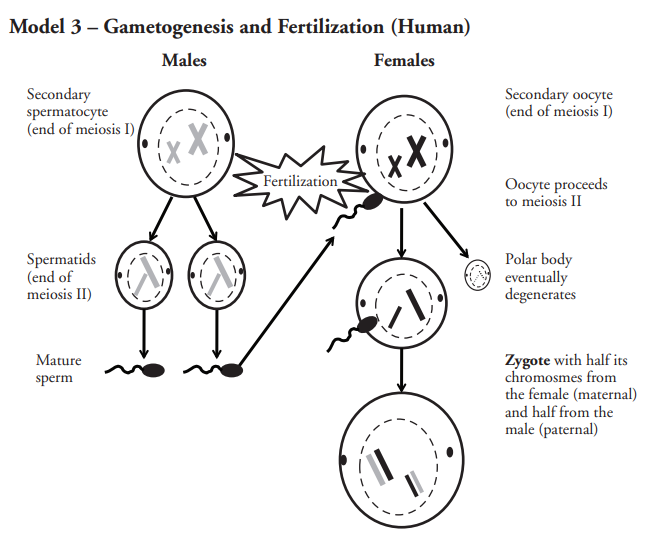
a. According to Model 3, what is the name given to the cells produced at the end of meiosis I in males?
b. What is the name given to the cells produced at the end of meiosis I in females?
c. At the end of meiosis II in males, what cells are produced?
d. What do these cells from the previous question eventually become?
e. Before fertilization, what will happen to the secondary oocyte?
f. During fertilization which two cells come together (be specific)?
g. What is the ploidy of the zygote produced by fertilization—haploid or diploid?
What would the ploidy of the zygote be if egg and sperm were produced by mitosis rather than meiosis? How would this affect the ploidy (number of chromosomes - haploid, diploid, polyploid) of each successive generation?